
Blog
Pink Rose Meaning: What Pink Roses Say (Admiration, Gratitude, and the Safest Rose There Is)

By Evercombe Team · Updated October 12, 2026 · 8-minute read
Quick answer: Pink roses mean admiration, gratitude, grace, and gentle affection — the warm sentiment without red’s weight. Light pink leans sweetness and sympathy; hot pink reads playful and energetic. Pink is the safest rose in the dictionary: the right default when you’re not sure. Shades, pairings, and the thank-you and Mother’s Day territory are below.
If the rose dictionary had a default setting, it would be pink. Not because pink is neutral — it isn’t — but because its meaning is warm in every direction and heavy in none: admiring without pursuing, grateful without proposing, affectionate without declaring. When people say “I like you but I’m not saying which kind of like,” pink is the color already doing that work.
What Do Pink Roses Mean?
Meaning: admiration, gratitude, grace, and gentle affection.
The entry sits deliberately beside red’s and a shade apart: same warmth, half the voltage. Pink’s admiration reading makes it the mentor-and-friend rose; its gratitude reading makes it the thank-you rose; its grace reading makes it the wedding-and-Mother’s-Day rose. It is the only color in the palette that works — appropriately, not just tolerably — for a partner, a parent, a colleague, a new acquaintance, and a retiring professor. Nothing else in this dictionary spans that range.
Market reality backs the reputation: pink commonly runs second to red in the rose palette’s popularity, and on Mother’s Day it arguably leads — pink and pink-and-white arrangements are the holiday’s visual default in most Western markets.
The Shade Split: Light Pink vs Hot Pink
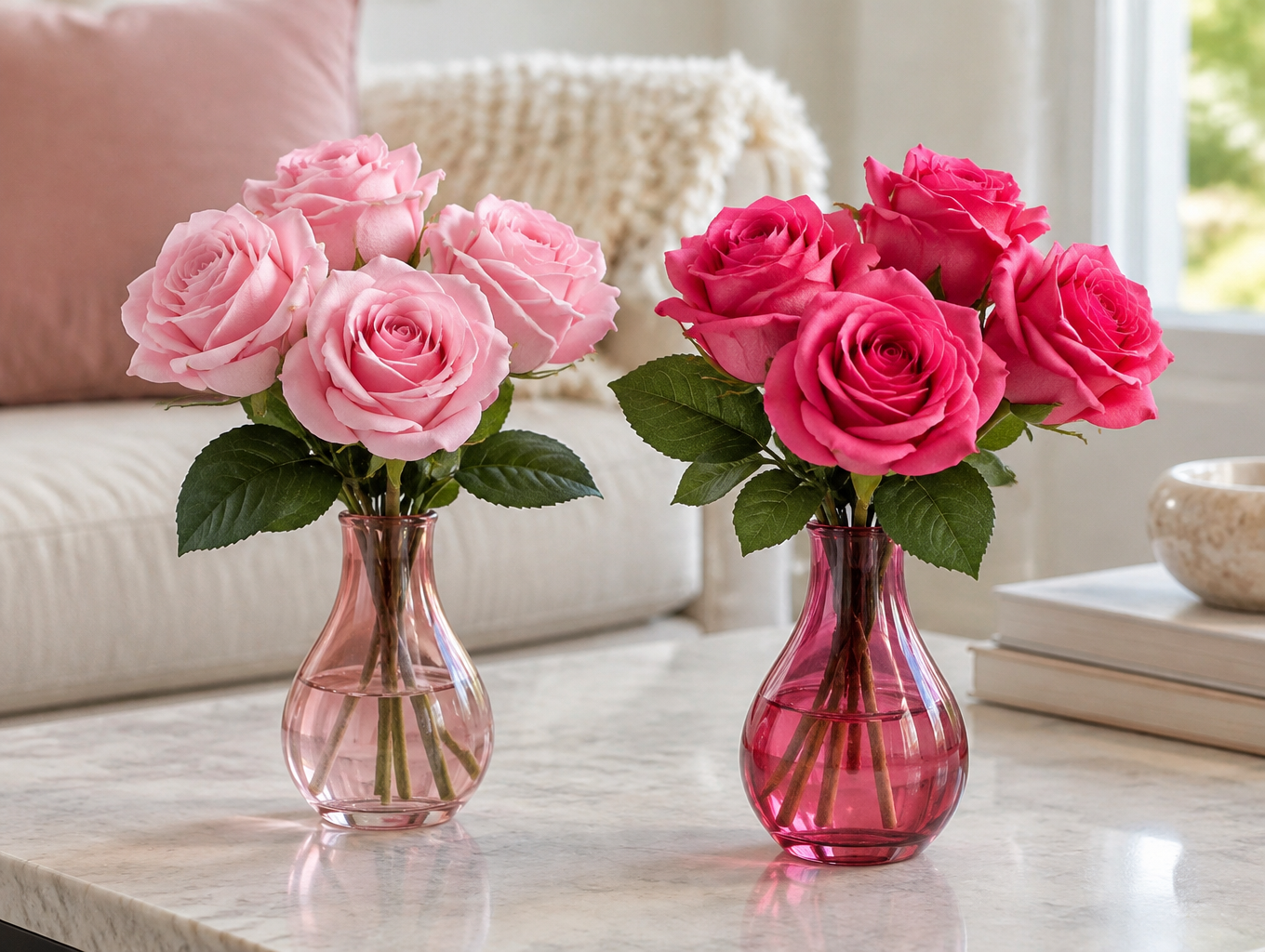
Pink’s one piece of necessary fine print:
- Light pink / blush — sweetness, grace, sympathy, gentle gratitude. The tender register: mothers, new relationships, get-well softness, condolence-adjacent warmth.
- Hot pink — energy, playfulness, spirited recognition. The fun register: friend birthdays, congratulations with personality, the recipient who finds pale pink too polite.
- Deep pink sits between: gratitude with more emphasis — the thank-you that means it.
Send blush where tenderness is the point; send hot pink where fun is the point. The gap between them is the widest emotional distance inside any single color in the dictionary.
Pink Rose Shades
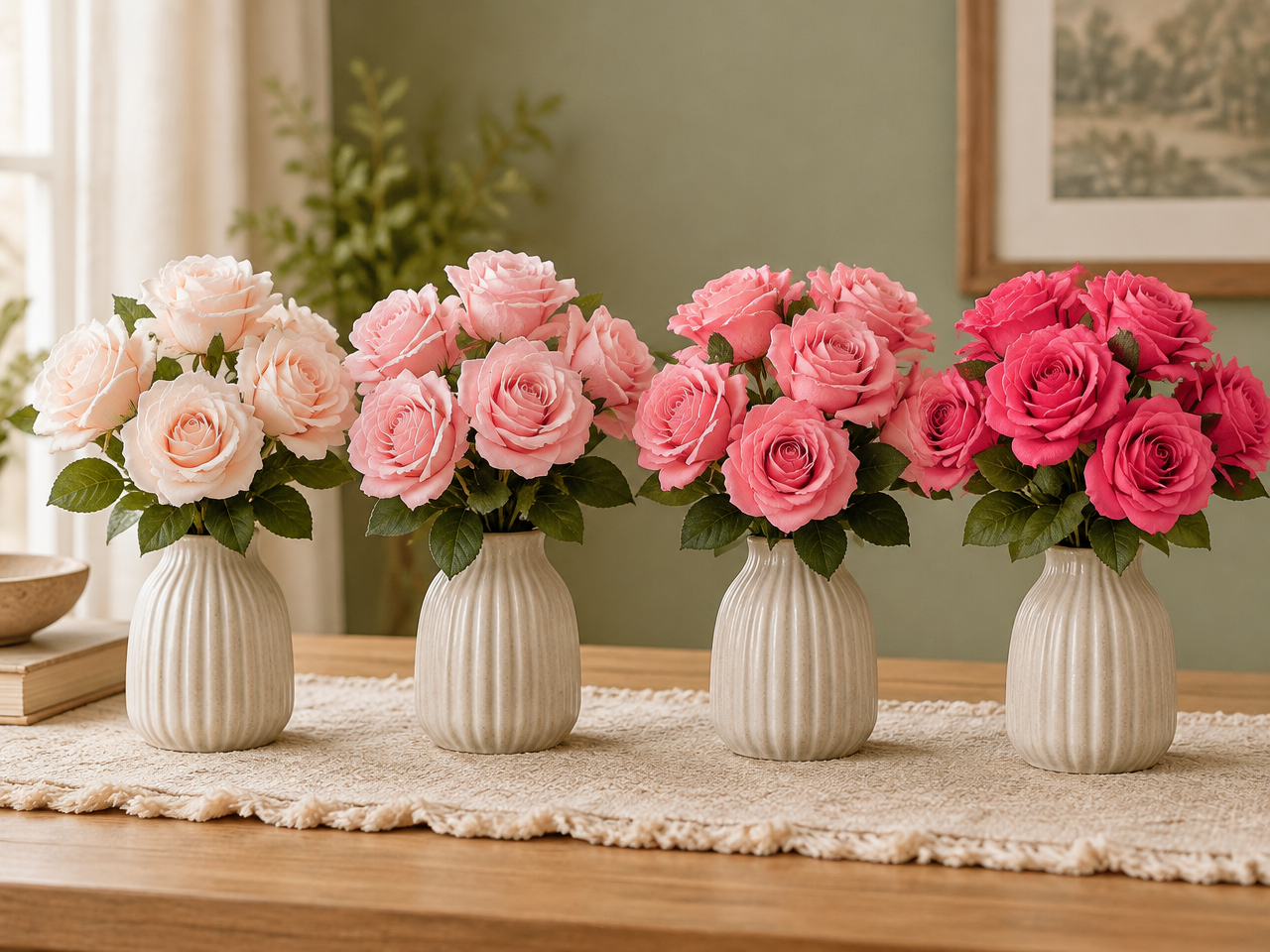
| Shade | Refined meaning | Best for |
|---|---|---|
| Light pink / blush | Sweetness, grace, sympathy | Mothers, new relationships, gentle thanks |
| Classic pink | Admiration, gratitude | The all-purpose default |
| Deep pink | Emphatic gratitude, appreciation | Thank-yous that mean it |
| Hot pink | Playful energy, spirited fun | Friends, birthdays, personality-forward gifts |
When to Send Pink Roses
- Mother’s Day and grandmothers — the holiday’s signature register; pink with white is the classic
- Thank-yous — deep pink’s emphatic gratitude is the flower dictionary’s best thank-you sentence
- New relationships — warm interest without red’s declaration; the early-dating rose that keeps the frame open
- Get-well and sympathy-adjacent warmth — light pink softens a room without asserting anything
- Colleagues and professional warmth — pink (with peach) is one of the two workplace-safe colors; red never is
- “Not sure” gifts — the default: when the relationship or occasion is ambiguous, pink carries warmth without risking a misread
When NOT to Send Pink Roses
- Full romantic declaration moments — proposals, milestone anniversaries: red’s job; pink says the sentence quietly and may read underpowered
- High-energy congratulations — launches, promotions, wins: orange and yellow carry voltage pink doesn’t
- To someone who reads pink as juvenile — some recipients (and some aesthetics) find pale pink young; hot pink or peach adjusts the register
- Formal ceremony and deep sympathy — confirmations want white; funerals want white or pale pink only if softness is explicitly the goal
What to Pair With Pink Roses
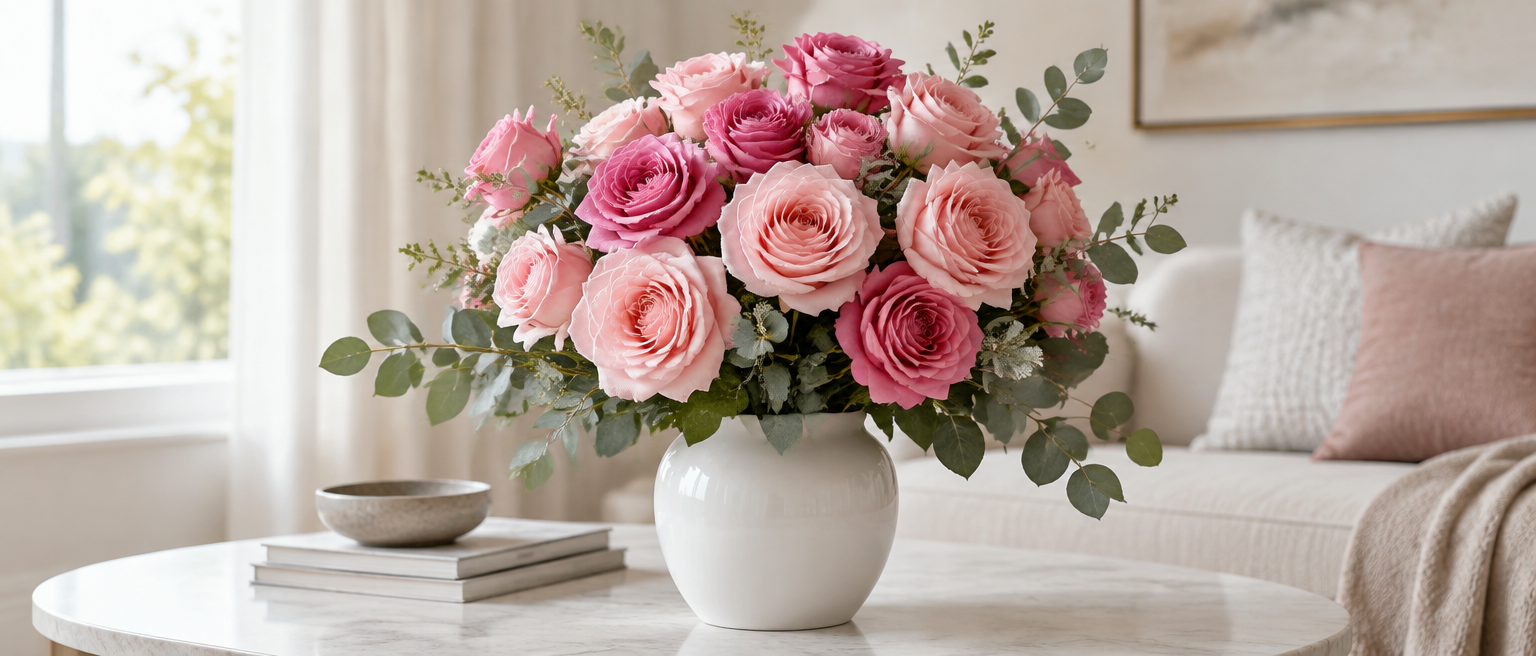
Pink with white is the Mother’s Day and wedding classic — grace, lifted. Pink with cream peonies (or faux equivalents) is the softest luxury pairing in décor. Pink with lavender goes whimsical; hot pink with orange goes party; blush with eucalyptus is the modern-wedding workhorse. Browse pink artificial flowers for the shade that holds.
Pink vs Peach (and Blush)
Pink and peach sit close enough on the wheel to get swapped constantly, and the sentences differ: pink means admiration and grace; peach means sincerity, gratitude, and modesty. The practical division of labor — pink for the person you admire, peach for the person you’re thanking. When in doubt at the florist, hold the two side by side; the orange undertone in peach is visible the moment there’s a comparison. Blush, the palest end of pink, deserves its own line: it’s the wedding-industry workhorse shade, the one that pairs with everything and photographs like candlelight — and the shade most often requested in faux, because fresh blush shifts tone as it ages.
Pink in Wedding Décor
Pink owns the modern-wedding palette the way red owns Valentine’s: blush-and-eucalyptus has been the default romantic-modern combination of the past decade, and pink roses do most of the lifting in it. The palette ladder runs light to dark by role — blush for the bridal bouquet, classic pink for the bridesmaids, hot pink for the after-party and the send-off. A pink-and-white pairing covers the full family of wedding events from shower to reception; deep pink alone covers the vow renewal, where emphasis is the register. For faux wedding work, blush holds its exact shade through heat, transport, and the whole photographs-at-dusk schedule. For everyday home use, classic pink with cream is the softest corner-of-the-room combination in the palette.
The 60-Second Cheat Sheet
| Occasion | Pink roses? | Better pick if not |
|---|---|---|
| Mother’s Day | Yes — the signature (with white) | — |
| Thank-you | Yes — deep pink | Peach as runner-up |
| New relationship | Yes — light or classic | Lavender for enchantment |
| Colleague warmth | Yes — with peach | Never red |
| Proposal / milestone romance | No — underpowered | Red |
| High-energy win | No — too gentle | Orange or yellow |
| Get-well softness | Yes — light pink | Yellow for cheer |
FAQ
What do pink roses mean?
Admiration, gratitude, grace, and gentle affection — warm sentiment without red’s romantic weight. The most versatile color in the rose dictionary.
What’s the difference between light pink and hot pink roses?
Light pink means sweetness, grace, and sympathy; hot pink means playful energy — the widest emotional gap within one color in the dictionary. Peach next door means gratitude and sincerity: pink for someone you admire, peach for someone you thank. Match shade to register.
Are pink roses romantic?
Gently — they suit early relationships, where warmth without declaration is exactly right. Proposals and milestone romance want red; pink keeps the frame open.
What do pink roses mean for Mother’s Day?
Gratitude, grace, and admiration — the holiday’s signature meaning, classically paired with white. Pink commonly runs second only to red in the palette’s popularity overall.
Can I send pink roses to a coworker?
Yes — pink (with peach and yellow) is among the workplace-safe colors, carrying warmth without subtext. Red is the one that never works professionally.
Do faux pink roses carry the same meaning?
Identically — and blush shades are among the most popular in faux form, holding the exact pale tone that fresh roses shift out of within days. Browse pink artificial flowers.
Related Reading
- Rose Color Meanings — the full 12-color dictionary
- Red Rose Meaning — the weight pink leaves out · White Rose Meaning — pink’s classic pairing
- Shop the shade: pink artificial flowers · by color