
Quick answer: Artificial cherry blossom branches are reproduction sakura built as branches rather than flower stems: a woody wire core carrying clusters of five-petal blooms and buds, 30 to 43 inches long overall. They deliver the bare-branch bloom that fresh cut sakura gives for roughly one week each spring, at any time of year, in pale pink and white. Buy by branch count and build - airy branches spaced for tall floor vases, denser sprays for arches and wall builds - with exact lengths stated per listing.
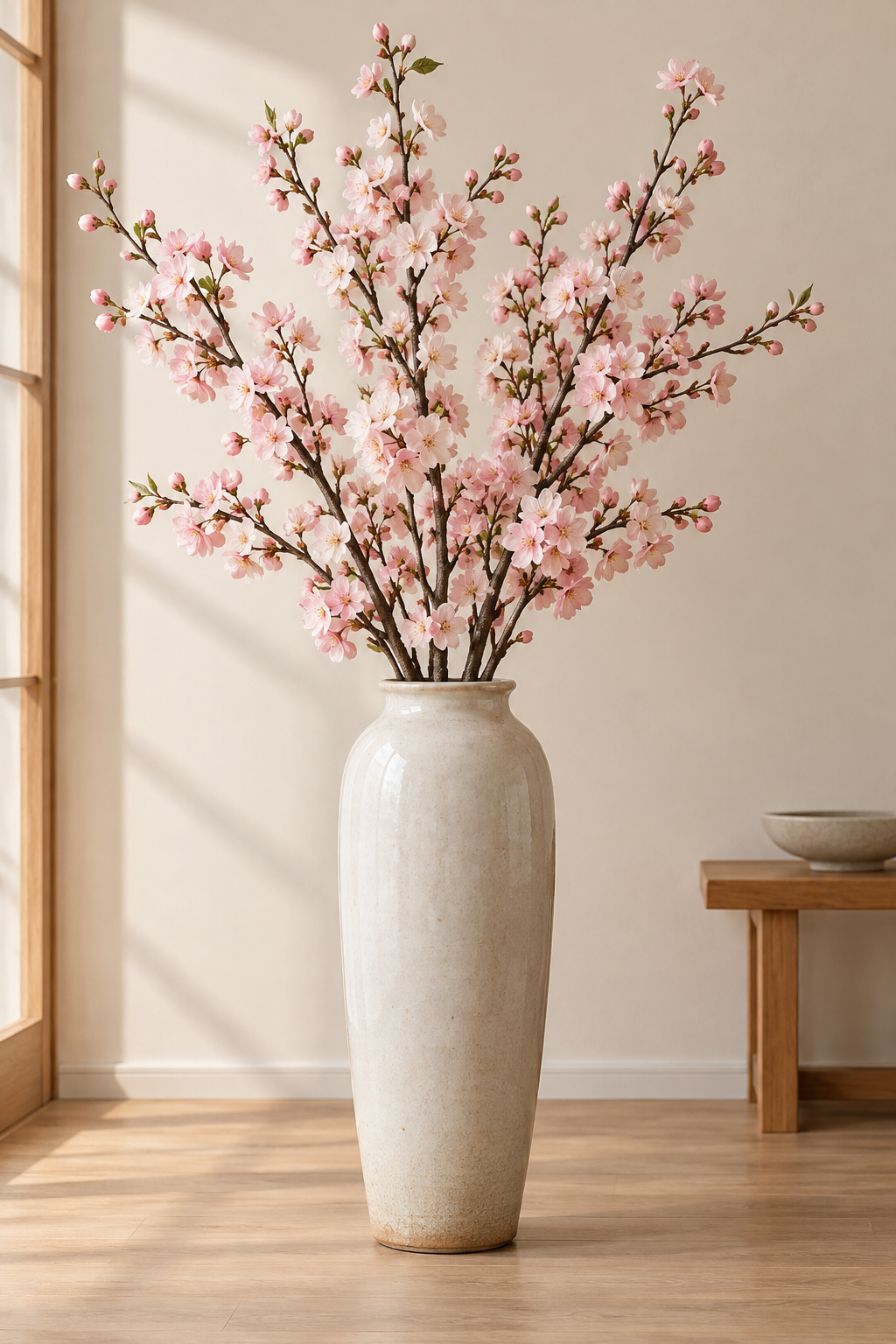
Artificial cherry blossom branches — full flowering sakura sprays on woody stems, 30 to 43 inches, in the pale pink and white the species is loved for. The real thing reaches florists for a week each early spring; these carry the same bare-branch bloom year-round, one branch to a tall vase doing the work of a whole arrangement. Every listing photo shows the exact branches you receive. Build follows the species: a woody core with the bark texture, bloom clusters spaced heavier toward the tips the way real sakura flowers, and five-petal florets with the soft notch at each petal edge. Pale pink does the quiet zen rooms and spring mantels; white carries wedding work and gallery-white interiors; the branches lean at whatever angle you set and stay. Two or three in a tall floor vase read as a sculptural statement - the reason entry stylists reach for sakura first.
Artificial Cherry Blossoms, Explained
What an artificial cherry blossom branch is
A cherry blossom piece is built as a branch, not a flower stem: a woody core carrying clusters of five-petal sakura blooms, buds and the occasional leaf, shaped so the bloom clusters fall the way real sakura does — heavier toward the tips. In the language of flowers, cherry blossom stands for the beauty and brevity of things — renewal celebrated precisely because it does not last — and our flower meanings hub collects that story alongside the other species.
That brevity is the practical case for the artificial branch: cut sakura is available from florists for roughly a week each spring and brown-petals fast indoors. The branch here keeps the same look through every season, which is why it reappears in spring mantels, January desk vases and October wedding arches alike.
Sizes and branch forms
Branches run 30 to 43 inches overall — measured flat, tape in frame, on every listing. Sub-forms differ by build: single airy branches with bloom clusters spaced along the stem (best for tall floor vases, two to three per vessel), and denser flowering sprays clustered toward the top (better for arch work and wall builds where the tip carries the visual weight). Branch count per listing is stated in the title — a set of 2 means two branches.
Yoshino, Kwanzan and the near-relatives worth knowing
Two sakura varieties set the look most branches copy. Yoshino cherry - the Tokyo canopy tree - flowers pale pink to white, five flat petals to a bloom, sparse along the branch: this is the airy, misty branch that suits floor vases and quiet rooms. Kwanzan cherry runs heavy: double blooms with dozens of ruffled petals, dense clusters that sit like small pompons along the stem, a fuller look that reads romantic rather than minimal. Most artificial stock follows Yoshino; ruffled-petal builds are the Kwanzan reading and sit denser at the same branch count.
One near-relative caution: flowering plum and peach branches reach florists in the same spring window with similar bare-branch habit, usually in deeper pink. The honest tell is petal count and notch shape rather than color alone - and on a reproduction branch, the listing says cherry and the petal build backs it.
Where they work best
The classic placement is a tall floor vase with two or three branches leaning at different angles — that single arrangement reads as a sculptural statement in an entry or beside a fireplace. Beyond the floor vase, cherry blossom branches are the backbone of wedding arch backs: their thin silhouette layers over greenery without bulk, which our wedding arch flowers line builds on. They also carry springtable styling and Japanese-inspired interiors — one branch in a dark vase is the whole look.
Colors that pair well
Pale pink and white are the two honest sakura tones, and both pair the same way: with deep greens (fern, eucalyptus) for contrast, with cream ranunculus and white roses for wedding work, or alone — cherry blossom is a one-color flower by nature. Blush-and-white mixed branches are labeled as mixed on the card. The pink runs soft, never saturated; saturation is how a fake sakura gives itself away, so the palette here stays in the pale band.
What arrives, and the two minutes after
Branches ship flat in a long box; expect two to three minutes per branch of shaping — fan the bloom clusters out from the main stem, space them along the wood, and bend the tip into its natural droop. The wire core holds every position you set. A shaping card ships in every box, and the same steps are shown on each product page.
How to Choose Cherry Blossom Branches
- Match branch length to vase height.
Branches should stand 1.5–2× the vase height: a 20 in floor vase takes 36–43 in branches; a 12–14 in table vase takes 30 in sprays.
- Pick airy or dense by placement.
Floor vases and sculptural statements → airy spaced clusters; arch and wall builds → dense tip-heavy sprays.
- Hold the palette pale.
Pink or white, one tone per vase, with deep green as the only strong contrast — saturated pink reads wrong for sakura.
- Count branches before checkout.
Floor-vase statement: 2–3 branches. Arch work: budget by width, roughly 3 branches per two feet of arch. Counts are stated per listing — order what the photo contains.
Buying Loose Stems in Bulk
Loose branches are the raw form of this species - the page is built around them, from airy single branches to dense arch sprays and bundled sets. Finished sakura pieces (styled arrangements, wedding-arch kits) suit decorators and planners who want the build done for them. Branches bend into place and stay, so the loose route costs only the arranging minutes; the finished route costs the arranging and not the wait.
Frequently Asked Questions
When can I buy real cherry branches — and why choose artificial?
Cut sakura reaches florists only in early spring, for roughly a week of good bloom, and the petals brown quickly indoors even in water. An artificial branch holds the bare-wood-and-bloom look in every month — January desk vases, October weddings — and reshapes after every storage, which is why designers treat it as a year-round structural element rather than a seasonal purchase.
How many cherry blossom branches per vase?
For a tall floor vase, two to three branches leaning at different angles make the complete sculptural statement — cherry blossom reads best when each branch keeps its air. Table vases take one 30-inch spray. Every listing states its branch count in the title: a set of 2 means two branches, no intertwined pairs photographed to look fuller. Cherry blossom is a species that spends its budget on line, not volume — the airy read is the correct read.
How do I shape the branches after unboxing?
Two to three minutes per branch. Fan the bloom clusters out from the main stem, space them along the wood, then bend the tip into its natural droop — the wire core holds every position you set. A shaping card with photos ships in every box, and the same steps appear on the product page; a shipped branch always needs this quick set-up, and we say so rather than promise otherwise.
Are the blossoms pink or white — and what do they pair with?
Both honest sakura tones are stocked, and each listing names its tone with a flat-lay photo of the actual branches; blush-and-white mixed builds are labeled mixed rather than sold as one color. For pairing: deep greens give contrast, cream roses and ranunculus extend wedding palettes, and alone-in-a-dark-vase is the classic placement. Keep one tone per vase — sakura is a one-color flower by nature.
Shop Artificial Flowers
By Species
Bulk & Wholesale
Stems & Craft Basics
Flower Guides
Cherry blossom's beauty-and-brevity story, beside every other species stocked here.
The chrysanthemum month — and the branch stems November birthdays reach for.
Layering branches and greenery on an arch — cherry blossom's main event build.