
Artificial Olive Trees
The olive tree is the statement plant of the decade — that gnarled, silver-green Mediterranean presence designers reach for when a corner needs a tree, not a filler. Real ones are a gardener's project; faux olive trees give you the look at statement scale, no sun calculus required. Every listing here states its honest numbers: height pot included, canopy spread at the widest branch, trunk style — natural wood, molded or wrapped — because a tree you order sight-unseen earns its place by stating what arrives.
Quick answer: Faux olive trees run 4 to 7 feet plus, in three trunk styles — natural wood, molded and wrapped — stated per listing alongside height pot included and canopy spread. Leave 12 inches of headroom under the ceiling: ceiling height minus 12 inches is your working maximum. Weight the planter for 6-foot canopies, keep silk foliage out of sustained direct sun, and expect monthly dusting as the entire care routine.
Choosing a Faux Olive Tree
Why olive
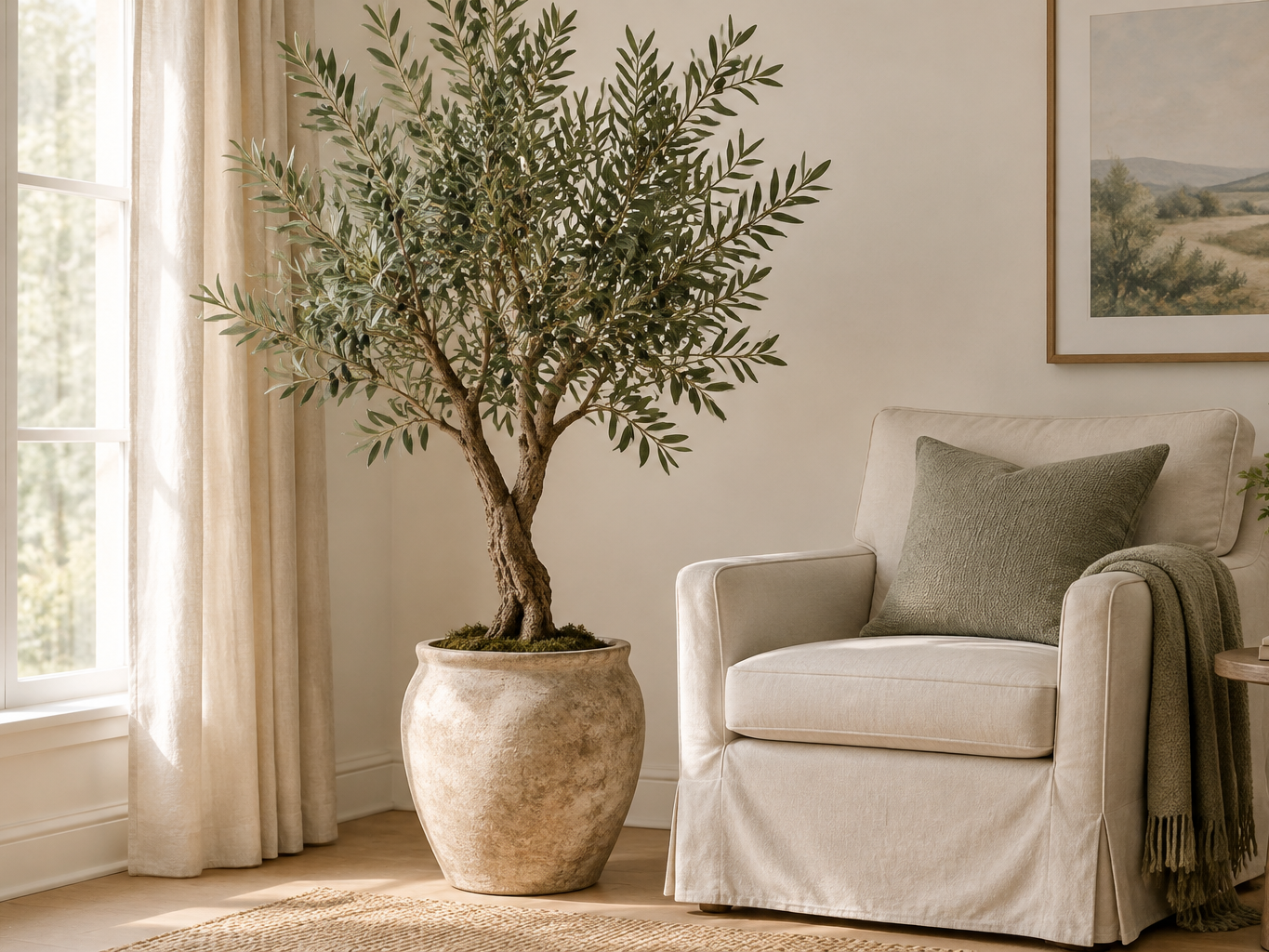
Of all the statement trees, olive earned its spot on a specific mix: the silvery green that flatters both warm and cool rooms, the sculptural trunk that reads as furniture rather than foliage, and the scale — a mature canopy that fills a corner without eating the room. Fiddle leaf figs went through this same moment and stayed fussier; olive arrived as the low-drama alternative and stayed. A faux version keeps the whole proposition: the presence, the scale, the grey-green palette — minus the Mediterranean sun a real one would demand.
Sizes, stated as they run
Statement trees earn range-stating more than any small plant, because the miss costs more. Listings here carry three numbers: height pot included (4-5 ft. mediums sit beside armchairs and fill entry corners; 6-7 ft. larges anchor a wall or stand behind a sofa; 7 ft. plus reads architectural), canopy spread at the widest branch (the number your walkway needs), and trunk style — natural wood where the grain is real, molded where it's built, wrapped where a natural-look finish covers the structure. Measure ceiling height against the height line first; a 7-foot tree under a 7-foot ceiling is a hat on a head.
Placement and light
Indoors, olive trees tolerate what real ones won't: the dark corner, the north window, the spot three rooms from any glass. Keep silk foliage off sustained direct sun and radiators — UV fades leaves slowly and heat curls them, the same physics as any fabric. Covered porches and sunrooms work with the placement checks above; open-sun outdoor use wants UV-treated foliage, flagged per listing as those arrive. Weight the planter for tall forms — a 6-foot canopy is a sail — and rotate the tree a quarter-turn every few weeks so one side doesn't age ahead of the other.
Care: a duster, not a watering can
The routine is monthly dusting with a soft brush, working branch by branch from the top, and a cool blow-dryer pass for the dense canopy interior. Silk-blend leaves wipe clean with a barely damp cloth; air-dry out of direct sun. That's the ownership story: the corner keeps its tree, the tree keeps its shape, and nothing depends on remembering anything. Trunk and planter finish care follows our furniture rules, not plant rules — dry cloth, no sprays.
How to Choose Your Olive Tree
- Measure the corner first.
Ceiling height minus 12 in. is your working maximum (a tree needs headroom to read as a tree, not fill the wall). Armchair-side and entry corners take 4-5 ft.; sofa-backs and wall anchors take 6-7 ft.; architectural reads go 7 ft. plus.
- Pick your trunk style.
Natural wood trunks carry real grain and the sculptural read olive is chosen for; molded trunks hold dense canopies at lighter weights; wrapped trunks split the difference with a natural-look finish. Listing states which — the trunk is half the presence.
- Check canopy density against the room.
Sparse canopies read airy and Mediterranean; dense canopies read lush and formal. Rooms with a lot of pattern take sparse; minimal rooms carry dense. Spread at the widest branch is the walkway number — check it against traffic.
- Plan the planter.
Trees ship in a nursery pot or fixed planter (stated per listing); a weighted decorative planter 2-4 in. wider than the nursery pot finishes the look and holds the tall form steady. Order both in one cart and check the pot-diameter line.
- Indoor or covered outdoor — decide now.
Standard silk foliage is an indoor-and-covered-porch material; open-sun placement wants UV-treated foliage as those selections arrive (flagged per listing). Sunrooms with afternoon sun sit between — favor UV-treated there too.
Frequently Asked Questions
What sizes do faux olive trees come in?
The useful range runs 4 to 7 feet plus. Mediums at 4-5 ft. sit beside armchairs, fill entry corners and stand on stair landings; larges at 6-7 ft. anchor walls, back sofas and define reading nooks; 7 ft. plus reads architectural — think double-height entries and open-plan dividers. Every listing states height pot included, canopy spread at the widest branch and trunk style, so the corner you measured is the corner you fill. Check ceiling height first: leave 12 inches of headroom or the tree stops reading as a tree.
Are the trunks real wood?
It varies by design, and every listing states which of three styles it is. Natural wood trunks use real seasoned branches — the grain, the lean and the character are wood's own. Molded trunks build the trunk from formed material — lighter, uniformly strong, and the right choice under very dense canopies. Wrapped trunks cover a structural core with a natural-look finish. None of the three is a hidden fact: the trunk style sits on the listing next to the height, because on a statement tree the trunk is half the presence.
Can I put an artificial olive tree outside?
A covered porch or sunroom, yes with placement checks; open sun, only with UV-treated foliage. The honest physics: UV fades silk-blend foliage slowly and heat curls it — same as any fabric outdoors — so open-sun placement wants the UV-treated selections, which are flagged per listing as they arrive. Wind matters more than rain for tall forms: a 6-foot canopy is a sail, so outdoor placement wants a weighted planter on a level surface. Pool the two rules and the covered-patio olive works for years.
How do I clean and shape a faux olive tree?
Monthly: soft brush, top to bottom, branch by branch — olive canopies are open enough to reach inside, and a cool blow-dryer on low clears the interior. Deeper clean: barely damp cloth on the leaves, air-dry away from direct sun, no hot water (silk curls). Shaping: branches hold their set but can be gently bent a few degrees to fill a corner's line — work from the trunk outward, small adjustments, and stop if a branch resists. Dust is the only real enemy; the rest is placement.
Why choose faux over a live olive tree?
Live olives need what most homes can't give: hours of direct Mediterranean-style sun, gritty fast-draining soil, and tolerance for the leaf-drop that follows any move. Faux gives you the designer outcome — the silvery presence at statement scale — in the dark corner, the north-facing room, the busy year. What faux gives up is equally honest: no growth, no seasonal character, a look that holds rather than lives. Sunny sunroom owners who enjoy tending should buy the real one; everyone else is who this page is for.