

Wreath & Flower DIY Kits
DIY kits that pair a build's parts with its instructions — wreath kits with form, dress materials and bow stock, centerpiece kits with foam and stems, crown kits for group crafts, wedding kits sized to the party. Every box lists its contents piece by piece, and the finished-result photo shows what the kit's own materials built — so the expectation is the box, not a styled display.
Quick answer: A kit buys the recipe instead of the materials: pre-portioned stems, the right form or vase, ribbon cut to length, and instructions written for the first-timer. Kits run $25-60 by size (as of October 2026, USD), with free US shipping over $200 — a small premium that buys the portioning, the palette match, and the elimination of the three craft-store trips beginners actually take. Start with a mesh wreath kit: tool-free, under an hour.
The Kit Lineup by First Project
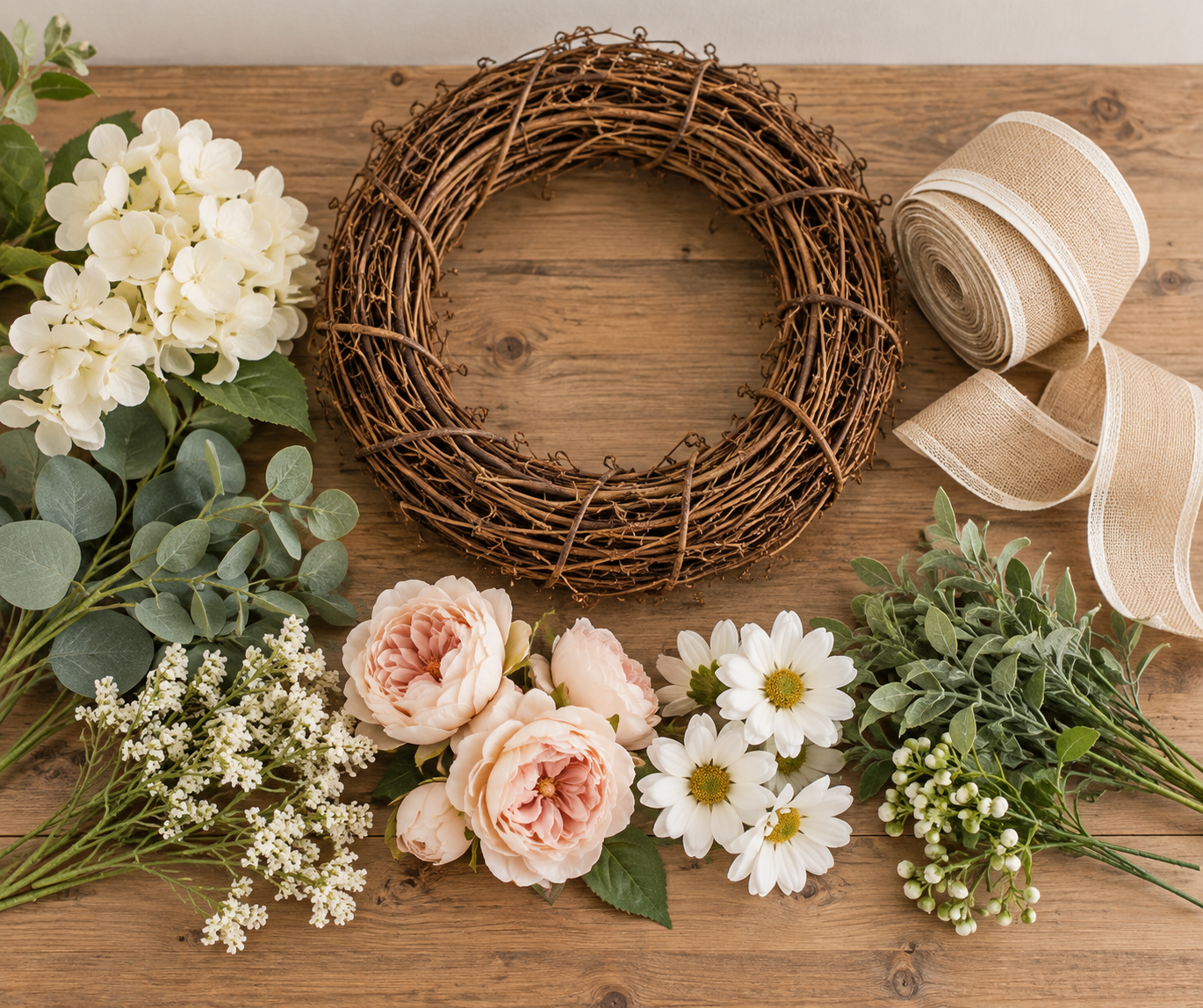
Kits exist because "make a wreath" has a shopping list that defeats beginners — the wrong form, the short ribbon, the seventh stem bundle that was five too few. Each kit solves one project completely, and the build times are stated per kit:
Kit versus sourcing it yourself, honestly
The math nobody puts on the box: sourcing the same materials loose runs 10-20 percent cheaper — but only from your second or third build onward. The first build is where kits win, because beginner material errors (wrong form, short ribbon, five bundles short) cost at least that difference on their own, and running short of greenery mid-build is the classic outcome. What the kit premium actually buys: portioning (nothing runs out mid-build), palette match (everything in the box was chosen together), and the instructions (written for zero experience, with the sequence a wreath-maker would actually follow — and the premium is the price of not buying a full spray you use a third of). Graduate to loose materials on build three or four; that's the standard arc, and the wreath making supplies and loose stems pages are the graduation shelf. The kit's contents list doubles as the shopping list for the loose round.
Wedding-scaled DIY with full quantity planning runs deeper on the DIY wedding flowers page.
How to Choose a DIY Kit
- What are you building, and for whom?
Kits sort by build and occasion: mesh and botanical wreath kits for door and season projects (the classic first build), arrangement kits for table and event work, crown kits for weddings-with-friends and kids' groups, panel kits for flower-wall backdrops. For groups — bridal parties, team afternoons, classroom crafts — crown and mini-wreath kits run 15-45 minutes per build and multiply cleanly; the group bundles price per seat and list per-seat contents.
- What is in the box — exactly?
The contents list leads every kit page: form or base, dress materials (sprays, picks, greenery), bow stock or ribbon, and the step guide — each item named with its count. The disclosure runs the other way too: what is NOT included (usually scissors and a glue gun) is stated in the same list. This is store policy for the whole kit line, because the category's classic disappointment is a box that implied more than it contained; here the list is the contract.
- How close will mine look to the photo?
The finished-result photo on each kit page is built from that kit's own materials — the same stems, the same bow stock — by a first-time builder following the included guide, not by a stylist with a supply closet, and labeled as such. Materials are wired and repositionable, so early placement mistakes bend out and re-set; the guide sequences the build so the fiddly parts come first. Between kits, expected variance is the honest kind: your loops sit slightly differently, and that is the signature of a hand build.
- Kit or loose materials — which is the better buy?
Kits trade a 10-20 percent premium for the two things first builds lack: a proven material count (someone has already done the arithmetic of how many sprays cover the form) and a sequenced guide. Loose materials win on price and freedom from build two or three onward — the craft supplies hub sells every component the kits use. The honest recommendation: one kit first, then the loose line in quantity if the craft sticks, which is the path most wreath makers here took.
- What if a piece is missing or damaged?
Kits pack against a printed checklist — the same manifest discipline as the bulk line's cartons — and the count check happens at pack-out. If a piece arrives missing or damaged, the kit's SKU and the manifest make replacement precise: one message names the exact piece. Wired materials survive shipping compression with a re-bend and fluff, which the guide's first step covers; cracked foam bases and crushed boxes are the damage cases, and those ship replaced rather than excused.
Frequently Asked Questions
What comes in a DIY wreath kit?
The contents list on each kit page, named and counted: the form (work wreath for mesh kits, wire-ring for botanical kits, grapevine or metal by kit), the dress materials (sprays, picks and greenery in the quantities the build was designed around), bow stock or ribbon, and the step-by-step guide. The same list states what is not included — typically scissors and a hot-glue gun, the two household tools most builders already own. Every kit runs this disclosure format because implied contents are the category's classic disappointment; the list is the contract, and the manifest it prints against is checked at pack-out.
Are these kits good for beginners?
They are built for beginners first — that is the point of the form. Mesh wreath kits are the true entry: tool-free, under an hour, forgiving of every first-timer wobble. Botanical wreath kits add cutters and 1.5-2 hours for the permanent-flower look, still guided end to end; centerpiece kits run 30-45 minutes; crowns run 15 minutes each, which is why groups run them. The materials are wired: placement mistakes bend out and re-set, which forgives the learning curve. What is not promised is effort-free — a first wreath takes an evening and both hands, and the kit is honest about that rather than selling a 20-minute miracle. The skill ceiling matters too: the same kits scale up with extra materials from the craft line once the first build is done.
What tools do I need beyond the kit?
Mesh kits: nothing — they attach by hand into the work wreath's ties. Botanical kits: one pair of real stem cutters (household scissors crush wired stems, which is the first tool lesson every wreath-maker learns). Arrangement kits: nothing beyond scissors for the wrap. Crown kits in group settings skip shared power tools entirely — glue is optional on most designs, with cold glue dots included where the build allows. Every kit's listing states its tool line plainly so nothing surprises at the table.
Will my wreath look like the picture?
The finished photo on each kit page is built from that kit's own materials by a first-time builder following the included guide — not styled with extras from a supply closet, and labeled as such. Your build will vary in the honest ways hand work varies: loop angles, bow fullness, the exact seat of each spray. Wired materials make early placements correctable, and the guide's sequence front-loads the fiddly steps. What the photo cannot hide and does not pretend to: a kit produces a hand-built piece, and that is its character — the difference between a door wreath and a factory one is visible, and most makers consider it the point.
Can kits be used for group events and workshops?
Routinely — crown kits and mini-wreath kits are the group formats: 15-45 minutes per build, no shared power tools (glue optional on most designs, cold glue dots included where the build allows), and per-seat contents lists so the host knows exactly what each seat gets. Bridal-party mornings, team afternoons and classroom crafts are the three common bookings. Group bundles price per seat, and hosts get the contents lists in advance — group kits check in against the same manifest discipline as everything else, because a workshop that runs short one seat into the craft is the worst version of the implied-contents problem.
Is buying a kit cheaper than buying the materials separately?
Honest arithmetic: loose materials run 10-20 percent cheaper per piece, and after a build or two most people switch — the craft supplies hub sells every component these kits use. What the kit premium buys is the count and the sequence: a material list proven to cover the form (the arithmetic first-timers get wrong — running short of greenery mid-build is the classic outcome) and a guide that orders the steps. The premium is the price of not buying a full spray you use a third of. Recommendation that most makers here took: one kit to learn the counts, then loose materials in quantity — and the kit's contents list doubles as the shopping list for the loose round.
Do DIY kits make good gifts?
Arrangement kits are the gift-box standard — vase, portioned stems and a template in one presentable box, a 30-to-45-minute project with a permanent result. Wreath kits gift well to the craft-curious with the caveat that they imply a project afternoon. The gift logic is the same as the purchase logic: a kit says "here's a finished thing to make" where loose materials say "here's a shopping trip."
Can a DIY kit build a whole wedding party's flowers?
The wedding party kits are scaled for exactly that — party-sized stem counts, wrap materials, ribbon and boutonniere supplies in one batch and one palette, run on the two-session schedule (a practice build that becomes the toss bouquet, then the finals). For the full planning layer — timelines, what to build versus buy, cost math — the DIY wedding flowers page carries the complete system.
Can I customize the colors in a kit?
Kits ship in their listed colorways, and the honest route to custom palettes is the kit-then-loose path: build the kit as the curriculum, then re-dress or extend with sprays and picks from the craft line in your palette — the forms and bases are identical to the loose line's, so nothing is orphaned. Some kits carry two or three colorway variations selectable on the listing itself. What this line does not do is assemble bespoke kits to order; the contents-list format exists precisely because fixed, published boxes are what keeps the count honest.