
Artificial Flowers In Pots
Quick answer: Size potted florals in three tiers — under 8 inches for desks and shelves, 10 to 16 for console tables and kitchen counters, 18 and up for floor placement. Every piece ships pre-fixed in its planter on a dense-foam-and-weight base; sun-facing rooms should order the UV-stable builds. As of October 2026, sill pieces run $29–58, tabletop $45–90, statement floor pots $95–180 (USD).
Potted artificial flowers in three size tiers — sill pieces under 8 inches, tabletop 10 to 16, statement floor pots 20 and up — with the pot materials (ceramic, terracotta, cement-look, fiberglass-look) and bloom materials (fabric, PE film, latex-touch) stated on every card. Heights are total, pot included, and every listing photo shows the exact piece that ships.
The 30-Second Pot Pick
- Start here: pick the spot's scale — sills take 8–12 in pieces, islands and consoles 12–20 in, corners and covered entries 20 in+. Heights are total, pot included, on every card.
- Pot materials per piece: ceramic, glazed ceramic, terracotta, cement-look and fiberglass-look — stated on the card, because the pot is half the object.
- Bloom materials per piece: fabric, PE-film or latex-touch petals, wired stems — stated bloom, greenery and stem separately.
- Price band as of October 2026 (USD): sill pieces $29–58, tabletop $45–90, statement floor pots $95–180; free US shipping over $200.
Why pots, and where they work hardest
The pot form answers a question vases cannot: what fills the spot with no surface, no vessel and no light — the windowsill that faces a wall, the corner by the door, the shelf above the radiator where no plant survives. Potted pieces read as plants (soil-look base, natural crown) while behaving as objects: no watering, no drainage saucer, no seasonal die-back, and the same silhouette in year three as week one. In rentals and offices they are the whole houseplant category with the maintenance deleted; on covered porches they do the entrance work that live plants only do until the first frost.
The Three-Tier Size System
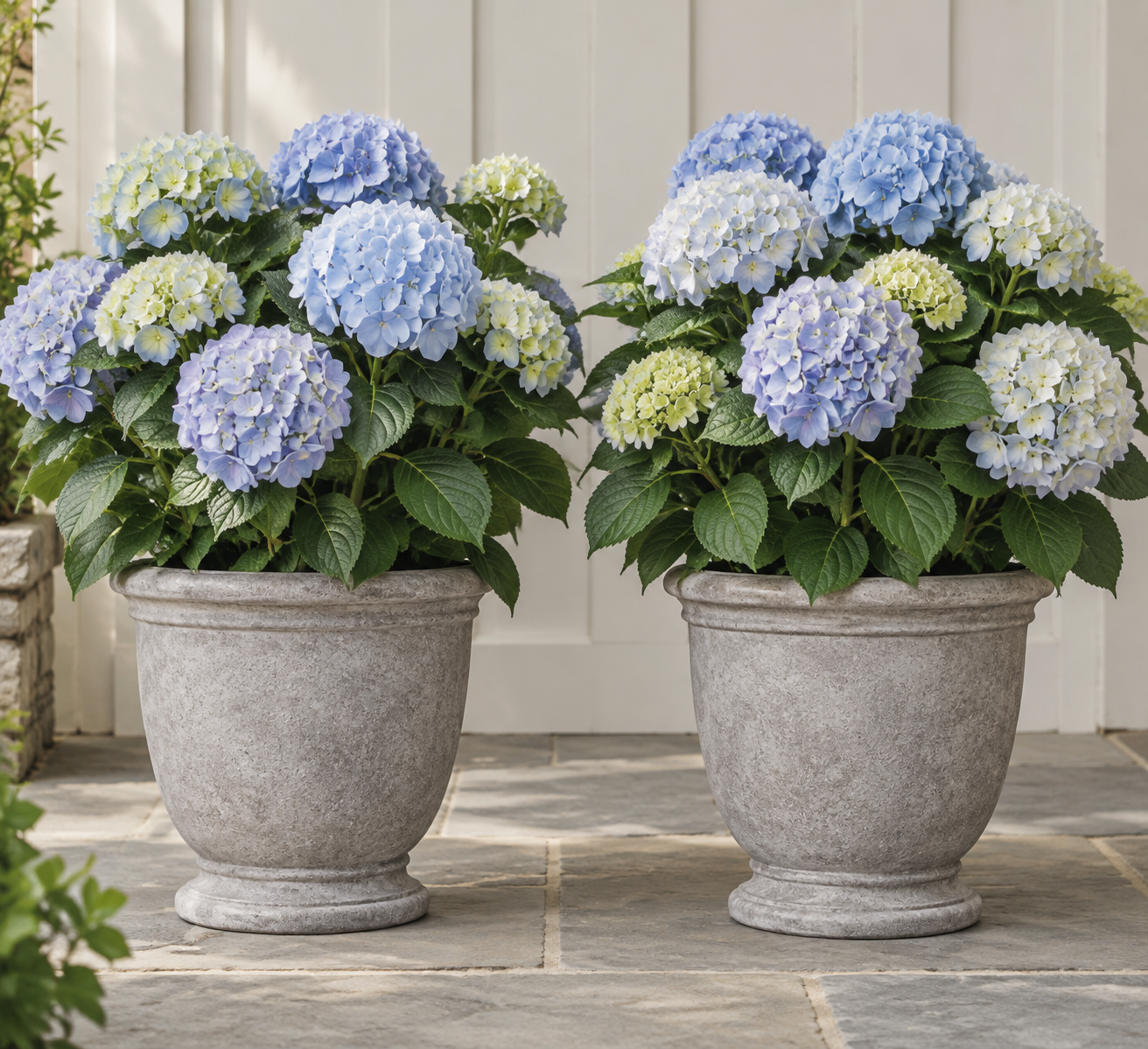
Potted florals scale-step more sharply than vased arrangements — a piece six inches too small for its spot reads like a placeholder, and one too large eats the surface it sits on. The eye judges potted green against furniture scale, not against other flowers. The three placement tiers, with the sizes that reliably work in each:
What "pre-fixed" means and why it matters
The failure mode of cheap potted florals is the slow lean: stems fixed in soft foam shift under their own weight until the arrangement lists sideways within months, and light pots tip as it goes. The builds here fix stems in dense foam set inside a weighted planter base — the arrangement keeps its shaped silhouette, and the pot keeps its center of gravity, for the life of the piece. It also means nothing to assemble: unbox, place, and the only maintenance is the cool hair-dryer dust pass twice a year. The same blooms in loose stem form for your own planters run through loose flower stems, and empty vessels are compared on the ceramic vases page.
Pot Materials and Room Matching
The planter is half the read — the same geranium reads farmhouse in a galvanized tub, minimal in a matte cylinder, traditional in glazed ceramic. The material families stocked: glazed ceramic (the polished default, suits kitchens and baths), terracotta and cement (warm, Mediterranean and rustic rooms), metal and galvanized (farmhouse and industrial), woven seagrass and rattan (coastal and boho — indoor use, as woven pots dust and fade outdoors). Sun rooms and south-facing placement want the UV-stable foliage builds regardless of pot; see the UV-resistant line for the full outdoor spec, and porch-and-patio-scale potted green runs through the outdoor collection.
How to Choose Potted Flowers
Four decisions — scale first, because a pot piece is placed, not arranged.
- Where does it stand?
Sills and shelves take the 8–12 in group; islands, consoles and coffee tables take 12–20 in; corners, flanking doorways and covered entries take 20 in+. Measure the spot's height clearance — total height, pot included, is on every card.
- Which pot material?
Ceramic and glazed ceramic read finished indoors and wipe clean; terracotta (unglazed) suits covered indoor use and reads Mediterranean; cement- and fiberglass-look finishes carry the statement scale. Each card names its pot's material and finish — no unstated "decorator" vessels.
- What should it read as?
Blooming pieces (tulips, hydrangeas, daisies) read seasonal accent; greenery-forward pieces read houseplant — the trick for plant-less corners. Mixed bloom-and-trailing pieces read garden. The green collection carries the plant-register end.
- Inside, or covered outside?
All groups here are indoor-rated; covered porches and entries work season-to-season. Fully exposed spots need the UV-rated outdoor line — sustained sun and rain are hard on any faux botanical, potted or not.
Frequently Asked Questions
What is the difference between flowers in pots and flowers in vases?
The form and what it's for. A vase arrangement is cut-flower logic — stems in water-look display, the register of a bouquet; it suits tables and mantels. A potted piece is plant logic — blooms and greenery set in a soil-look base inside a planter, the register of a houseplant; it suits sills, corners, entries and any spot without a surface for a vase. Neither imitates the other: choose the register the spot calls for, and the with-vase collection holds the other form.
What size potted flowers should I buy?
Place first, then size: under 8 inches overall for desks, shelves and sills; 10 to 16 inches for console tables, islands and nightstands (the workhorse tier); 18 inches and up for floor placement beside furniture. A pot too small reads like a placeholder in its spot, and one too large eats the surface — the tiers exist because the eye judges potted green against furniture scale, not against other flowers.
Can potted artificial flowers go outside?
Under cover — a porch ceiling, an overhang, a covered entry — most builds hold up season to season, with the UV-stable foliage preferred where sun hits. Full exposure is a different job: sustained direct sun fades any faux botanical and driving rain finds every seam, so open decks and beds need the UV-rated outdoor line with drainable planters and weighted bases built for weather. Woven seagrass and rattan pots are indoor-only — rain spots them and sun bleaches the weave. Treat a covered-porch pot like a cushion: out for the season, in for the storm.
Why do cheap potted fake flowers lean over time?
Fixative and ballast. Cheap builds set stems in soft, unweighted foam: stems creep sideways under their own weight, and light pots tip as the arrangement leans. The builds here use dense foam inside a weighted planter base — the silhouette holds and the center of gravity stays put for the life of the piece. If a piece ever arrives shifted from shipping, stems reshape by hand; the base keeps them where you put them.
What are the pots made of?
Stated per piece: ceramic and glazed ceramic (the indoor standard, wipe-clean), unglazed terracotta (Mediterranean register, covered indoor use), and cement-look or fiberglass-look finishes at the statement scale. The card also states whether the pot is weighted — the floor-scale pieces are, so corners and entries get stability a real houseplant pot has. No pot here is described beyond the material it lists.
Do potted artificial flowers need any care?
Effectively none: no water, no drainage, no feeding, no deadheading. The maintenance list is a cool hair-dryer or soft-brush dust pass twice a year, a monthly brush pass over the soil-look base (it collects dust silently), keeping the piece off continuous direct sun — all artificial botanicals fade eventually, slower rather than never — and lifting rather than sliding when you clean around it. Never rinse the entire pot under water: the base materials are set, not sealed. That is the entire care program; the full method by material is in the cleaning guide.
How do I style potted flowers around the house?
Match the pot material to the room first (glazed ceramic for kitchens and baths, terracotta for warm and rustic rooms, metal for farmhouse, woven for coastal), then cluster within a tier — a trio of desk minis on a shelf reads intentional where one lonely pot reads forgotten. Floor pieces anchor the corners furniture can't fill, flanking fireplaces and sofa arms. Pot-and-room matching does more for the look than the flower choice itself.
Why choose potted faux flowers over real houseplants?
For the spots real plants cannot hold: north-facing sills, dark corners, radiator shelves, offices with the lights off on weekends, rental homes where nobody will water in August. A potted faux piece delivers the plant silhouette with zero inputs — no light requirement, no watering schedule, no pest cycles, no repotting — and holds it for years at a houseplant's one-time price. Real plants still own the joy of growing; faux owns every spot that joy has failed.