
Quick answer: Artificial hydrangeas are reproduction hydrangea heads sold three ways: single stems with one 6-8 inch mophead, bushes carrying four to eight heads on branching stems, and loose heads on picks for wiring onto wreaths and arches. They hold the full head that fresh cut hydrangeas lose within five to nine days, in blue, green, white, blush and vintage tones. Budget by heads rather than stems - one bush fills a wide-mouth vase on its own - and buy from listings that state the head count.
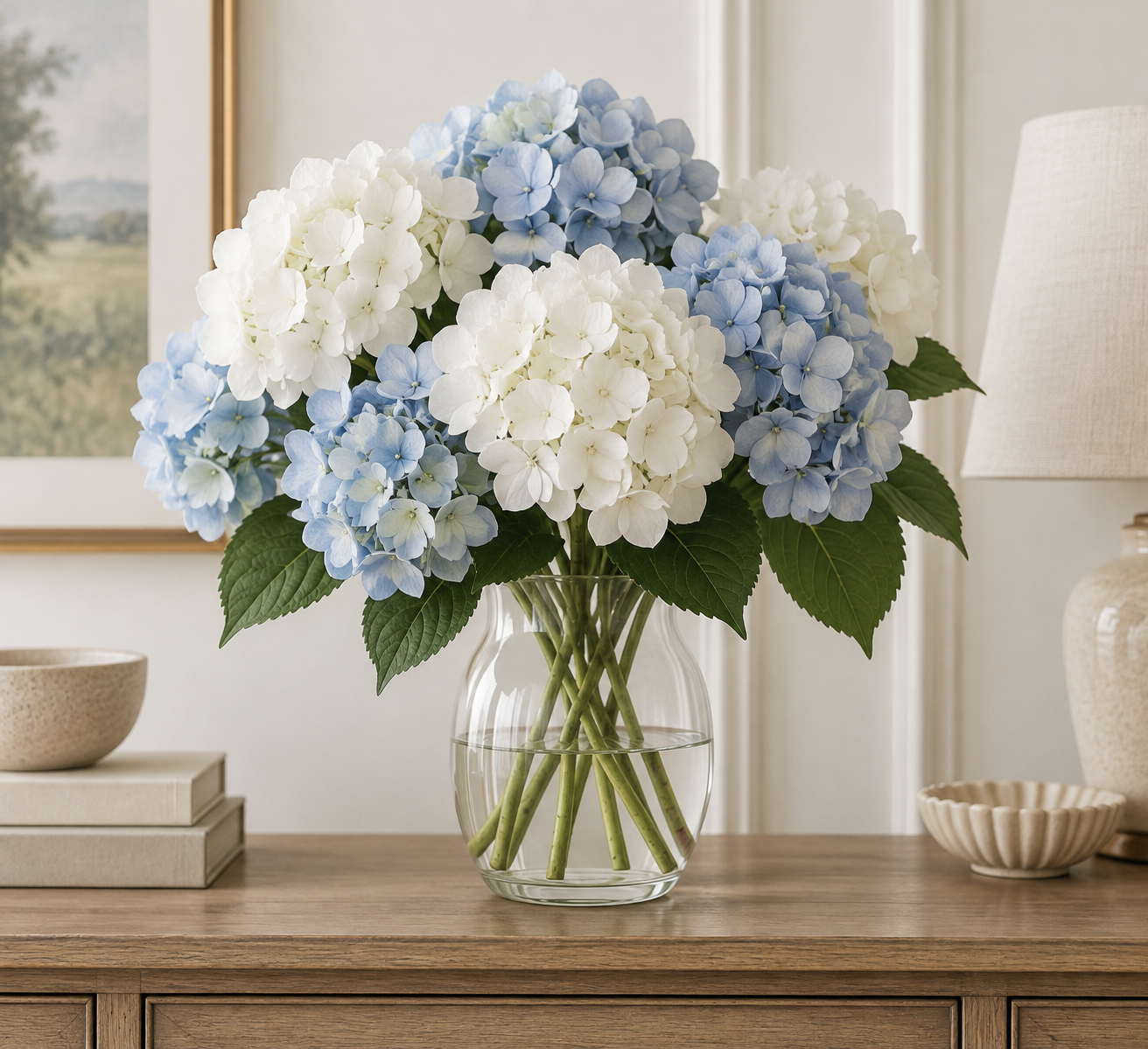
Artificial hydrangeas in the three forms florists actually use — single stems, multi-head bushes, and loose flower heads for wiring onto wreaths and arches. Blooms run 6 to 8 inches across, in blue, green, white, blush and vintage tones. Fresh hydrangeas famously collapse in a vase within the week; these hold the same full head for years. Every listing photo shows the exact stems you receive. Petals are the four-petal floret build of the real mophead - dozens to a head, each creased at the center - on wire-cored stems that hold the angle you set them at. Beyond the blues, green hydrangeas bridge to foliage work, white and cream anchor wedding palettes, and the vintage tones - mauve, dusty rose, celadon - carry the faded-garden look farmhouse rooms ask for. Event builders load arches and pew ends with bushes; home decorators fill a single wide-mouth vase and stop there.
Artificial Hydrangeas, Explained
What an artificial hydrangea is
An artificial hydrangea reproduces the one thing hydrangeas are loved for: a single mophead bloom the size of a small cabbage, made of dozens of four-petal florets. Because one head carries that much surface, hydrangea is the workhorse of fullness — the flower arrangers reach for when a vase or a wedding arch needs mass fast. In the language of flowers, hydrangea stands for gratitude and heartfelt emotion, with blue read as apology and pink as genuine feeling — our hydrangea meaning guide covers the palette.
The honest weakness of the fresh version is shelf life: cut hydrangeas drink through their petals and are notorious for wilting within five to nine days even in perfect water. The artificial version keeps the full head indefinitely, which is why it anchors so many of our DIY and bulk listings.
Three forms: stems, bushes, heads
Single stems (one head on a 12–24 in stem) drop straight into vases and mixed arrangements. Bushes carry four to eight heads on branching stems — one bush fills a wide-mouth vase or a urn on its own, and our hydrangea bushes page gathers them. Loose heads come with a short wire pick instead of a full stem, built for wiring into wreaths, garlands and arch builds where a long stem is just in the way. Head diameter and head count per listing are printed on every card, measured flat with a tape reference.
Mophead, lacecap, panicle - which hydrangea a listing reproduces
Four flower shapes carry the hydrangea name, and most artificial stock follows the first. Mopheads are the ball-shaped heads of dozens of four-petal florets - the classic nursery hydrangea and the form nearly every silk version takes. Lacecaps flatten into a disc: an outer ring of show florets around a center of tiny true flowers, a subtler look that suits modern rooms. Panicle hydrangeas run conical - the late-season limelight shape - and smooth hydrangeas (annabelle) make the loose white globes of cottage gardens.
This page's mophead build covers the fullness work; check the listing form line before ordering a lacecap or panicle look, because the shapes do not convert into one another at the vase. Color moves by tone family rather than variety on artificial heads - blue and green on the cool side, white and cream in the middle, blush and vintage at the warm-faded end - and listings name the tone per head.
Where they work best
Hydrangeas are the filler that makes a sparse arrangement look finished — three heads behind a line of roses reads as a florist build. They carry summer mantels, kitchen-counter jars and wedding arches; event builders typically budget one bush per two feet of arch width. In home use, one bush in a wide ceramic bowl is a complete centerpiece with nothing else required.
Colors, named per listing
Blue and green hydrangeas do the cool, quiet work; white and cream anchor wedding palettes; blush and the vintage tones — mauve, dusty rose, celadon — carry the faded-garden look that farmhouse rooms want. Color names are disclosed per listing with a flat-lay photo of the actual heads: what the card shows is what ships, and mixed-tone heads are labeled as mixed rather than sold under a single name.
What arrives, and the two minutes after
Heads compress slightly in transit — expect two to three minutes of fluffing per bush, separating the florets with fingers and rotating each head until it reads round. A shaping card ships in every box. Piece counts are stated in every title: a set of 6 heads means six heads, a single stem means one.
How to Choose Artificial Hydrangeas
- Pick the form for the job.
Vases and arrangements → single stems; wide bowls, urns and fast fullness → bushes; wreath, garland and arch wiring → loose heads on picks.
- Size the head to the vessel.
6 in heads suit jars and small bowls; 8 in heads carry floor urns and arch builds. Head diameter is measured flat on every card.
- Choose color by room temperature.
Cool rooms take blue, green and white; warm rooms take blush, vintage mauve and celadon. One or two tones per vase — hydrangea is already the loudest mass in the room.
- Budget heads, not stems.
Arch and garland builds: roughly one bush or 3–4 heads per two feet. Home vases: 1 bush or 3 stems complete. Counts per listing are in the title — no guessing from photos.
Buying Loose Stems in Bulk
Loose hydrangea stems, bushes and heads are the raw material of the look: bushes fill urns in one piece, loose heads wire onto wreath frames and arch chuppahs, and singles drop into mixed builds behind roses. Finished hydrangea pieces - styled arrangements and wreaths - suit decorators who want the volume without the build step. Wiring heads is the event route; buying finished is the gift-table route.
Frequently Asked Questions
Do artificial hydrangeas come as single stems or bushes?
Both, plus a third form: single stems (one 6–8 in head on a 12–24 in stem) for vases and mixed arrangements; bushes (4–8 heads on branching stems) for wide-mouth vessels and event builds — gathered on our hydrangea bushes page; and loose heads on short wire picks for wiring into wreaths, garlands and arches. The form is stated in every title, and head counts are listed per listing.
Why do fresh hydrangeas wilt so fast?
Cut hydrangeas drink through both their stems and their petals, and when transpiration outpaces uptake the heads collapse — often within five to nine days even in fresh water, which is why florists treat them as a short-run flower. An artificial hydrangea holds the full mophead shape with no water routine at all, year after year, which is the entire case for swapping it into a permanent arrangement.
How do I fluff artificial hydrangeas after unboxing?
Plan on two to three minutes per bush. Heads ship slightly compressed, so work through each head once: separate the florets with your fingers, rotate the head until it reads round, and bend the wired stems outward for an even spread. The florets hold where you leave them. A shaping card with photos ships in every box — this is stated plainly rather than promising a piece that skips transit.
Will the color I order be the color in my room?
Each listing carries a flat-lay photo of the actual heads with its color name — blue, green, white, blush, vintage mauve and mixed tones listed as mixed — so you are choosing from a photograph of the stock, not from a rendering. Artificial petals read slightly different under warm bulbs than daylight, the way any fabric does; we name the color on the card and photograph it in neutral light rather than making claims beyond that.
Shop Artificial Flowers
By Species
Bulk & Wholesale
Stems & Craft Basics
Flower Guides
Gratitude, apology and heartfelt emotion — what each head color has stood for.
Wiring, taping and shaping basics — the skills behind arch and wreath builds.
Dusting to deep-cleaning by material — florets included.