
Artificial Tulips And Faux Tulips
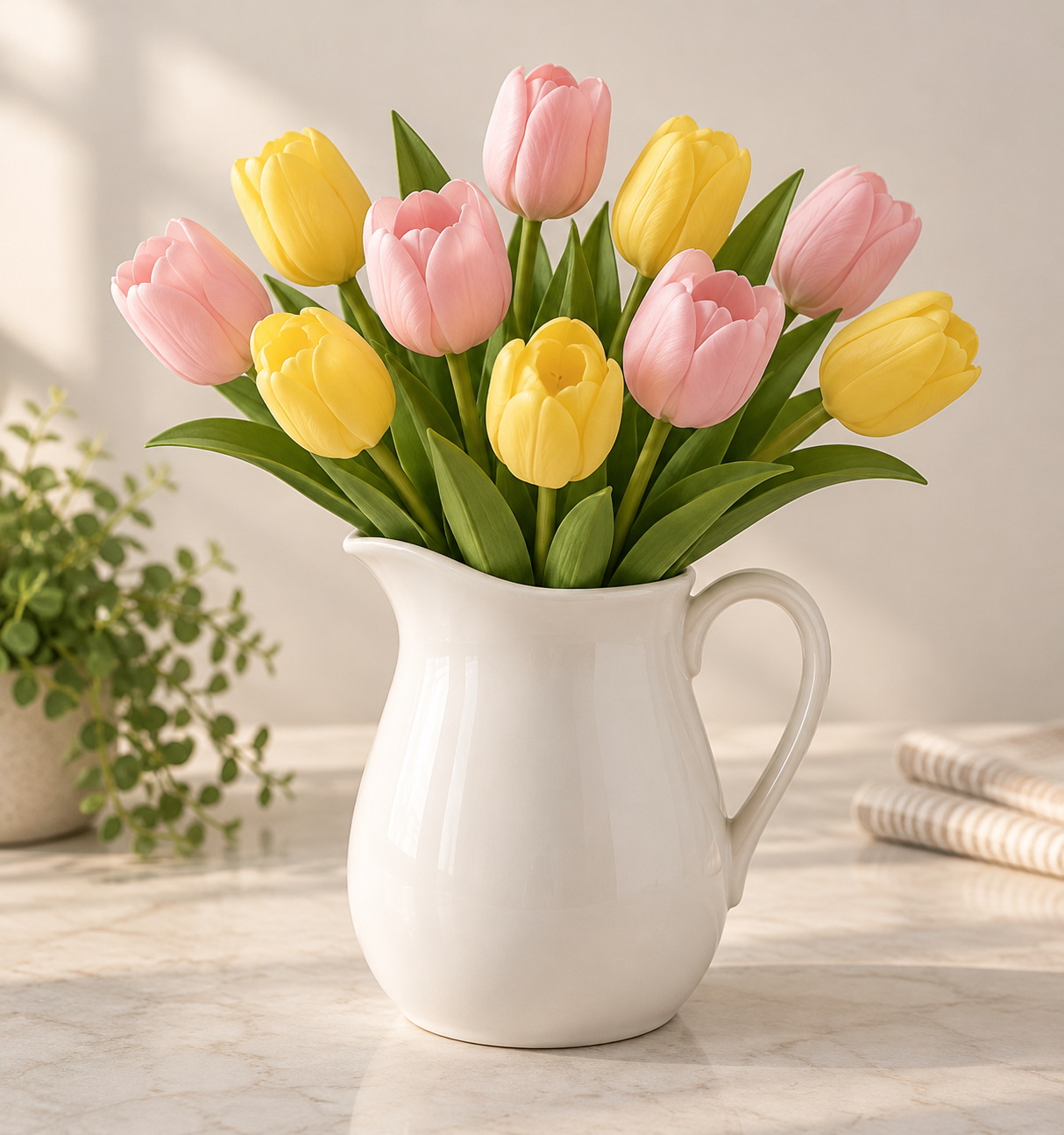
Tulips are the flower that fresh never delivers for long — three graceful days, then the drop — and the species with the widest color range in any bouquet. This page holds the whole faux tulip family: single wired stems, market-style bunches, and potted pieces, across every tulip color from white through parrot stripes, in open, half-open and closed-bud forms. Petal, greenery and stem materials are stated on every card, and stems photograph exactly as they ship.
Quick answer: Buy faux tulips by bloom stage, not just by color: open blooms make the statement in a vase, half-open carries a mixed arrangement, and closed buds read fresh the longest. Bendable wired stems are the spec that matters — they hold the natural curve you shape, where cheap rigid stems read fake from across the room. Twelve to fifteen stems fill a standard table vase, twenty-plus for floor scale; as of October 2026, single stems run from $13, bunches $18–42 and potted pieces $29–58 (USD).
The 30-Second Tulip Pick
- Start here: pick the form — stems and bunches for your own vases, potted pieces for sills and tabletops, finished arrangements for the spring table.
- Materials per piece: PE-film petals (the tulip standard), fabric and latex-touch options, wired stems — stated bloom, greenery and stem separately on every card.
- Heights: single stems 18–24 in; potted pieces 8–14 in total; finished arrangements 12–20 in — exact H×W per listing.
- Price band as of October 2026 (USD): single stems from $13, bunches $18–42, potted pieces $29–58, arrangements $40–150; free US shipping over $200.
What makes faux tulips different
Two things. First, tulips are the shortest-lived cut flower in the trade — three to five days of grace, then the stems bend and the petals drop, which is exactly the cycle faux deletes: the same open-cup silhouette in month three as day one. Second, real tulip stems keep growing and bending in the vase (the famous drunken lean), a look faux reproduces deliberately — stems here are wired, so each one holds either the upright market stance or the natural lean you bend into it, and never flops past the point of charm.
Buy by Bloom Stage
Fresh tulips are sold by stem count, but the visual difference between a good display and a great one is bloom stage — and the artificial line takes the idea further, because the stage you buy is the stage you keep. Real tulips open within days, blow wide within a week, and drop petals by the second; these hold their purchased stage for years. The three stages and their jobs:
The bendable stem is the whole trick
Living tulips never stand in a straight drill — they arch, lean and drift, and the eye reads that imperfection as life. Cheap artificial tulips come on rigid straight stems, which is why they read artificial from across a room. The stems here run wire through the full length: bend each one a few degrees off vertical, let a couple lean out of the vase mouth, and the display transforms. This is also why tulips are the friendliest first build for DIY arrangements — the shaping is literally hand-bending, no tools, and mistakes unbend. Spring door displays run on the same palette — spring wreaths in tulip and daffodil builds.
Stem Counts and Where They Go
Working counts by placement: a standard table vase (8–10 inches tall) fills on twelve to fifteen stems; a kitchen counter or entry statement on a tall vessel wants twenty-plus; bud vases run three to five stems each and multiply down a dining table better than one big arrangement. Bundles here are priced so the mixed-stage strategy is easy — closed buds as the base order, half-open to fill, a handful of open blooms as the accent — which is also exactly how a flower shop builds a tulip display. Vessels are their own decision — heights and silhouettes are compared on the vases for artificial flowers page, and the full spring line beyond tulips runs through the flowers hub.
Single, parrot, fringed — the tulip shapes worth knowing
Three shapes cover the category. Single tulips are the classic cup — the clean silhouette that suits modern rooms and single-color bunches. Parrot tulips carry torn, striped, ruffled petals — the maximalist statement where one bunch does the talking. Fringed tulips finish their petal edges in a fine fringe — texture at arm's length, which suits sill pieces and gifts where the eye gets close. Every listing names its shape alongside its color, and the mix rule holds across all three: one shape reads deliberate, all three in one vase reads busy.
How to Choose Faux Tulips
Four decisions — form first, then color discipline.
- Stems, pot, or finished arrangement?
Stems and bunches suit vase owners and rebuilers (the craft line sells them loose in bulk); potted pieces are the complete object for sills and gifts; finished arrangements do the spring table in one move. Most tulip buyers eventually own all three.
- Which bloom stages, and which color register?
Weight mixed orders toward closed buds (40–50%), fill with half-open, accent with open blooms. Single-color bunches read modern and Dutch-market; mixed pastels read spring and soft; parrot and striped varieties read maximal — one statement bunch, not a theme.
- Upright or leaning?
The wired stem is the whole trick: bend stems outward in a bunch for the natural lean, or keep them vertical for the market-fresh stance. Bend once, cleanly — the wire holds. The one thing not to do is mix extremes in one vase; tulips look best all leaning roughly together.
- How close will people stand?
Tulip petals are flat and simple — the friendliest shape for standard materials at distance. At arm's length (sill pieces, held bunches), PE-film petals hold their cup depth best; the latex-touch options are listed per piece.
Frequently Asked Questions
What is the difference between artificial tulips and faux tulips?
Nothing about the product — the two words are different search dialects for the same thing, and this page sells both labels on one shelf: fabricated tulips in fabric, PE-film or latex-touch petals on wired stems. "Artificial" is the plain search term, "faux" the interior-design register, "fake" the casual one. What actually differs between listings is material and form — stems, bunches, pots, arrangements — and every card states those plainly.
How many artificial tulips do I need for a vase?
Twelve to fifteen stems fill a standard 8–10 inch table vase; twenty-plus for a tall floor or entry statement; three to five per bud vase, which multiply down a dining table better than a single arrangement. For mixed-stage displays, weight the order toward closed buds (40–50% of stems), add half-open for fill and finish with a handful of open blooms as the accent.
Why do some fake tulips look fake immediately?
Two tells, both fixable at the point of purchase: rigid straight stems (living tulips arch and lean, so a drill-straight bundle reads artificial across a room — bendable wired stems are the spec that fixes it) and single-stage blooms (a vase of all-open blooms reads like a photograph of tulips rather than tulips; mixed stages read life). Shape each stem a few degrees off vertical, let a couple lean, mix the stages, and the same budget reads like a florist built it.
Which tulip colors look most natural?
The colors tulips actually grow in — white, cream, blush, yellow, red, purple and the classic bicolors — read most natural because the eye has seen them in gardens; colors horticulture never produced are the ones that break the illusion. Within the natural range, yellow and white carry the strongest fresh association for spring displays, deep purples photograph richest in winter months, and each depth here matches its family on the color axis — yellow tulips with the yellow collection, purple with purple — so palettes cross species cleanly.
Can I bend faux tulip stems?
Yes — that is what the wire inside each stem is for. Real tulips bend on their own as they age (the grower's nightmare, the stylist's charm), and faux stems reproduce that only when you ask: bend each stem a third of the way down, outward and slightly to one side, and the wire holds the lean permanently. Bend back for the upright market stance, and re-shape for a new season when the display changes. One caution: bend cleanly and avoid re-bending the same spot repeatedly — work-hardening is real wire physics, and a fatigued stem eventually snaps.
Can artificial tulips be used for weddings?
They are a staple of the spring-wedding build: half-open stems carry mixed bouquets, closed buds line aisle arrangements, and the bendable stems shape into bouquet work with no wiring. The bendable stem also survives handling that snaps fresh tulips — a ceremony, a photo session, a reception — holding the shaped curve to the last dance. Spring palettes and party pieces are organized through the wedding bouquets line.
How do I clean and store artificial tulips?
Dust with a cool hair-dryer blast or a soft brush — wiping works dust into petal texture, and the flat cup-shaped petals are the easiest shape in the catalogue to dust. Deeper marks wipe off with a barely damp cloth; keep liquid away from latex-touch petals and never soak a bunch with wired stems. Off-season, store stems upright in the vase or laid flat in a box, and re-bend on the next arrangement — the wire takes and releases shapes well, short of repeated re-bending at the same spot. Keep displays out of continuous direct sun, where all artificial botanicals fade — slower, not never.
What do tulips mean, and when are they given?
Tulips carry spring, renewal and — in the classic flower lexicon — declaration of love (a whole field of meaning grew from the Dutch mania of the 1630s, the first recorded asset bubble). Practically, they are the February-through-April flower: a tulip bunch reads as spring's opening statement, which is why faux versions sell steadily through winter. The tulip meaning guide covers the color-by-color lexicon in depth.