
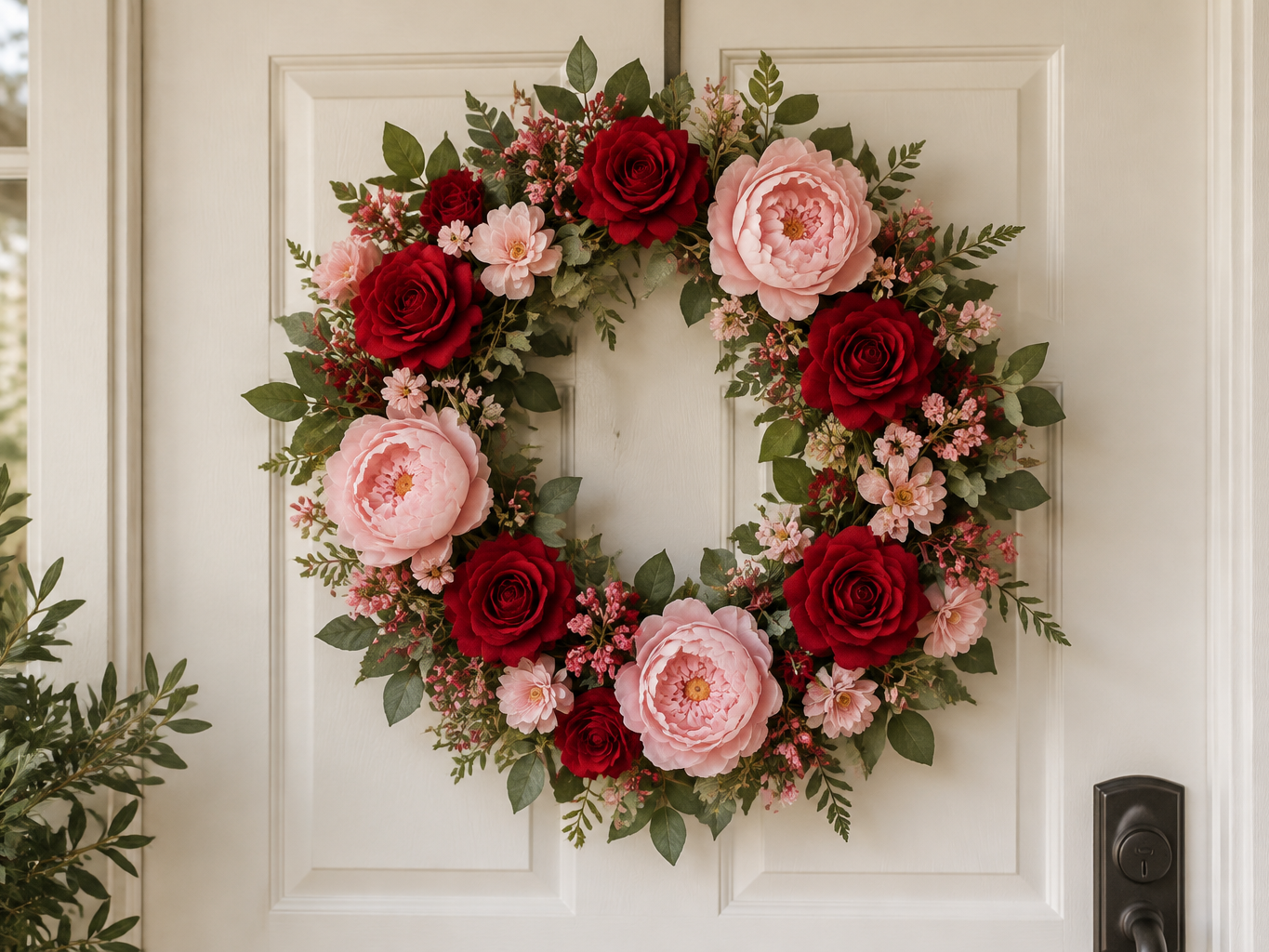
Valentine's wreaths in the three colors the holiday actually wears — red, pink, and white — built from roses, peonies, and berry picks on grapevine and evergreen bases, 18 to 24 inches for doors, mantles, and entry walls. Hang it the last week of January, keep it through February 14th, box it for next year. Every listing photo shows the exact single wreath you receive.
Valentine's Day Wreaths, Explained
What a Valentine's Day wreath is
A Valentine's wreath is a February door piece built on a fixed ring — grapevine, evergreen, or a workroom frame — dressed in the holiday's three-flower repertoire: roses, peonies, and ranunculus, with red berries, eucalyptus, and wired ribbon filling the gaps. The palette is deliberately narrow. Red reads classic and romantic, blush pink reads soft and modern, and white-and-cream reads elegant enough to outlive the holiday itself — more on that below, because a white Valentine's wreath is secretly a winter-to-spring bridge piece.
On build quality: greenery and filler on every wreath in this collection are specified at the same material grade as the main blooms — the eucalyptus sprigs, inner petals, and backing are not a cheaper afterthought, which is exactly where low-grade wreaths get caught out at handshake distance.
The three colorways, and who each one suits
Red is the curb-reader: saturated against dark or navy doors, unmistakably February, and the one guests photograph. Pink — blush through hot magenta — suits white, cream, and pale-grey doors, where true red can read harsh; it also carries best into a Galentine's brunch or a daughter's room door after the 14th. White and ivory is the quiet third option: it reads as elegant winter decor on a February door, then keeps working into March and April while every red piece in the neighborhood has already come down. Same bases, same blooms, three statements — which is why the color selector on each listing switches the variant rather than a separate product.
When to hang it, and when to take it down
The honest calendar: search for Valentine's wreaths peaks in January, which is exactly when doors actually go up — the last week of January through February 14th is the full display window, about three to four weeks. Take it down the weekend after Valentine's Day if it is explicit red-and-heart styling; a white or blush piece can stay up into early March without reading late. There is no reason a February door has to go bare waiting: this page's mother collection, winter wreaths, covers January, and the same hanger swaps one for the other in thirty seconds.
Choosing the right size
Valentine's wreaths run 18 to 24 inches because February is an intimate-scale holiday — the door decor equivalent of a close-up rather than a wide shot. A standard 36-inch front door pairs best with a 22–24 inch wreath; 18–20 inch pieces suit narrow doors, interior walls, bedroom doors, and the mirror or mantle arrangements the holiday invites. Every product page lists the measured diameter, and every listing photo shows the single wreath you receive, photographed flat with a tape reference — no intertwined pairs, no borrowed props.
Beyond the front door
February decor works indoors harder than any other season except Christmas: over the mantle with candlelight, centered on an entry mirror, on the guest-room door ahead of a visiting partner, or laid flat as the base of a Valentine's table centerpiece around votives. Indoor placement also removes every weather question — no porch overhang needed, no storm routine. For covered porches, any build here carries the month; for fully exposed doors, dense evergreen-based builds fare better than airy all-rose pieces.
Cost per February, not cost per order
A fresh Valentine's arrangement is a two-week purchase — market roses and peonies are at their annual price peak in early February, and they are compost by mid-month. An artificial Valentine's wreath at $40–120 is a one-time buy that comes out of its box every January: nothing browns, drops petals, or wilts on the coldest week of the year. Stored dry and flat in its shaped box, the same wreath decorates the door for many Februaries — amortized across even five years, the per-season cost lands far under the fresh-florist habit, at the week of the year when fresh flowers cost the most.
How to Choose a Valentine's Day Wreath
- Pick the colorway before the build.
Red for classic curb impact on dark doors, pink for pale doors and softer interiors, white to carry the door from February into early spring.
- Size to the door — or the mirror.
22–24 in. on a standard 36-in. door; 18–20 in. for narrow doors, interior walls, mantles, and table-centerpiece duty.
- Check the bloom mix.
Roses read traditional, peonies read lush and full, ranunculus add the layered-petal look; berry picks and eucalyptus keep the piece from reading flat.
- Plan the hang window.
Last week of January through February 14th; white and blush styles earn an extra two to three weeks before they read late.
- Buy for reuse.
One shaped box, stored dry and flat, brings the same wreath back every January — check piece counts on sets so you know exactly what arrives.
Frequently Asked Questions
When should I hang my Valentine's wreath?
The last week of January through February 14th is the natural window — early enough to enjoy the whole month, late enough that it doesn't read like a leftover from the holiday clearance aisle. Shoppers search hardest in January precisely because that's when doors go up. If the styling is explicit — hearts, XOXO ribbon — take it down the weekend after Valentine's Day; white, ivory, and soft-blush pieces can stay into the first week or two of March without reading late, which makes them the smarter buy if you want the longest display season per dollar.
What's the difference between a Valentine's wreath and a winter wreath?
Palette and motif. A winter wreath keeps cold-weather neutrals — flocked evergreen, pinecones, plaid, ice blue — with no holiday iconography. A Valentine's wreath pulls warm and romantic: red, pink, and white blooms (roses, peonies, ranunculus), berry picks, and often heart or ribbon motifs. The two seasons hand off directly — winter covers January, Valentine's takes February — and a plain white-bloom Valentine's piece bridges both months without reading like either holiday's leftover. Both collections share the same size logic and the same storage routine.
Red, pink, or white — which should I choose?
Match the door first, then the household. Dark, navy, black, and deep-green doors carry saturated red best — it reads from the curb and photographs strongly. White, cream, and pale-grey doors suit blush and pink, where true red can dominate. White and ivory is the third call: it reads as elegant late-winter decor rather than a themed piece, and it stays presentable into March after every red wreath on the street has come down. Inside the house — mantles, mirrors, bedroom doors — pink and white do most of the work. All three colorways run on the same bases and sizes, so the choice is genuinely just palette.
What size Valentine's wreath do I need?
February runs intimate: 22–24 inches is the ceiling for a standard 36-inch front door, and most households are just as happy at 18–20 inches, which also suits narrow doors, interior walls, and mirrors. Over a mantle or as a table centerpiece base, 18 inches is the working size. Every product page lists the measured diameter, and each listing photo shows the single wreath flat with a tape reference — the piece in the photo is the one that ships.
Can a Valentine's wreath stay outside in February?
Under cover, yes — a door with an overhang or a covered porch carries any build here through the month, and February's cold is gentler on artificial botanicals than summer sun. The risks are physical rather than seasonal: freezing rain and wet snow load branches with water weight, so bring the wreath in during ice storms. On fully exposed doors, dense evergreen-based builds hold their silhouette better than airy all-rose pieces. We do not claim weather immunity — treat an exposed wreath like a seasonal flag and it comes back next year.
How do I store it until next February?
Keep the shaped box it arrives in — inner supports hold the ring round, which is the whole trick. Let the wreath come to room temperature and dry fully if it has been out in damp weather, give it two minutes of fluffing so petals and berries sit outward, then box it flat and store it somewhere dry and cool; avoid hot attics directly under the roof. Nothing shrivels or browns in the box, so next January the piece comes out looking like it did this year. Stored this way, the same wreath handles many Februaries — one purchase instead of a fresh arrangement reordered every year at the week fresh roses cost the most.
Shop the Wreaths & Garlands Collection
Shop by Season
By Size & Base
Garlands
Tools & DIY