
Wedding Corsages
The corsage is the wedding's way of marking its most important guests — the mothers, the grandmothers, the women who got everyone there. It is also the one floral that gets touched, hugged, and photographed at arm's length all day, which is exactly why the silk version took the category: it looks identical in the evening photographs and still looks right in the keepsake box.
Quick answer: Wedding corsages are the wearable florals for the mothers, grandmothers and honored guests — two forms, wrist (on a band, the modern default) and pin-on (the classic chest spray), worn on the left, stem down. Order 4 to 6 weeks out, in the same order as the bouquets so every piece shares one dye batch. Plan one corsage per honored woman (most weddings: 2–6) and one boutonniere per honored man — sets cover both.
Corsages, Explained
Wrist versus pin-on
Corsages are the honor-marker layer of a wedding, and the count is set by roles rather than the size of the guest list. Ordering from the role list — not from "everyone" — keeps the floral budget proportionate and the honors meaningful.
Building the wearable list
The standard allocation: corsages for both mothers and stepmothers, living grandmothers, and any woman with a ceremony role — readers, singers, hostesses. The matching boutonniere list runs fathers and stepfathers, grandfathers, groomsmen, ushers and the officiant. The working count for most weddings: 2–6 corsages, 4–10 boutonnieres, all in one order. Every wearable orders in the same batch as the bouquets — wearables sit beside the bridal flowers in every photograph, and dye-lot drift shows hardest at that distance. Style logic: corsages echo the wedding palette in miniature — the anchor flowers repeat, the complexity drops — with one primary bloom (rose, orchid, ranunculus), filler, and a ribbon tail matching the gown register.
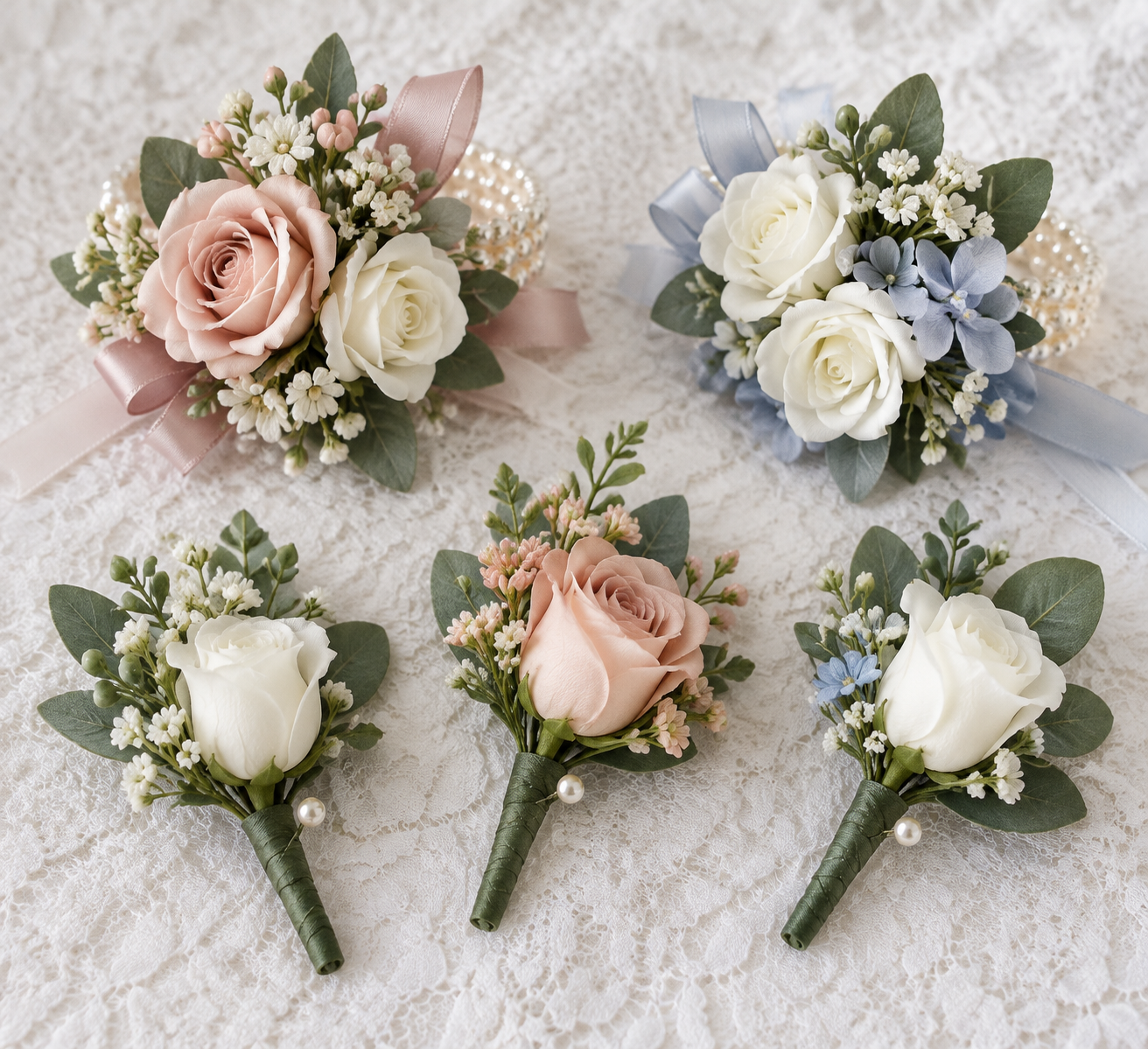
Why Silk Took the Wearables
- They arrive early and stay ready. Fresh corsages come from the cooler the morning of and wilt by the first dance — a fresh piece sits on warm skin through hugs, dinner and a dance floor, and reads visibly tired by the toasts. Silk pieces arrive with the rest of the program weeks out, need nothing, and carry the entire day at full form.
- They survive the day's handling. Corsages get more physical contact than any other wedding floral — hugs, handshakes, dancing. Wire-and-fabric builds take it; fresh blooms bruise.
- They keep. The mother's corsage from the wedding is precisely the piece worth keeping — boxed dry after the wedding, an artificial piece still looks like the day at every anniversary after. Silk makes it the keepsake it deserves to be.
- DIY economics at scale. Wearables are the classic DIY win — picks and rose stems plus ribbon make a corsage in fifteen minutes, or order finished in the wedding DIY packages.
Placement, Timing and the Day-Of Kit
Conventions worth knowing before the morning-of: corsages go on the left (over the heart), boutonnieres on the left lapel, both stems pointing down. Pin corsages through a seam or the inner structure of the garment — never straight through delicate fabric — and keep two spare pins in the emergency kit; a fallen boutonniere at the ceremony is a two-second fix with a pin in hand.
Timing: order 4 to 6 weeks out with the rest of the florals (silk keeps indefinitely, so ordering earlier with the two-to-three-month program is fine too). Fluff each piece for a minute on arrival — petals and ribbon take a set in the box — and distribute at the getting-ready site; handing corsages to the mothers is itself a small ceremony, usually in the first round of photos. Color-critical weddings add a single-stem swatch round before the full order, photographed in daylight against the fabric.
Frequently Asked Questions
Who gets corsages at a wedding?
The honor list, not the guest list: mothers and stepmothers, grandmothers, and women with ceremony roles — readers, singers, hostesses. The matching boutonniere list covers fathers and stepfathers, grandfathers, groomsmen, ushers and the officiant. The working count for most weddings: 2–6 corsages, 4–10 boutonnieres, all in one order with the bouquets. Ordering by role keeps the count proportionate; "everyone" is not the convention and multiplies cost for no added honor.
Wrist corsage or pin-on — which is better?
Default to wrist for the mothers: it puts nothing through silk or chiffon, survives hugs and the dance floor, fits a range of wrist sizes on its band, and photographs cleanly on the forearm. Pin styles suit structured dresses and jackets that take a pin cleanly, and photograph slightly more classically on the chest. When in doubt over a dress you have not seen, wrist is the safe gift — it cannot damage the outfit. The diplomatic answer practiced by planners: ask each honoree — the choice is a courtesy, and asking is part of the honoring.
How far in advance can I order silk corsages?
Order 4 to 6 weeks out, in the same order as the bouquets so every piece shares one dye batch — and since silk wearables have no shelf-life clock, ordering earlier with the rest of the wedding program at the two-to-three-month mark works too. Pieces sit boxed until the day. The only timing note: unbox and fluff a few days out so ribbon tails and blooms relax from shipping.
How do I match corsages to the wedding colors?
Place the corsages in the same order as the bouquets — same-batch dye discipline is what keeps the mothers' pieces and the bridal party reading as one palette. Corsage designs are built as softened versions of the bridal palette: the anchor flowers repeat, the complexity drops, and ribbon tails carry the accent color — the piece that ties each honoree to the wedding party in photographs. Color-critical weddings add a single-stem swatch round before the full order, photographed in daylight against the fabric.
Do artificial corsages hold up through the whole wedding day?
That is precisely the category's strength: fresh corsages wilt on warm skin through hugs and dancing and read tired by the toasts, while a wired artificial build holds full form from first photos to last dance — no cooler, no morning-of delivery dependency, no water source. After the wedding, boxed dry, it keeps: the piece the mothers still have at every anniversary.