
Wedding Boutonnieres
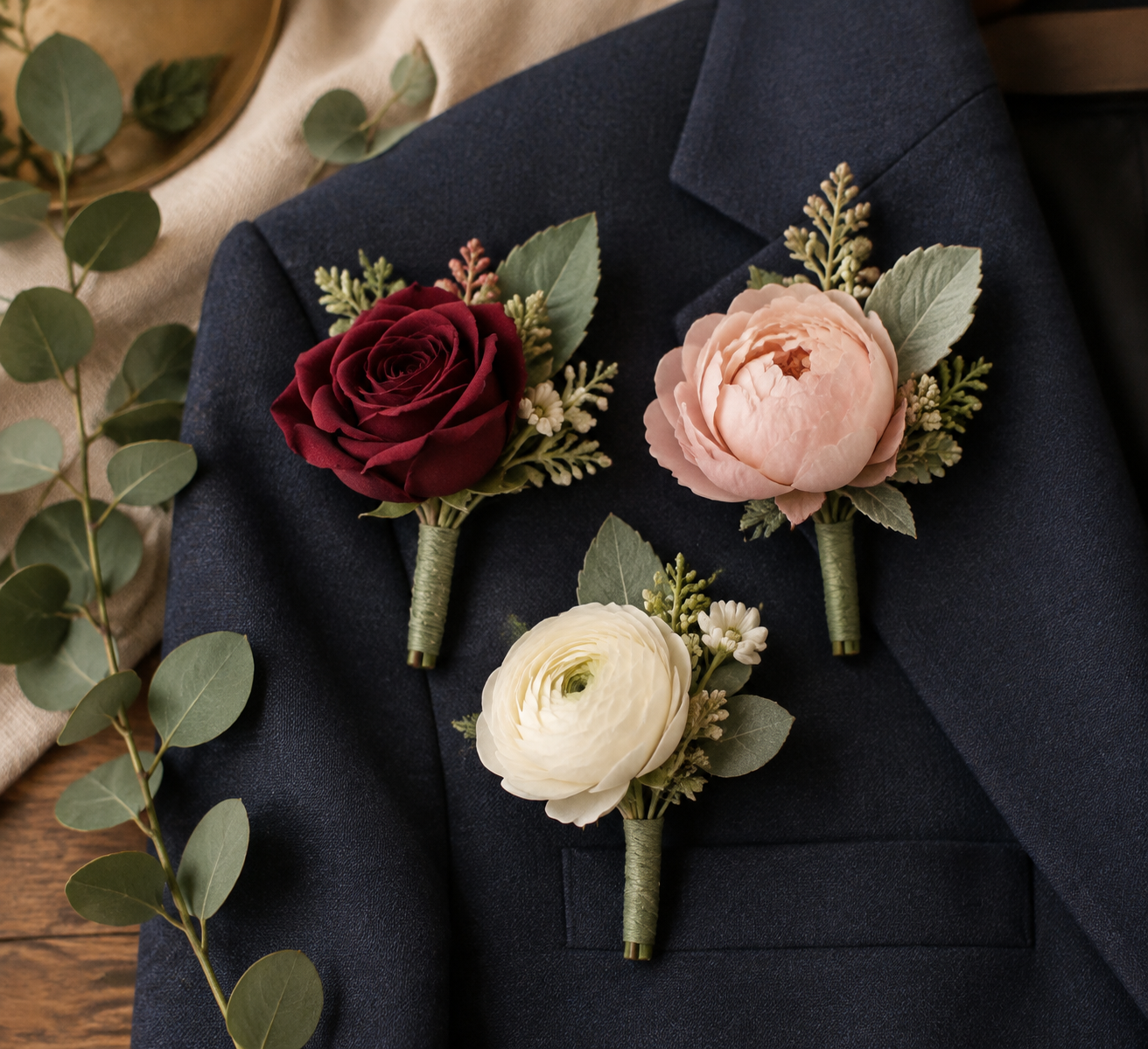
Faux boutonnieres for the groom, groomsmen, fathers, ushers and ring bearer — in silk-blend and real-touch materials that need zero preservation from order date to wedding morning. Every listing states the exact piece count shown in its photos, and single stems come in 8 wedding-palette colors on one listing.
Quick answer: Count boutonnieres by the seating chart — groom, each groomsman, both fathers, grandfathers, ushers and the ring bearer, plus 1–2 spares. Most parties land at 8–14 worn pieces across boutonnieres and corsages. Wired artificial builds arrive 2–4 weeks early (not the florist's 48-hour window), pin straight through the lapel buttonhole, and hold their shape through the last dance. Singles run $7.50–12, sets $24–78 as of October 2026.
The 30-Second Boutonniere Pick
- Count first: groom + groomsmen + both fathers + grandfathers + ushers + ring bearer, plus 1–2 spares → Set of 6 or the 12-pack list exact counts.
- Size: groom wears the larger triple-bloom style; groomsmen singles stay under 3 in wide so suits read clean in group photos.
- Materials on this page: silk-blend petals (fabric visible up close) or real-touch foam (soft, latex-like) — the material is listed per product.
- Price band: singles $7.50–12, wedding-party sets $24–78 (as of October 2026, USD); free US shipping over $200.
The People Layer: Who Wears What
The boutonniere count is arithmetic, and the corsage count runs beside it. Corsages go to the mothers, grandmothers, readers, and honored guests — the women whose flowers announce their role in the day. Most parties land between eight and fourteen worn pieces across the two, and set listings here state the exact count per box, so the wedding-morning math is done before anyone buttons a jacket.
Artificial builds bring two advantages specific to this list: the pieces arrive weeks before the wedding rather than 48 hours before (the fresh-florist window that concentrates every couple's risk into the two days with no slack), and wired stems hold their arranged shape through a full ceremony, photo line, reception and the last dance without wilting — no water source, no refrigeration, no droop at the altar. Per-piece and set listings state exactly what ships; the photo shows the exact piece, not a styled cousin of it.
The Count Worksheet
Set listings here are packed to this worksheet — a Set of 3 covers groom plus two attendants at a lower per-piece price than singles, and the count is stated in the title, not implied by the photo. A typical 4-groomsman party orders 10–12 pieces.
Materials: Silk-and-PE, Sola Wood, and What Wired Means
Boutonniere builds come in three working materials. Silk-and-PE builds (this collection's standard) layer fabric petals over wired stems — silk-blend petals show a visible weave up close, while real-touch foam is soft with a latex-like give; at ceremony distance both read as fresh, and close-up ring shots are where fresh flowers still win if you have them. The wire is what lets each piece be pinned at the angle the photographer wants and re-adjusted after hugs — all-plastic stems spring back and droop by the toasts. Sola wood pieces (wood-shaving blooms, the craft-market favorite at 8.1K monthly searches) read soft and natural but crush easily and dislike humid outdoor ceremonies. Fresh flowers — the traditional default — cost more through a florist, wilt by the reception, and lock you into the 48-hour delivery window. For destination weddings and summer heat, the wired artificial build looks the same in the getting-ready photos and the last-dance video.
The build standard across this collection: greenery and filler are cut at the same material grade as the focal bloom — the sprig of eucalyptus behind a rose is not visibly cheaper material, which is exactly where low-grade pieces fail at handshake distance. Glue lines are specified invisible at half a meter; pieces get a pull test before boxing.
Color, Pinning, and the Five-Minute Fix
Color discipline is simple: boutonnieres take one accent color from the wedding palette plus greenery, while bouquets carry the full blend — the lapel is a punctuation mark, not a paragraph. Same-order pieces leave from the same production batch, so the groom's rose and the groomsmen's roses read as one color family in photos (same-order same-batch is the stated fulfillment rule, not a hope). The groom's piece differentiates by scale or a distinct focal bloom rather than by leaving the palette — commonly a rose or ranunculus matching the bridal bouquet's dominant bloom, with groomsmen in the same bloom smaller.
Pinning: over the left lapel, on the seam above the heart — the same side as the breast pocket, bloom sitting at the buttonhole line pointing up along the lapel edge. Thread the wired stem through the buttonhole from the back, or on suits without one pin straight through the fabric behind the lapel, stem down and slightly out, anchored with one pearl-head pin pushed down and a second back up beneath the bloom. A straight pin works for heavier triple-bloom styles. Build the angle before the ceremony — wired stems re-bend in seconds, which is the whole reason photographers prefer them. The five-minute fix exists because it will be needed: a spare piece, a spare pin, and a steadier hand than the wearer's.
How to Choose Wedding Boutonnieres
- Run the count worksheet first.
People, then spares; sets pack to the standard counts and list exact piece counts in their photos — no hidden extras, no "styled with" pieces that don't ship.
- Whose lapel gets what?
The groom's piece reads visibly larger from the third row of the ceremony — that's why the triple-bloom style exists alongside singles. Groomsmen singles stay under 3 inches wide so a six-person lineup photographs evenly.
- Choose material for the venue.
Wired silk-and-PE or real-touch for heat, humidity and destination; sola wood only for temperate indoor ceremonies. The sample box ships one of each material so you can decide against your suit fabric.
- Order as one batch.
Same-order same-batch keeps every lapel in one color family. Singles carry 8 palette variations on one listing; for palette-critical work, order a single stem of the colorway against a swatch of the bridesmaid fabric before locking the full order.
- Stage a pinning rehearsal.
Order 2–4 weeks out so pieces arrive before the final headcount locks, leaving margin for a count correction or color adjustment. Unbox, check against attire, and run one pinned run at home — it saves ten minutes and one panic on the wedding morning.
Afterward: The Piece That Survives the Day
Unlike fresh boutonnieres, wired builds box flat after the reception and keep — many couples pin the groom's piece into a shadow box or the front of an album. A two-minute re-fluff (bend the stem straight, open the outer petals) restores the photographed shape. Pieces stored dry and flat hold that shape for years; the color-fade caveat that applies to sun-exposed displays barely applies to a piece that lives in a box.
Frequently Asked Questions
How many boutonnieres do we need for the wedding?
One per suit on the wedding side, plus spares: groom, each groomsman, both fathers, both grandfathers, ushers and the ring bearer — then one or two spares, because a crushed or lost boutonniere is only a fixable problem if a spare exists. Most parties land at eight to fourteen worn pieces across boutonnieres and corsages. A typical 4-groomsman party orders 10–12 pieces; the Set of 6 and 12-piece packs list exact piece counts in their photos — what you see is the count you receive.
How do you attach a boutonniere so it stays put?
Thread the wired stem through the left lapel's buttonhole from the back, or on suits without one pin straight through the fabric behind the lapel — stem down and slightly out, flower head at the buttonhole line, one pearl-head pin pushed down through the stem side and a second back up beneath the bloom. The build detail that keeps it wearable all day: wired stems flex to the lapel's angle and stay there — all-plastic stems spring back and droop by the toasts. Give the wearer a spare pin; lapel fabric thickness varies more than any instruction accounts for.
Which side does the groom wear a boutonniere on?
Over the left lapel, on the seam above the heart — the same side as the breast pocket. The bloom sits pointing up along the lapel edge, not flat against the chest.
Are artificial boutonnieres acceptable at a formal wedding?
They are, and the honest framing is material rather than tradition: a wired silk-and-PE build in the wedding's accent color, with same-grade greenery, reads as a boutonniere at every distance guests and cameras view it from — and it holds that read from the first photo through the last dance, which fresh pieces famously do not in summer heat. What artificial does not deliver is scent and the florist-studio provenance some couples want on the record. Destination weddings, outdoor summer ceremonies and long photo schedules are where the artificial advantage is decisive rather than merely acceptable.
Do faux boutonnieres look real in wedding photos?
At ceremony-and-reception distance — roughly 3 feet and beyond — fabric main blooms read as fresh-cut in photos. Up close, petal fabric and seams are visible, which is why close-up ring shots work better with fresh flowers if you have them. Each product page shows a macro close-up so you can judge the near view before ordering.
How far in advance should we order boutonnieres?
Artificial builds ship on the normal parcel timeline — order two to four weeks out so pieces arrive before the final headcount locks, leaving margin for a count correction or a color adjustment. Faux stems keep indefinitely, so there is no wilt deadline; the real timing is your staging. Early arrival also lets you stage the pinning rehearsal and photograph the set against the suits — the check that catches a color mismatch while it is still fixable.
What color should the groom's boutonniere be?
One accent color from the wedding palette, plus greenery — and the groom's piece differentiates by scale or a distinct focal bloom rather than by leaving the palette. Common pattern: groom in a rose or ranunculus that matches the bridal bouquet's dominant bloom, groomsmen in the same bloom smaller, fathers and grandfathers in the same build with a slight variation, so family reads at a glance in the photo line. Same-order same-batch is what makes this work across a whole party.
What is the difference between a boutonniere and a corsage?
A boutonniere is a single bloom or small cluster worn on a lapel; a corsage is a larger arrangement worn on the wrist or pinned at the shoulder, typically for mothers and grandmothers. Matching pairs for both are in our wedding corsages collection.
Can I keep the boutonniere after the wedding?
Yes — wired builds box flat after the reception and hold their shape for years, which is why many couples pin the groom's piece into a shadow box or album cover. A two-minute re-fluff (bend the stem straight, open the outer petals) restores the photographed shape before it goes on display. The one storage rule: dry and flat, out of direct sun — a boxed piece barely fades, while a sun-exposed display softens over a couple of seasons like any fabric.