
Quick answer: Artificial wisteria reproduces the hanging flower truss - racemes of 12 to 24 inches draping from woody stems - sold as hanging branches, raceme sprays and long-drape pieces. It delivers the curtain effect of a mature wisteria vine, which takes a decade to grow and drops its blooms within a fortnight, on day one and every year after. Purple, lavender-white and pink; buy raceme length by the drop you need and layer over a greenery base for wedding arches and backdrops.
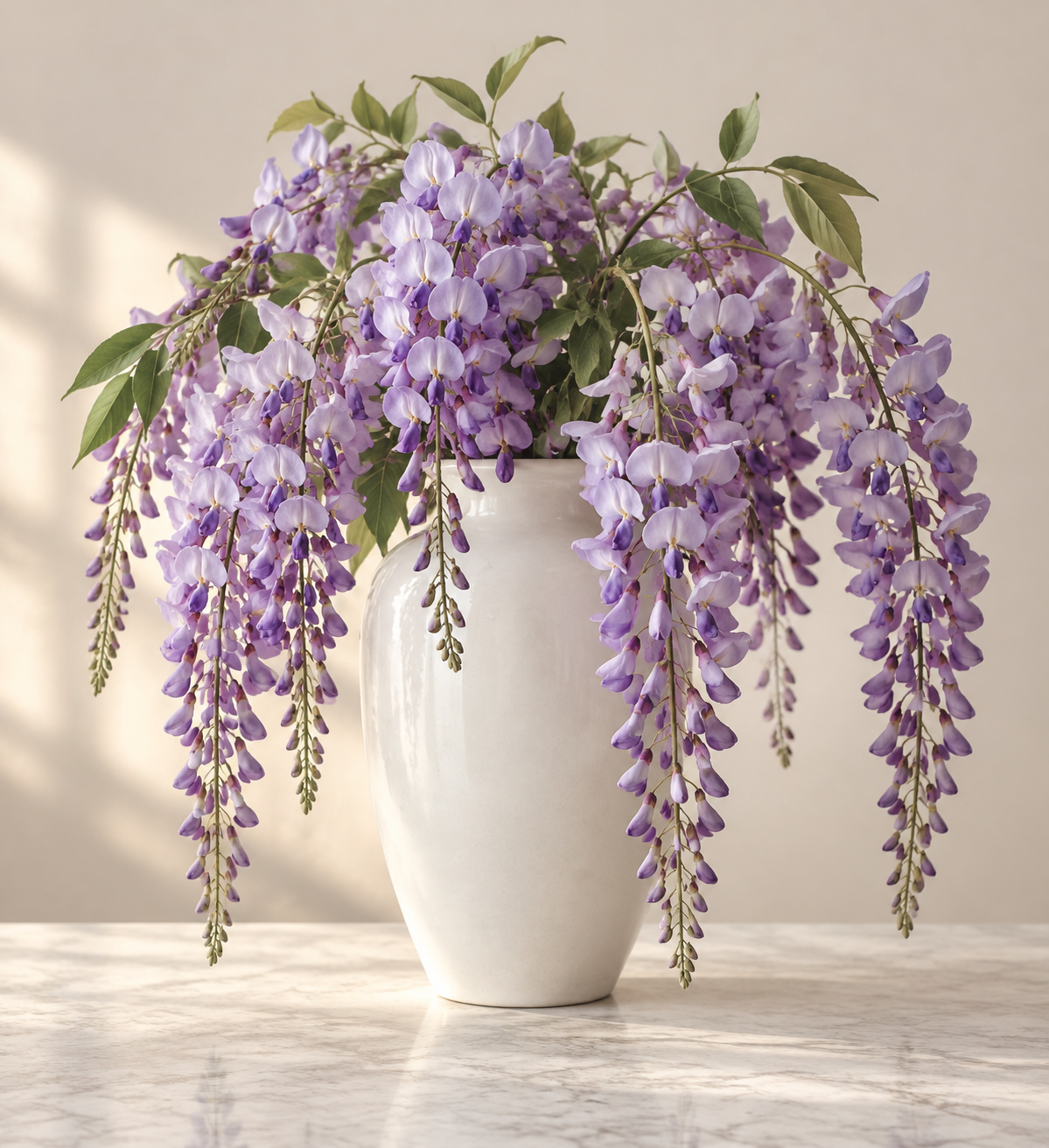
Artificial wisteria in the form the species is loved for — racemes that hang. Flowering trusses of 12 to 24 inches draping from woody stems, in purple, lavender-white and pink, built for wedding arches, photo backdrops and garden-style builds. The living vine takes a decade to cover a pergola and drops its blooms in a fortnight; these hang the same curtains on day one, every year. Every listing photo shows the exact stems you receive. Raceme build is the test: each truss carries its florets on short stems off a central cord, spaced the way gravity hangs them, with the petal texture of the pea-family flower it is. Purple is the deep succession of a mature vine, lavender-white the softer wedding reading, pink the garden-cultivar note. One long branch across a doorway does the work of a planted pergola; layered trusses over a greenery base fill an arch edge to edge.
Artificial Wisteria, Explained
What artificial wisteria is
Wisteria is a hanging flower: the bloom is a raceme, a tapered truss of pea-like florets that gravity pulls straight down from the vine. A faithful artificial version reproduces that droop — the truss must fall, not stick out — along with the twining woody stem and the sparse fine leaves. In the language of flowers, wisteria stands for devotion and patient, long-hoped-for love, drawn from the years a vine climbs before its first full flowering; our flower meanings hub keeps the story.
The practical case for artificial is that patience itself: a living wisteria spends years establishing before it covers a pergola, and even a mature vine holds its curtain for one to two weeks each spring. The raceme here hangs its full curtain from the first zip tie, on a backdrop that needs it in June or January alike.
Sizes and forms
Racemes run 12 to 24 inches — the length that does the draping, measured hanging with a tape reference on every card. Forms split by build: full hanging branches (woody stem plus a fall of racemes and leaves — the backdrop unit), raceme sprays (trusses on lighter stems for threading into arch builds and garlands), and bush-form pieces that fountain from a base for planters. Raceme counts per piece are stated in the title; a branch of 7 racemes means seven hanging trusses.
Chinese and Japanese wisteria - the raceme is the tell
Two vines carry the wisteria name, and raceme length separates them. Japanese wisteria (floribunda) hangs the longest trusses in cultivation - eighteen inches to two feet plus, open and airy, the waterfall look of the Kawachi tunnels; it is the variety wedding backdrops copy. Chinese wisteria (sinensis) runs shorter and denser - racemes of roughly a foot, florets packed tighter, more scent in the living vine - and reads fuller at the same piece count. American wisteria stays shorter still and mostly matters as garden knowledge.
On reproduction pieces the practical choice is drop length per truss, and the listings state it: long-drape pieces follow the floribunda reading, raceme sprays the sinensis. Layering both builds the full arch - long drops for the outline, shorter dense sprays to fill the face.
Where they work best
Wisteria's job is vertical softness on structures: wedding arch backs and ceremony aisles, photo-backdrop walls, balcony rails and bed canopies — anywhere a curtain of bloom should fall rather than stand. Builders layer it over a greenery base: eucalyptus or ivy first for coverage, wisteria racemes draped last so the tips hang free and move. On the practical side, hanging pieces read at distance, so this is one species where fuller counts genuinely pay — the draping line carries the whole look.
Colors that pair well
Purple is wisteria's home key — from deep violet to soft lavender — and it pairs the way lavender fields do: with creams and whites, with sage greens, with pale pink for spring bridal work. White wisteria reads garden-wedding classic against greenery; pink belongs to cherry-blossom-adjacent palettes. One tone per drape keeps the curtain clean; the two-tone look is better built by layering two single-tone pieces than by mixing on one stem.
What arrives, and the two minutes after
Racemes ship gathered flat to protect the florets; expect two to three minutes per piece — separate the trusses so each hangs on its own line, then straighten the florets down the raceme with a fingertip pass. Gravity does the finishing after the first hang. A shaping card ships in every box, and raceme counts are stated in every title.
How to Choose Artificial Wisteria
- Pick the form by the structure.
Backdrop walls and canopy tops → full hanging branches; arches, aisles and garland threading → raceme sprays; planters → bush-form fountains.
- Buy raceme length for the drop you want.
12–16 in racemes suit table edges and rail drapes; 20–24 in racemes carry arch backs and backdrop walls. Length is measured hanging, on every card.
- Layer over a greenery base.
Coverage first (eucalyptus, ivy), wisteria draped last with tips hanging free — the moving line is the whole look.
- Count trusses, not stems.
Backdrop math runs roughly 2–3 branches per foot of width; raceme counts per piece are printed in every title, counted on the card — no stacked-fall photography.
Buying Loose Stems in Bulk
Loose wisteria - hanging branches, raceme sprays, long-drape pieces - is the raw curtain: branches drape from arch frames and doorway tops, sprays wire into bouquets and chuppah corners, drops layer over eucalyptus or ivy groundwork. Finished wisteria pieces (arch kits, backdrop panels) assemble the layering for you. Planners building a dozen arches buy pieces by count; the one-arch wedding takes the finished kit.
Frequently Asked Questions
How long do fresh wisteria blooms last?
One to two weeks. A mature wisteria vine covers itself in hanging racemes for a short spring window, then spends the rest of the year as plain foliage — and getting to that mature flowering stage takes years of establishment first. Artificial racemes hang the same curtain on demand, which is why backdrop builders and wedding designers work in silk rather than waiting on a vine.
How do I get the racemes to hang properly?
Two to three minutes per piece, then gravity. Racemes ship gathered flat for protection: separate the trusses so each hangs on its own line, and run a fingertip down each raceme to straighten the florets toward the tip. Hang the piece, and the first hour of gravity finishes the drape. A shaping card with photos ships in every box — flat shipping is a fact of the category, stated up front rather than hidden.
How much wisteria do I need for a wedding arch or backdrop?
For arch backs, roughly two to three branches per foot of width once the greenery base is up — the draping tips, not the stems, carry the coverage. For a photo-backdrop wall, start at one branch per square foot and drape the racemes over the top edge so they fall free. Raceme counts per piece are printed in every title and counted on the card, so the math you plan with is the math that arrives.
What do wisteria flowers symbolize?
Devotion, and patient long-hoped-for love — the meaning comes from the vine itself, which climbs for years before its first full flowering, then rewards the wait with a curtain of blooms. Purple wisteria carries that devotion reading most directly; white leans toward new beginnings, which is why it anchors garden-wedding palettes. The full story, alongside every other species stocked here, is in our flower meanings guide.
Shop Artificial Flowers
By Species
Bulk & Wholesale
Stems & Craft Basics
Flower Guides
Greenery base first, wisteria draped last — the layering recipe this page's racemes are built for.
Wisteria's devotion-and-patience story, beside every other species stocked here.
Dusting hanging trusses in place — material by material.