

Christmas Garlands
A Christmas garland is a rope of artificial greenery, sold by the foot, that drapes across a mantle, winds down a staircase, or frames a doorway. Mainstream lengths run 6 to 9 feet; every style here comes pre-lit or unlit. Listing photos show the exact strand you receive.
Quick answer: Garland sizing is arithmetic: mantel width plus 1-2 feet of drape per side (a 5-foot mantel takes 7-9 feet), stair railing run times 1.5 (a 10-foot railing needs about 15 feet). Market bands as of October 2026, USD: plain pine $25-60 per 9 feet, pre-decorated $50-130, pre-lit $70-180 — versus fresh cedar at $65-100 per 25 feet, which is compost by early January.
Christmas Garlands, Explained
What a Christmas garland is
A Christmas garland is a rope of artificial greenery, sold by the foot. Where a wreath hangs as a ring and a swag hangs as a gathered drop, a garland runs horizontally: draped along a mantel, wound down a staircase railing, wrapped over a doorway, or laid down the center of a table. Mainstream lengths are 6 to 9 feet for mantles and standard runs — the standard retail lengths are 6, 9 and 12 feet, plus 50-foot wholesale spools for event and banister work — because the sizing formulas land on round numbers. Because a garland gets seen from both sides in a way a wreath never does, the collection standard here is one material grade throughout — the back-side greenery and inner branches are cut at the same grade as the display side, not a cheaper afterthought.
Bases run from classic cedar, pine, and fir to the florist-leaning line of eucalyptus, magnolia, and juniper — the varieties section below compares what each one does.
Length by placement: measure before you style
Garland length is a placement decision before it is a style decision, and the two formulas cover almost every install. Mantle: garland length = mantel width plus 1 to 2 feet per side for drape — a standard 5-foot (60-inch) mantel takes a 7-to-9-foot garland, wider 6-foot mantels want 9 feet, with the ends dropping 6 to 12 inches over each side; full floor-length drops call for 12 feet or more. Staircase: garland length = railing run times 1.5, because the wrap-around-the-railing spiral consumes the extra and a straight lay looks sparse — a 10-foot railing needs about 15 feet, usually built from two 9-foot pieces overlapped and zip-tied at the joint. Doorway: two installs live here — 8 to 10 feet covers a standard 36-inch door frame wound once, while a full frame wrap (top width plus both side drops, plus 10% for the swag) takes 12-14 feet; double doors and archways scale up. Table runner: 6 feet down the center of a standard dining table, 9 feet with drop ends.
None of this needs to be guessed at checkout: every listing states its measured length — garland gets measured end to end before boxing — and the length-by-placement table below does the arithmetic for the common cases.
Where garlands go: placement and length at a glance
Pre-lit or unlit: the two builds
Pre-lit garlands come with warm-white LEDs woven through the greenery at stated bulb counts per length — typically 100-200 lights per 9 feet — powered by battery packs with timers on shorter runs and plug-in transformers on long ones. The light count per foot is worth checking: the comfortable glow standard is roughly 10-15 lights per foot of garland, so a 9-foot piece carries 100-135. Unlit garlands are the flexible half of the line: weave in light strands you already own, change the color story year to year, and never diagnose a dead section mid-December. The trade is the same as the pre-lit wreath question — pre-lit trades money for setup time (about an hour of untangling string lights saved annually), unlit trades ten minutes of weaving for freedom. For porch runs, check the power type on the listing: battery packs tolerate weather duty better than transformers, and covered placement is still the rule for any artificial botanical.
Greenery varieties, compared
Cedar reads soft and cascading — flat, feathered branchlets that drape, which is why it is the classic stair greenery. Pine reads dense and traditional, holding a full silhouette under ornaments and ribbon. Fir reads structured, with upright branching closest to a tree's texture. Juniper carries berries and a woodsy, gathered-in-the-woods look. The florist line goes quieter and more modern: eucalyptus in sage-silver tones, magnolia in large leathery panels — the two varieties that read contemporary against all that classic green.
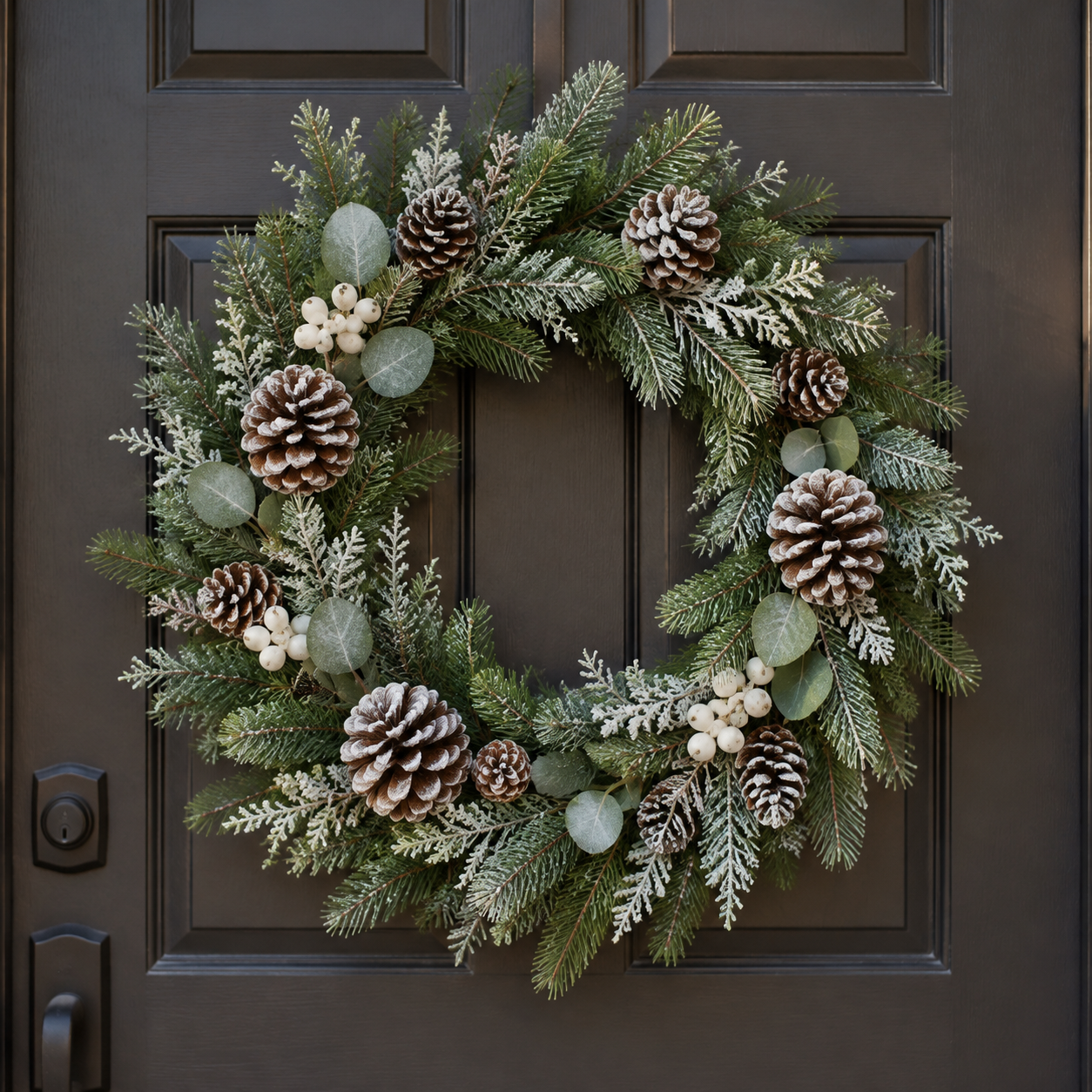
Pricing clusters by build tier and length rather than by brand, and the market bands as of October 2026 (USD) run like this: plain pine garland — the DIY base for your own bows, berry picks and ornaments — runs $25-60 per 9 feet; pre-decorated garland (pine plus wired-in pinecones, berries, ribbon) runs $50-130 per 9 feet and installs in one motion; pre-lit garland adds the warm-white LED at $70-180. Across the whole specialist retail field, single strands span roughly $35 to $290, with long spools priced by the foot. Compare the fresh alternative once: fresh cedar-and-fir garland from the specialty farms runs $65-100 per 25 feet (Lynch Creek's 2026 line, checked October 2026) and is compost by early January — a single season at a similar price to an artificial piece that returns annually.
Material spec, and what the listing states
The build inside the greenery: PE injection-molded tips carry the close-range fidelity; PVC fills the body; the mix is stated per listing alongside tip count. Greenery and decorations are pull-tested before boxing, and glue lines on decorated styles are specified invisible at half a meter. One disclosure matters in this category more than most: piece count. Marketplace listings routinely photograph two looped garlands and ship one — here the count states what ships, and the photo shows exactly one garland unless the title says a set.
Wreath, swag, garland: one theme, three forms
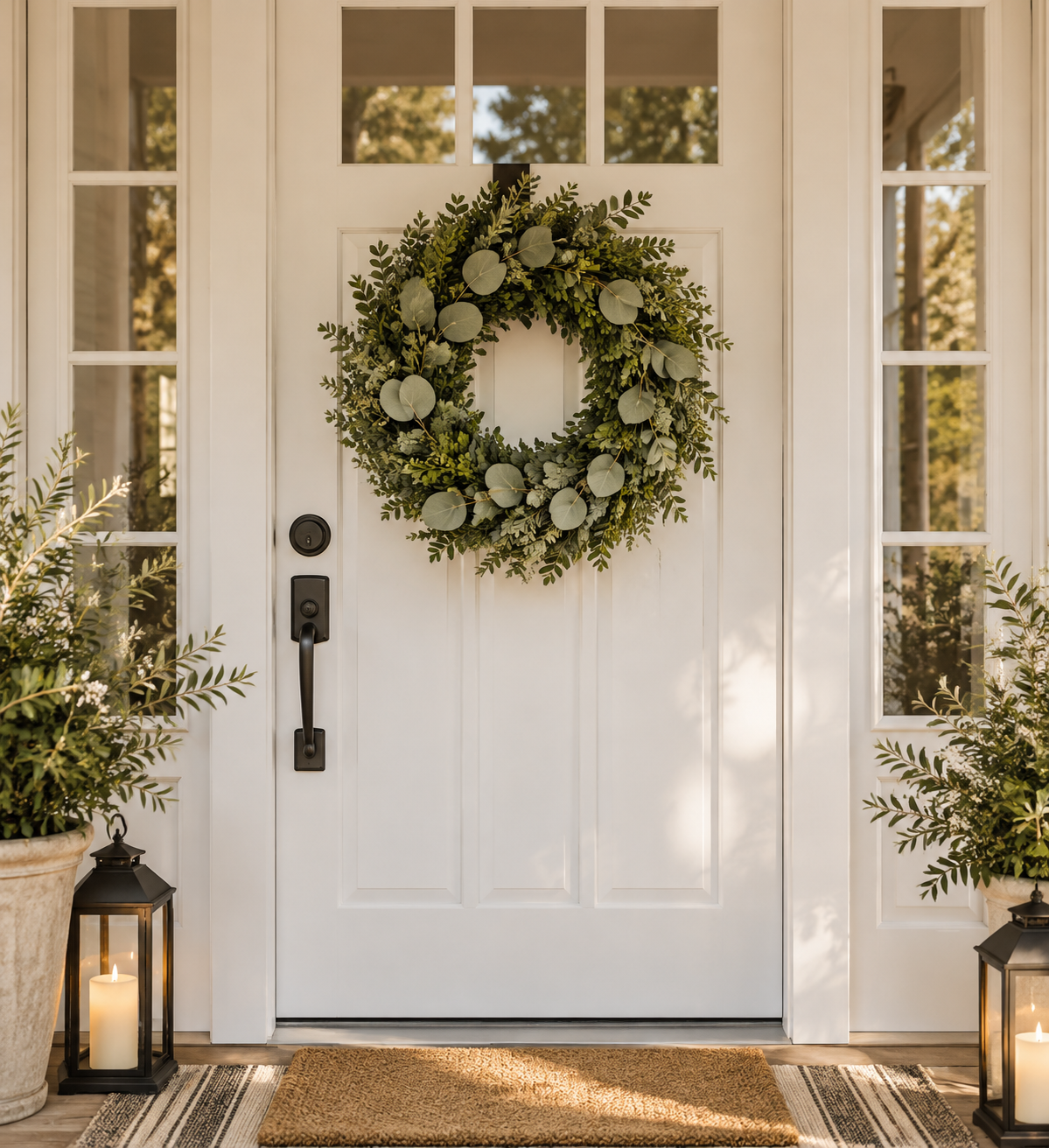
Most garland families in this collection are built in the same theme as a wreath for the door and a swag for the hard-to-dress spots — newel posts, window frames, chair backs, mailbox posts, lamp posts, the center of a door where a wreath is too round, each side of a double gate. That is the quiet way to dress a whole entry from one greenery decision: garland down the rail, wreath on the door, swag on the mailbox. The Christmas swags line and the Christmas wreaths line are linked below for exactly that pairing.
What arrives, and how it stores
A boxed garland travels compressed — expect a few minutes of fluffing the branches outward before it photographs right, and listings here say so plainly instead of promising a display-piece arrival. Each listing states its piece count and measured length, and draped photos show the single strand, not a doubled-up prop run. After the season, box the garland dry, loosely coiled in its original bag or a 20-gallon tote, somewhere cool — hot attics shorten the life of both tips and light strings — and no water, no needle sweep. A five-minute re-fluff next December (bend tips outward, straighten the drape) restores the silhouette. Bought once and reused for five seasons, the per-year cost lands at roughly the price of one-and-a-half fresh seasons — the entire value case against the fresh-rope habit of the December tree lot.
How to Choose a Christmas Garland
- Run the length formula for your spot.
Mantel width + 1-2 ft per side; railing run × 1.5; door frame top width + both side drops + 10%; 6 ft as a table runner.
- Pick the tier.
Plain for DIY decorating ($25-60 per 9 ft), pre-decorated for one-motion install ($50-130), pre-lit where glow matters ($70-180) — market bands as of October 2026, USD.
- Check lights-per-foot.
10-15 warm-white LEDs per foot is the comfortable glow standard — a 9-foot piece carries 100-135, and listings state the bulb count.
- Match the exposure.
Covered = anything; exposed = dense-tip builds, zip-ties for fast rescue, and a bring-it-in-during-named-storms routine. Battery packs suit weather duty; transformers need an outlet. Stair drapes hang on zip ties or rail hooks — plan one anchor per swag.
- Verify count and tip mix.
Listings state length, piece count, and PE/PVC mix — photo shows exactly what ships. Box the strand loosely in January, and the same run dresses the same rail next December.
Frequently Asked Questions
What length Christmas garland do I need?
Match the length to the placement, not the eye. Mantels: mantel width plus 1-2 feet of drape per side — a standard 5-foot mantel takes 7-9 feet, a 6-footer takes 9. Staircases: railing run × 1.5 — a 10-foot railing needs about 15 feet, built from two 9-foot pieces overlapped. Doorways: 8-10 feet wound once over a standard 36-inch frame, or 12-14 feet for a full top-plus-sides wrap. Tables: 6 feet as a runner, 9 with drop ends. Every listing on this page states its measured length, and the length-by-placement table above runs the arithmetic for the common cases.
How much garland do I need for my mantle?
A standard fireplace mantel takes its width plus 1 to 2 feet of garland per side, so the drape hangs over each edge — the classic install drops 6-10 inches below the shelf line. A 5-foot mantel takes a 7-to-9-foot garland; a 6-foot mantel takes 9 feet; full floor-length drops call for 12 feet or more. If you plan to layer candles or stockings on the shelf, favor the shorter drape (1 foot per side) so the garland frames the mantel instead of burying it. If the mantel garland is the anchor of the room's Christmas styling, buying toward the top of the band keeps the drape generous instead of stretched. And yes — mantle and mantel are the same piece; both spellings show up in searches and both get the same answer here.
How do I hang a garland on a staircase?
Multiply the railing run by 1.5 — the wrap-around-the-railing spiral consumes the extra length, and a straight lay looks sparse. A 10-foot railing needs roughly 15 feet, which most households build from two 9-foot garlands overlapped and zip-tied at the joint. Attach with zip ties in green every 12-18 inches (faster to remove in January than wire), rail hooks, or florist wire wrapped at each rise, one anchor per swag — and start from the top so the splice hides at the bottom turn. Let the garland fall in natural loops rather than pulling it flat — cedar styles drape best, and the loops are what read as fullness from across the room. Pre-lit stair runs should use battery packs (hidden in the greenery, usually on timers) rather than cords down a staircase. The same strand winds back into its box in January for next year.
Pre-lit or unlit garland — which is better?
Neither is better; they trade differently. Pre-lit garlands arrive with warm-white LEDs woven in at stated bulb counts (typically 100-200 per 9 feet), battery- or plug-powered, and save about an hour of untangling string lights annually. The honest caveat: the light string is the component most likely to fail across years — a dead string leaves a perfectly good garland that goes dark, so treat pre-lit as paying for convenience, not permanence. Unlit garlands cost ten minutes of weaving your own lights and return total freedom: your strand, your color scheme, your year-to-year changes, and no dead section you cannot diagnose. Porch and stair runs favor battery pre-lit; mantel and table runs — where outlets and storage are easy — are natural unlit territory.
Can Christmas garlands be used outside?
On covered porches and entries with an overhang, garlands run late November through early January without complaint. Fully exposed runs are a different job: driving rain, snow load, and weeks of direct sun are hard on any artificial botanical, and plug-in transformers belong indoors regardless. Dense-tip builds handle weather visibly better than airy, wide-spaced constructions. The practical pattern on exposed railings, fence lines and door frames: a battery pre-lit style, zip-tied rather than wired (faster rescue), brought in during named storms and at the season's end — and check the light-string connection points first on pre-lit pieces, because they are the weather-sensitive component. What we do not claim is weather immunity — treat an exposed garland like a seasonal flag and it returns for years.
How much does a good Christmas garland cost?
Market bands as of October 2026 (USD): plain 9-foot pine garland runs $25-60; pre-decorated (pinecones, berries, ribbon) runs $50-130; pre-lit runs $70-180; 50-foot wholesale spools for event and banister work run higher, priced by the foot. The fresh comparison: specialty-farm cedar garland runs $65-100 per 25 feet (Lynch Creek's 2026 line, checked this month) and lasts one season — so an artificial garland priced like one-and-a-half fresh seasons returns every December thereafter.
Do artificial garlands shed?
A well-built artificial garland does not shed the way a fresh rope does — there are no needles to drop, and nothing browns by January. What can happen is transit compression: a boxed garland arrives dense and needs a few minutes of fluffing, bending the branches up and out until the silhouette reads full. Listings state this plainly rather than promising an untouched-by-transit display piece. The build standard that matters for shed resistance is grade consistency — the inner and back-side greenery at the same material grade as the display side, which is exactly where low-grade garlands get caught at close range.
What is the difference between a garland, a wreath, and a swag?
Form factor. A garland is a continuous length that runs horizontally — mantels, railings, door frames — measured in feet. A wreath is a ring that hangs flat on a door or wall. A swag is a teardrop or fan cluster, 24-48 inches, that hangs as a single vertical statement: the center of a door where a wreath is too round, a lamp post, each side of a double gate, newel posts, window frames, chair backs, mailbox posts. The practical rule: lengths of run take garland, single points take a swag or wreath — and many installs use both. Most families in this collection are built in all three forms on the same theme, so one greenery choice can dress an entire entry.
How do I store a Christmas garland after the season?
Box it dry, loosely coiled — tight winding is what breaks branch tips over a summer in storage — in its original bag or a 20-gallon tote, laid flat and cool; hot attics shorten the life of both tips and light strings, and crushing weight is the other enemy. No water, no refrigeration, no needle sweep. Come next December a five-minute re-fluff — bending tips outward, straightening the drape — restores the silhouette. Reused across five seasons, the per-year cost of an artificial garland lands well below replacing a fresh rope every December, which is the honest arithmetic for buying artificial.