
Front Door Wreaths
A front door wreath is the handshake of your home. This collection gathers every style we make — spring wildflowers, summer greens, fall harvest and Christmas pine — in 18 to 36 inch sizes, on evergreen, grapevine and mesh bases, so one hook on your door serves all four seasons.
Quick answer: A front door wreath should span 50–70% of the door panel — 22–24 inches on a standard 36-inch door — hung from hardware matched to the door material (over-door hanger, magnetic hook on steel, frame-mount on glass panels). The strongest setup is one neutral anchor wreath plus three or four seasonal rotations, swapped in thirty seconds on a second hanger.
About Front Door Wreaths
Nothing announces a cared-for home quite like a wreath on the front door. It is the first thing guests see from the sidewalk and the last detail you pass on your way out, which is why front door wreaths remain the most-loved piece of curb-appeal decorating — and why so many households now keep a small rotation of them, swapping designs as the seasons turn instead of paying a florist every few months.
One anchor wreath plus a rotation
The strongest front-door styling is not one wreath — it is one anchor piece plus three or four seasonal rotations. The anchor is a neutral build (eucalyptus, olive branch, magnolia, cream hydrangea) that carries the everyday weeks between holidays; the rotation slots are the big four: a fall harvest piece from the first week of September, a Christmas wreath from late November, a spring bloom piece after the thaw, and a summer greenery or coastal style for the long warm stretch. Two over-door hangers — or one hanger plus a hook at the same height — make each swap a thirty-second job, and every artificial piece goes back in its box instead of the compost.
Front doors take more punishment than any other wreath location, so build grade matters here more than anywhere. Greenery and filler on every wreath in this collection are specified at the same material grade as the main blooms — the inner leaves and backing are not a cheaper afterthought, which is exactly where low-grade wreaths fail at handshake distance. Glue lines are specified invisible at half a meter, and heads and clusters get a pull test before boxing.
Size: the 50–70% rule
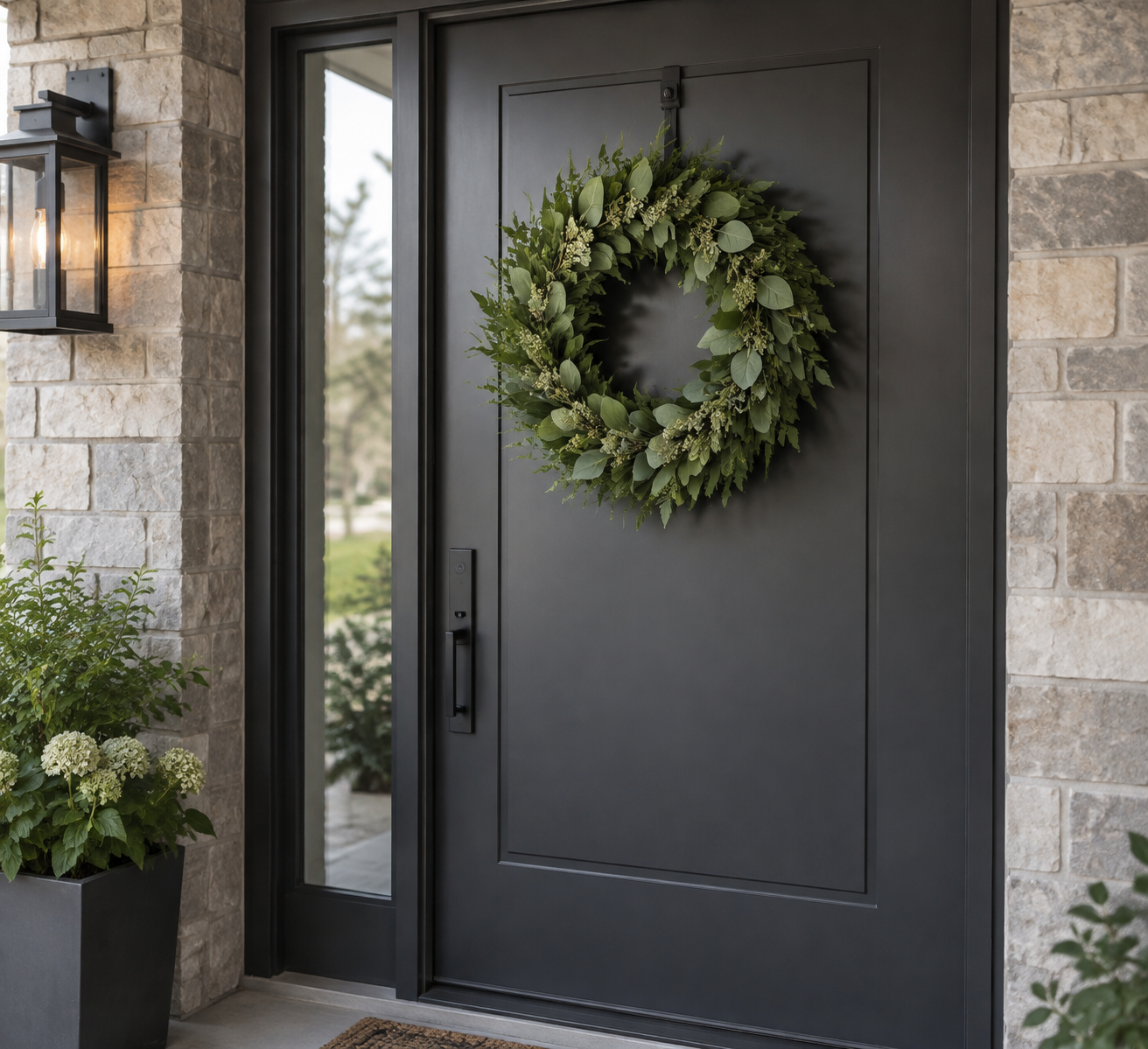
Size is the single most common mistake. The right wreath spans roughly half to seventy percent of the door's width — about sixty percent is the most common look, a 22–24 inch wreath on a standard 36-inch door, while 18–20 inches reads quiet and deliberate on the same door. Below half reads quiet; past about seventy percent the wreath crowds the door edges. Every product page lists the exact measured diameter — photographed flat with a ruler beside the piece, so what you measure is what arrives — and the size filter narrows the collection in one click.
Hardware: match it to the door material
Hardware depends on the door, and the wrong route is how wreaths meet porches at speed. Over-the-door hangers — the simplest, no tools — fit doors that open away from the frame and clear the top rail. Magnetic hooks suit steel doors but not aluminum or fiberglass. Adhesive hooks hold light 18–20 inch builds on glass and smooth surfaces, but respect the printed weight rating: a dense 24-inch build on a discounted adhesive strip is a common failure. On glass-panel doors, hang from the frame or top rail rather than the glass, and note that a wide wreath on a full-light door trades greenery for the view.
Three bases, three looks
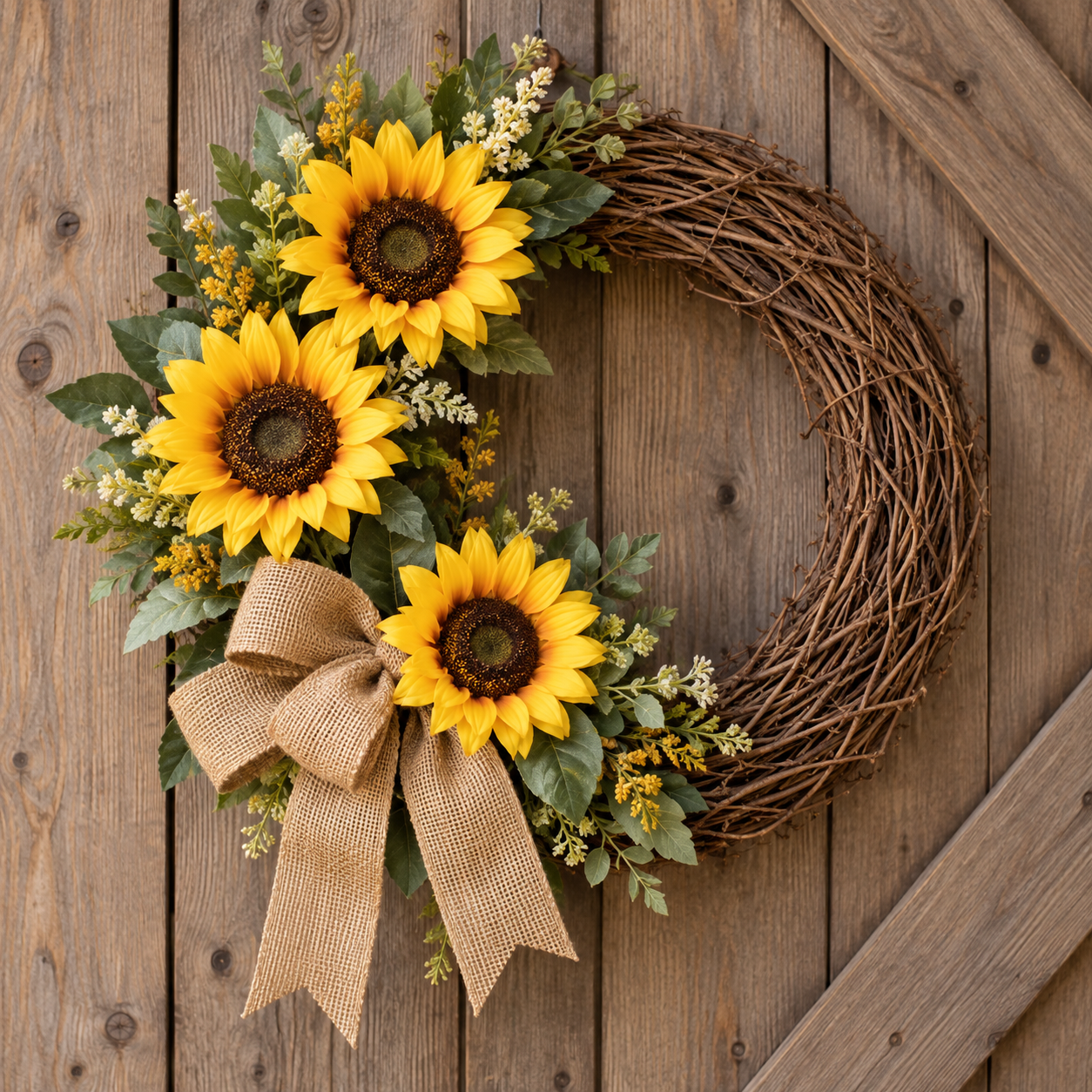
Evergreen bases give a dense, opaque, traditional silhouette that suits Christmas and year-round boxwood designs — maximum presence from the curb. Grapevine bases add a rustic, airy, see-through structure that dried florals and fall picks love to nestle into; the ring weighs less and catches less wind than a full evergreen build. Deco mesh bases — ruffled ribbon in saturated colors — bring volume, movement and weather-toughness for playful summer and celebration doors. The base is called out in every product name, photo set and filter, because it changes both the look and the way each wreath hangs.
Weather, storm doors, and the honest limits
A covered porch extends any wreath's life indefinitely; a fully exposed door is a different contract. Driving rain, snow load, and weeks of direct sun are hard on any artificial botanical, and that boundary is stated plainly here rather than dressed up as weather immunity. Dense builds (grapevine, mesh, tight evergreen) handle wind better than airy, wide-spaced pieces; storm doors create a greenhouse effect in summer sun that cooks finishes, so vent or lift the wreath out of direct contact in hot months. The practical pattern on exposed doors: bring the wreath in during named storms, box it dry at season's end, and expect years — not decades — from any piece living in full weather. Each listing carries an honest placement tag — covered porch or fully exposed — rather than a one-size promise.
A wreath for every season, at florist-adjacent prices
Door wreaths from a flower shop are routinely billed at fresh-floral prices and wilt in two weeks. The designs in this collection are built to be unpacked, fluffed in about five minutes, hung, and reused year after year — the per-season cost of a faux wreath drops toward pocket change the longer you keep the rotation going. Start with one year-round design, then add the seasons your door loves most.
How to Choose a Front Door Wreath — Five Decisions in Order
- Measure the panel.
Wreath = 50–70% of door width; 22–24 inches is the default on a 36-inch door.
- Match hardware to the door material.
Over-door hanger for outswing clearance, magnet for steel, frame-mount for glass panels.
- Start with a neutral anchor.
Eucalyptus, olive, magnolia, or cream hydrangea carries the between-holiday weeks.
- Rotate the big four.
Fall, Christmas, spring, summer — two hangersmake each swap thirty seconds.
- Match the build to the exposure.
Covered porch takes anything; exposed door wants dense builds and a storm routine.
Frequently Asked Questions
What size wreath is best for a front door?
Measure the door slab edge to edge, then aim for a wreath spanning 50–70% of that width — a 22–24 inch wreath on a standard 36-inch door is the most versatile choice, reading from the curb without covering the peephole, house numbers, or door trim. Below half reads quiet; past seventy percent it crowds the edges. 18–20 inches suits narrow 24–30 inch doors, storm doors, sidelights and windows; 30 inches fits 38–48 inch doors and entries with sidelights; 36 inches holds 48-inch-plus doors and double doors — or run two matching 22–24 inch wreaths, one per panel, hung at the same height.
How do I hang a wreath on my front door without nails?
Three no-nail routes, matched to the door: an over-the-door hanger needs no tools, holds up to about 10 pounds, and fits doors whose top rail clears the frame when opening; a magnetic hook holds firmly on steel doors only — aluminum and fiberglass need another route; and adhesive hooks carry light 18–20 inch builds on smooth surfaces when you respect the printed weight rating. On glass-panel doors, hang from the top rail or frame, never the glass itself. Our step-by-step hanging guide covers each method, including how to protect the door finish.
Can I leave one wreath on my door all year?
You can, and an all-season neutral build — eucalyptus, olive, magnolia, cream hydrangea — is designed exactly for that. Two honest limits: a wreath on a fully exposed door weathers faster than one under cover (sun and storms are hard on any artificial botanical), and a single year-round piece reads as decor rather than as seasonal welcome. The stronger pattern is the anchor-plus-rotation: the neutral piece carries the everyday weeks, and seasonal wreaths slot in for their six-to-ten-week windows.
How often should I change my front door wreath?
The practical calendar is four swaps a year: a fall harvest piece from the first week of September, a Christmas wreath from late November through the holidays, a spring bloom piece once frost risk passes, and a summer greenery or coastal style for the warm stretch. Between those windows the neutral anchor stays up. Each swap is thirty seconds with a second hanger, and every artificial piece stores in its box for the next year instead of being rebought.
Do wreaths damage front doors?
Damage comes from hardware choices, not wreaths. Over-the-door hangers can rub paint at the contact point — a felt pad on the hook's foot solves it; magnetic hooks leave no mark on steel; adhesive hooks are the one route that can pull finish when removed, so follow the release instructions (pull tab or fishing line, not force) and keep them on the glass or a painted-metal area you can touch up. A dense wreath in wind also swings — a hanger with a small lip or a clear door stop keeps it from tapping the panel all night.
Should the wreath match my door color or my house?
Match the wreath to the door trim and the season, then let the house palette pick the accent within it. On dark doors (navy, black, forest), cream, eucalyptus, and warm harvest builds read crisply; on white and light doors, saturated fall tones and deep evergreens carry the contrast; on bold doors (red, teal), neutral greens and cream let the door color stay the statement. The unbreakable rule is size, not color — the best-colored wreath still fights the door if it spans the whole panel.
How do I store front door wreaths between seasons?
Keep the box or use a wreath storage container slightly larger than the design, pad blooms with tissue, and store upright in a dry spot away from attic heat. Never stack heavy items on top. Properly stored wreaths re-fluff in minutes year after year — our storage guide includes a full checklist and a sizing table for containers.
Can I leave a faux wreath outside in the rain?
Light rain will not ruin a quality faux wreath, but constant moisture and direct sun will fade and loosen blooms over time. If your door is fully exposed, choose a design tagged for outdoor exposure, hang it under the deepest overhang possible, and bring it inside during named storms. For covered-porch doors, the whole collection applies.