
Diy Wedding Flowers
Build your own wedding flowers from bulk stems — or start from a box that tells you exactly what it makes. Every DIY box on this page carries a ratio table: the number of finished pieces it yields, with focal blooms, secondary stems, greenery and filler listed by count, so 'ran out of greenery' isn't a story from your wedding. Wired stems, named materials, and the wiring walkthroughs to match.
Quick answer: DIY with artificial stems typically saves 25 to 50 percent versus finished-piece pricing — the materials carry most of the cost either way; what you trade is hours. Boxes run $39-149 by yield and bulk bunches $9-24 each (as of October 2026, USD, free US shipping over $200). Bouquets and centerpieces are the beginner builds (45-90 minutes each); corsages and boutonnieres are the fiddly, high-failure pieces best bought finished. Order stems 8-10 weeks out and build on a two-session schedule, not the night before.
The 30-Second DIY Pick
- Box or à la carte: boxes when the yield math fits your list; bulk bunches when you're building custom shapes.
- Read the ratio table first — every box states finished-piece yield with stems listed by type (focal / secondary / greenery / filler).
- Working ratio for custom builds: 3-5 focal stems + 6-10 secondary + 6-8 greenery + 3-4 filler per bouquet — and order 10-15 percent over the recipe counts.
- Price band: boxes $39-149 by yield, bulk bunches $9-24 each; free US shipping over $200.
The Honest DIY Math
Every DIY wedding guide quotes savings; almost none count hours. Both columns, side by side, for the standard party of one bridal bouquet, four bridesmaid posies, six centerpieces and tossing pieces — with United States materials and finished-piece pricing context as of October 2026:
How to Build DIY Wedding Flowers
Five decisions, in the order DIY couples make them — with the arithmetic made public at every step.
- Box or build from bunches?
Boxes win when your finished-piece list matches their yield table — a 'yields 3 bouquets + 6 boutonnieres' box is honest arithmetic: the contents are counted to finish exactly those pieces, with the surplus built in that real builds consume (a stem breaks, a bloom gets recut). Bulk bunches win when you're building custom shapes or unusual quantities. The failure mode this page is built against is the under-packed box — buying 'a box of wedding flowers' and discovering mid-build that the greenery covers half the photos — so yields and counts are printed on every listing, not implied.
- How many stems per bouquet?
The working recipe for a full round bouquet: 3-5 focal blooms (roses, peonies, ranunculus), 6-10 secondary stems, 6-8 greenery stems, 3-4 filler sprays. Bridesmaid pieces run about two-thirds of that; boutonnieres are single stems. A ceremony order (1 bridal + 4 bridesmaid + 8 boutonnieres) needs roughly 90-120 stems plus wiring supplies — the bulk listings each state their per-bunch stem count so the shopping list adds up before checkout. And order 10-15 percent over the recipe counts: with artificial stems the DIY failure mode is under-ordering, not craft skill, and the surplus is what makes a first build look deliberate rather than sparse.
- Which materials wire up best?
Real-touch foam blooms wire into cascades and handled pieces beautifully — the stems bend and hold. Silk-blend fabric is the workhorse for volume builds: boutonniere rows, table arrangements, anything at decor distance. PE buds and berries are filler that hides seams. All three are listed per product, and the sample box ships one of each with a contents card — wiring a test stem before committing 120 is the cheapest insurance in DIY flowers.
- What tools does the build actually need?
Floral tape, 22-gauge wire, wire cutters, ribbon for wraps, and workspace you can scatter — sharp stem cutters, not household scissors, which crush wired stems. Every box on this page lists its included tools on the contents card — tape type included, because 'the tape supplied is not double sided' is a real review from a real competitor's kit, and it's why our cards specify. Bulk builders: the tools listing carries the same card. Budget an evening per 3-4 bouquets for a first-time builder; wired stems are forgiving, and every listing links the wiring walkthrough for its piece type.
- When should the build start?
Order stems 8 to 10 weeks out. Materials should be in hand at least two weeks before the wedding — the standing delivery policy for wedding orders, buffer built into checkout — and for DIY specifically, staging the boxes three to four weeks out is the comfortable plan. Faux has no freshness clock, so the build calendar is purely labor: swatch the palette-critical colors on arrival (single stems, daylight, against fabric), build the trial bouquet and all centerpieces in session one (every piece that improves with iteration), then posies, final fluffing and boxing by event and room in session two the week of. Nothing floral belongs on the rehearsal-eve to-do list except transport.
Why Artificial Stems Change the DIY Calculation
Fresh-flower DIY runs on a killing clock — stems arrive Thursday, decisions are final, and every miscut is money. Artificial stems lift all three pressures: materials arrive weeks early, mistakes can be undone (pull the stem, re-cut, re-place), and the build splits across calm weekends instead of collapsing into the rehearsal-eve marathon. That is why the artificial DIY failure mode is under-ordering stems rather than craft skill — the 10-15 percent surplus rule exists precisely so a first build reads deliberate rather than sparse. Stems are stocked by variety at loose flower stems; bulk pricing kicks in on the bulk artificial flowers page.
The Two-Session Build Schedule
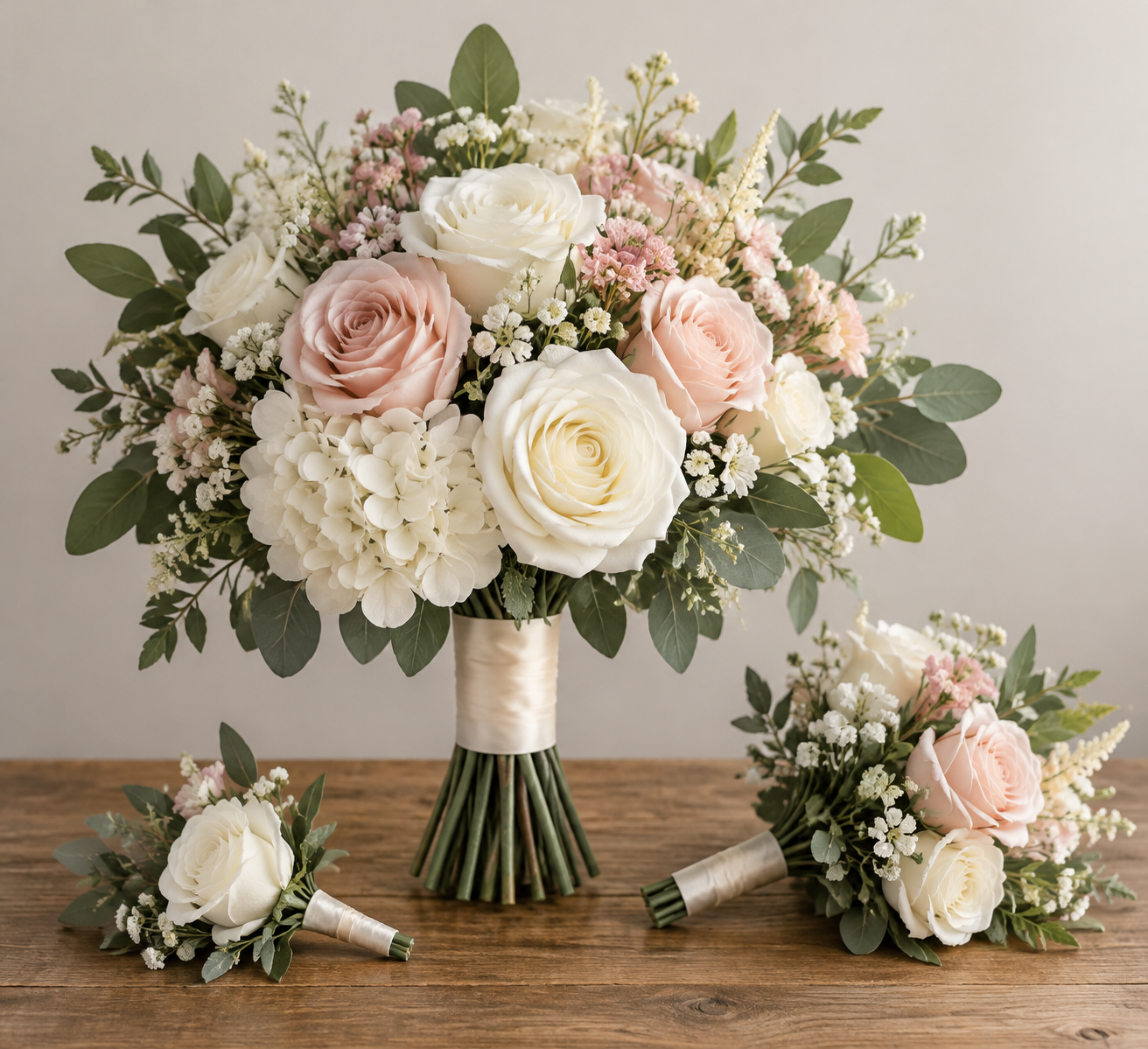
Order at 8 to 10 weeks out; swatch the palette-critical colors on arrival. Session one, three to four weekends before the wedding: build the practice bouquet (it becomes the toss bouquet — nothing is wasted) and all centerpieces, every piece that improves with iteration. Session two, the week of: bridesmaid posies (they're faster once practiced), final fluffing, boxing by event and room. The buy-finished lane for everything this page talks you out of building — finished bouquets, corsages, arch kits — sits at wedding bouquets and the wedding flowers hub.
Frequently Asked Questions
How many flowers do I need for DIY wedding bouquets?
Per full round bouquet: 3-5 focal blooms, 6-10 secondary stems, 6-8 greenery, 3-4 filler. Bridesmaid pieces run two-thirds of a bridal recipe; boutonnieres are single stems. A ceremony order of 1 bridal + 4 bridesmaid + 8 boutonnieres lands around 90-120 stems — and plan 10-15 percent over whatever the recipe counts. Every bunch listing states its stem count and every box its yield table — 'yields 3 bouquets + 6 boutonnieres' means the box is packed to finish exactly those pieces, so the arithmetic is done at checkout rather than discovered mid-build.
Is DIY actually cheaper than finished bouquets?
With artificial stems, typically 25 to 50 percent below finished-piece pricing for the same party — a $149 box that yields 3 bouquets + 6 boutonnieres undercuts the finished equivalents by about a third. The savings hold only if you count honestly: add the tools (wire, tape, ribbon), the 10-15 percent stem surplus, and your time at whatever you'd pay yourself. It's labor economics, not magic, and the top-up trap is what kills DIY budgets elsewhere (buying a second box because the first under-packed). The yield table keeps the budget arithmetic honest: cost per finished piece, printed, before you buy — and corsages and boutonnieres, where first-timer failure rates are highest, are usually cheaper bought finished.
Which wedding flowers should I DIY and which should I buy finished?
DIY the centerpieces (near-failure-proof with a grid vase) and the bouquets (one practice run and you're competent — the practice piece becomes the toss bouquet). Buy finished the corsages and boutonnieres: the taping and pin mechanics defeat most first-timers and finished pieces are inexpensive. Buy arch florals as pre-arranged kits rather than custom-building large pieces on site — kit sections turn a 2-4 hour install into zip-ties, not floristry.
Will there be enough greenery in the box?
It's counted, on the box: the ratio table lists greenery stems as their own line next to focals, secondaries and filler. The complaint that haunts this category — a box that photographs fuller than it packs, greenery short, a mid-wedding top-up run — is exactly what the printed yield table is for. If your trial build runs thin on any line, single-bunch top-ups in the same colorway are sold by count, and ordering them three weeks out still beats the story of buying extra flowers the week of the wedding.
How far in advance should DIY materials arrive?
Order 8 to 10 weeks out; materials in hand at least two weeks before the wedding — standing policy for wedding orders, buffer built into checkout — and three to four weeks out is the comfortable staging plan. Faux keeps indefinitely, so early ordering carries none of fresh's spoilage risk. That window covers the swatch round for palette-critical colors, the trial bouquet with a daylight color check against attire, a counted top-up if the trial runs thin, and boutonniere rows built in a single matching sitting.
What supplies do I need beyond the stems?
The working kit is short: floral tape, 22-gauge wire, sharp stem cutters (not household scissors — they crush wired stems), ribbon for wraps, and zip ties for arch kit sections. Vase grids eliminate most centerpiece arranging. Every box lists its included tools on the contents card — tape type specified — and supply kits bundling the whole list exist on the craft pages, alongside wired ribbon by width and colorway.
How do you wire a bouquet with faux stems?
Spiral and tape: hold the first focal at the angle you want, add stems one at a time rotating the bundle, wire the spine with 22-gauge where stems are soft, wrap with floral tape pulled taut to activate, then ribbon over the tape. Wired faux stems are more forgiving than fresh — bend them back if the angle drifts, no stem wasted. Every box and bunch listing links the wiring walkthrough for its piece type (round, cascade, hand-tied); the sample box is the cheap way to practice the spiral once before committing the wedding build.
Can I mix DIY and store-bought wedding flowers?
Not just can — should. The strongest version of DIY wedding florals is hybrid: build the centerpieces and posies where practice pays off, buy finished the pieces where failure is expensive (the bridal bouquet if you'd rather not risk it, corsages always), and take arch kits for the big surfaces. Order everything in one batch for palette consistency across the DIY and finished pieces alike — same dye-batch rules either way.
What if we'd rather skip the build?
That's what the finished line is for — the same materials, wired and wrapped by the build team, delivered in shaped boxes: wedding flower packages at three bundle levels, or finished bouquets piece by piece. DIY stays the right call for the labor-arbitrage budget and the couples who want the build night; the finished pages are for everyone else. Same palettes, same dye-batch rules either way.