

Yellow Artificial Flowers
Yellow is the room-brightener — the color interior designers reach for when a north-facing room needs light no lamp gives. This collection runs from golden sunflowers with real presence to soft butter and cream-yellow tones that warm without shouting: stems for your own vases, potted pieces, and finished arrangements for counters and mantels. Bloom, greenery and stem materials are stated on every card.
Quick answer: Yellow runs three volumes: golden sunflowers carry a kitchen or mantel alone, soft butter and cream yellows warm bedrooms and nurseries quietly, and yellow-and-white daisy mixes brighten with the lightest touch. Stems run 18–24 inches from $13, potted pieces 8–14 inches at $29–58, finished arrangements $40–180 (as of October 2026, USD) — the one color that adds light rather than just color.
The 30-Second Yellow Pick
- Start here: pick the volume — golden sunflowers carry a kitchen or mantel alone, soft yellows warm quietly, and yellow-and-white mixes brighten the lightest touch.
- Materials per piece: fabric, PE-film or latex-touch petals, wired stems — stated bloom, greenery and stem separately on every card.
- Heights: stems 18–24 in for your own vases; potted pieces 8–14 in; finished arrangements 10–20 in — exact H×W per listing.
- Price band: single stems from $13, potted pieces $29–58, finished arrangements $40–180; free US shipping over $200.
Why yellow, and where it works hardest
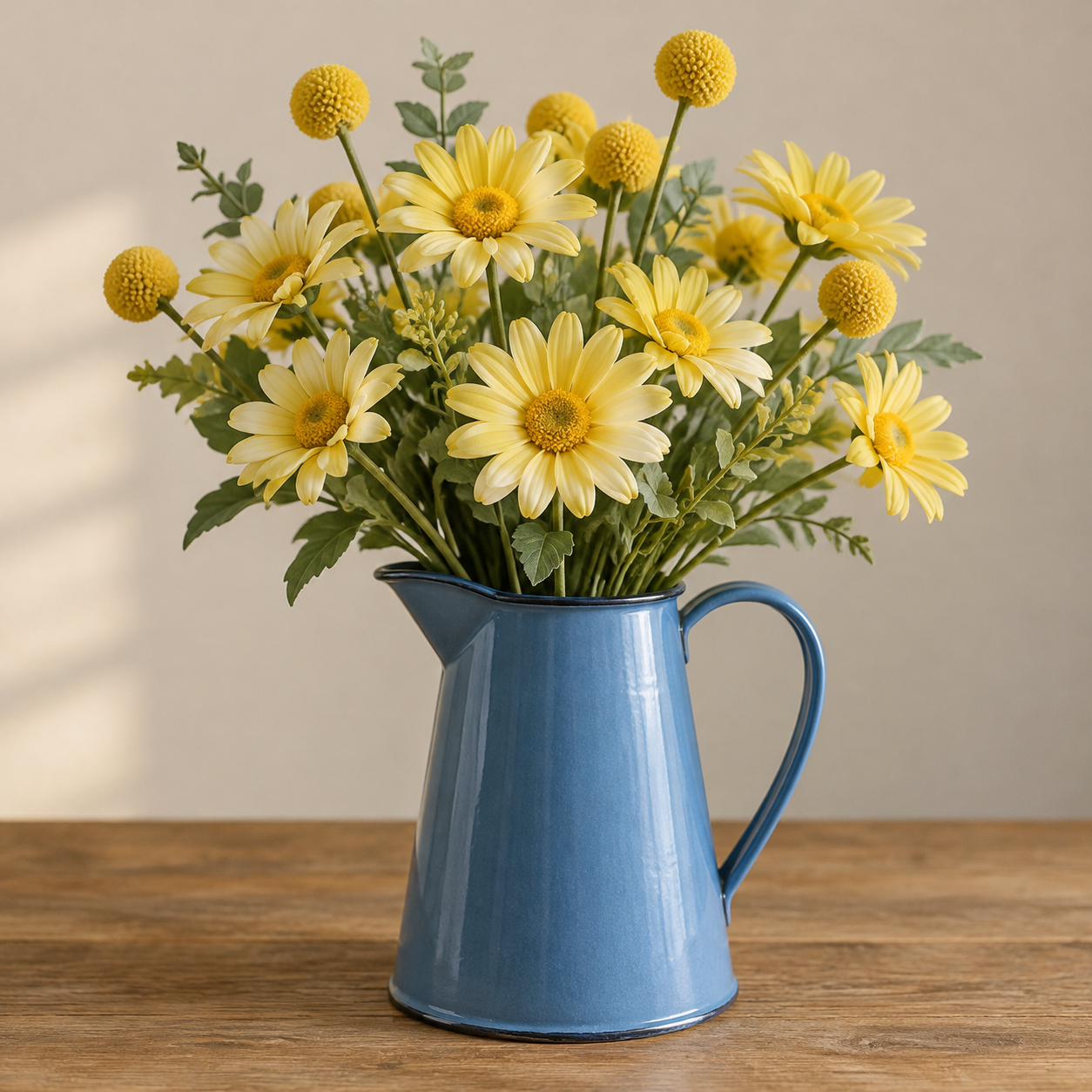
Yellow does a job no other flower color does: it adds light. In north-facing rooms and short-winter months, decorators use yellow as compensation — the counter-intuitive trick of British cottage interiors for generations. Kitchens are its home turf (sunflowers on the counter is the classic), and soft yellows do the same work in bedrooms and nurseries at lower volume. One honest caution: yellow is the fastest color to read seasonal — golden tones pull fall, daisy mixes pull spring — so anchor with greenery if the piece lives out year-round.
How to Choose Yellow Faux Flowers
Four decisions — volume before everything, because yellow sets a room's energy level.
- How much yellow?
One golden sunflower bunch carries a whole kitchen; soft yellows tolerate spreading (nightstand plus shelf plus counter). The more yellow mass, the more energy a room reads — decide how much lift the room actually needs.
- What room is it for?
Kitchens and dining rooms pull the golden group; bedrooms and nurseries take soft yellows; low-light studies and hallways take either, that being yellow's whole job. Yellow tulips have their own species page.
- How close will people stand?
Kitchen counters are arm's-length territory — and kitchens are where fresh flowers die fastest (heat, drafts, no watering discipline). Faux wins the room structurally; for the close-range pieces the latex-touch line is the standard.
- Daylight or lamplight?
Yellow is the least lighting-sensitive flower color — it reads warm under every bulb, which is half of why low-light rooms use it. Golden versus butter depth still shifts under warm lamps; judge the card's warm-lit photo if the piece lives under evening light.
Frequently Asked Questions
What do yellow flowers do for a room?
Yellow adds light and energy — decorators treat it as the compensation color for north-facing rooms, short winters and dark hallways, where it does work no lamp quite manages. It reads cheerful without the formality of red or the coolness of blue. The depth sets the volume: golden yellow energizes a kitchen, butter and cream yellows warm a bedroom at a third of the intensity. Yellow's meaning associations — friendship, spring — ride along, but the brightness is the working part.
What colors go well with yellow artificial flowers?
Yellow with white is the spring classic — daisy mixes are pre-built that way. Yellow with grey is the modern graphic pairing (one golden bunch against a grey wall); yellow with brown wheat, seed heads and rust tones is the fall version. The combination to use sparingly is yellow with orange — neighboring colors that merge into one loud block unless separated by greenery or cream.
What are yellow artificial flowers made of?
Each listing names its materials piece by piece: fabric petals (polyester blends), PE-film petals, or latex-touch petals, plus wired stems. Filler and greenery materials are listed too — they are cut at the same grade as the main blooms. Sunflower centers deserve the close-up check: the seeded face is where budget versions flatten out, and the card photography shows it at petal-eye range.
How do I clean yellow artificial flowers?
A cool hair-dryer burst or soft brush weekly, and a barely damp cloth every couple of months. No water on latex-touch petals — wipe-only for those. Yellow holds up against dust visually better than white, but sunflower faces collect it in the crevices — the brush does the work there. The full method by material is in our cleaning guide.
Are yellow flowers good for kitchens?
The kitchen is yellow's best room, and faux yellow its best version: fresh flowers die fastest in kitchens — heat, drafts from the oven, nobody watering on schedule — while faux needs no water and ignores the temperature. Placement note: keep pieces off the wall directly above the cooktop, where steam and grease film dust into grime; a counter or open shelf a few feet away keeps the piece clean for months between brushings.