

Fall Wreaths
Autumn wreaths on grapevine, mesh, and evergreen bases, sized 18 to 36 inches for doors, mantles, and covered porches. Styles run from September harvest tones to Halloween black-and-orange to Thanksgiving neutrals. Every listing photo shows the exact single wreath you receive.
Quick answer: Fall runs September through Thanksgiving — one harvest-neutral wreath covers all three months, or swap: harvest tones early, black-and-orange for October, neutrals for November. Fresh wreaths run $50–90 and compost by mid-November; artificial builds at $40–150 USD (as of October 2026) re-hang every September. Size 22–24 inches on a standard 36-inch door, spanning half to 70% of door width.
Fall Wreaths, Explained
What a fall wreath is
A fall wreath is an autumn doorpiece built on a fixed ring — grapevine, deco mesh, or evergreen — dressed with harvest materials: sunflowers, wheat stalks, maple leaves, cotton bolls, mini pumpkins, berries, and burlap ribbon. It is the longest-season wreath on the calendar: one neutral harvest piece works from the first week of September straight through Thanksgiving, or you can run a swap — warm harvest tones in early fall, black-and-orange for October, back to cream-and-tan neutrals for November. Three months, one hanger.
On build quality: greenery and filler on every wreath in this collection are specified at the same material grade as the main blooms — the wheat stalks, inner leaves, and backing are not a cheaper afterthought, which is exactly where low-grade wreaths fail at handshake distance.
Fall wreath sizes vs. door width
Size follows the door, and fall is the season where over-sizing hurts most — a wreath that swallows the panel fights with the season's color instead of framing it:
Working rule: the wreath spans half to seventy percent of the door's width. The wreath size calculator settles the exact number from two tape measurements, every product page lists the measured diameter, and every listing photo shows the single wreath you receive, flat, with a tape reference — intertwined pairs and borrowed props are called out as such or kept out of frame.
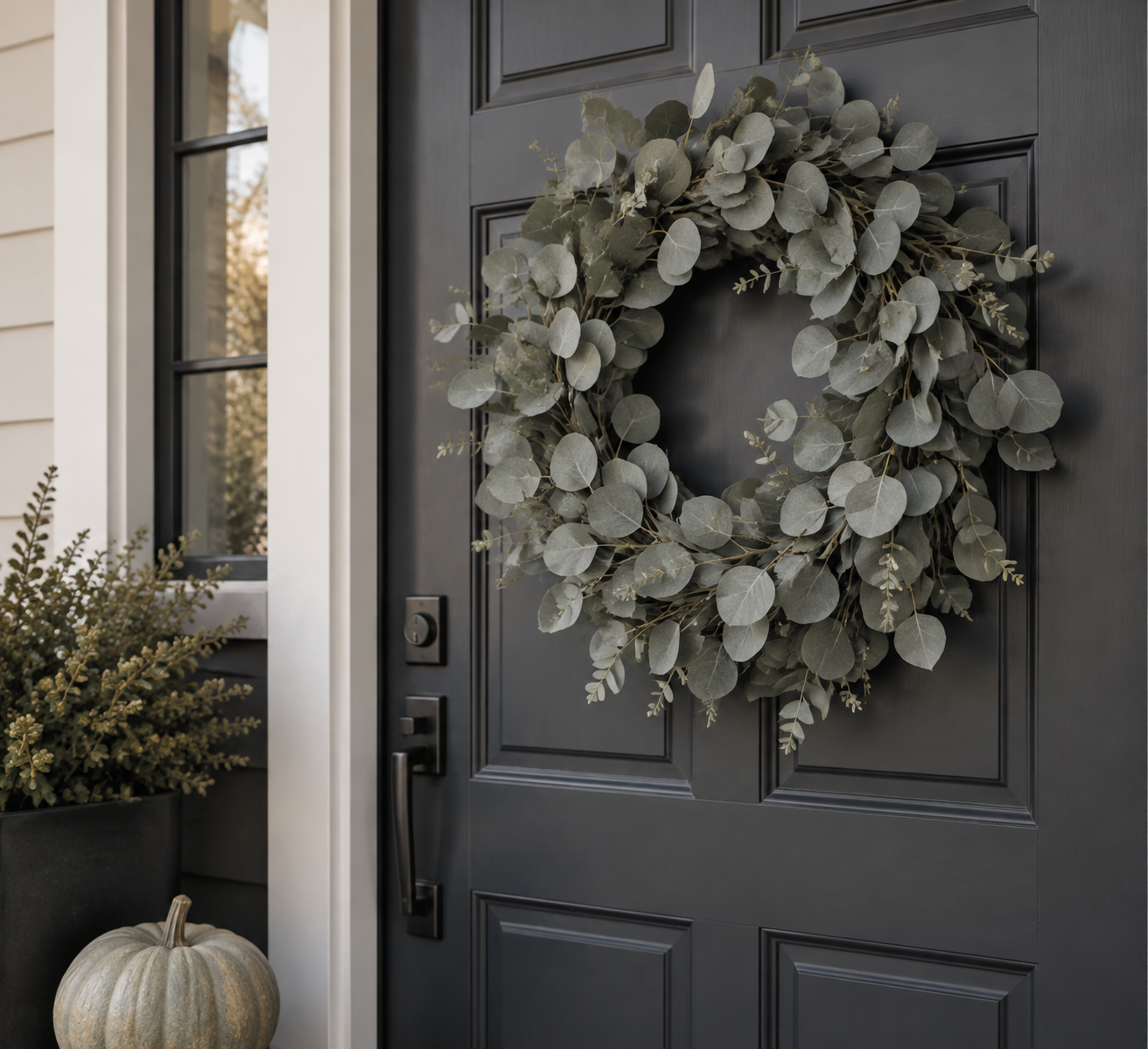
Where to hang one
The front door is the anchor spot, but fall wreaths earn their keep elsewhere: centered above the mantle with candle lanterns, on a kitchen window, wired to a stair rail, or laid flat as a table base around a pumpkin stack. Covered porches take any style in the collection; on fully exposed doors, dense grapevine and mesh builds shrug off wind better than airy wheat-only pieces, and storms are worth bringing the wreath in for.
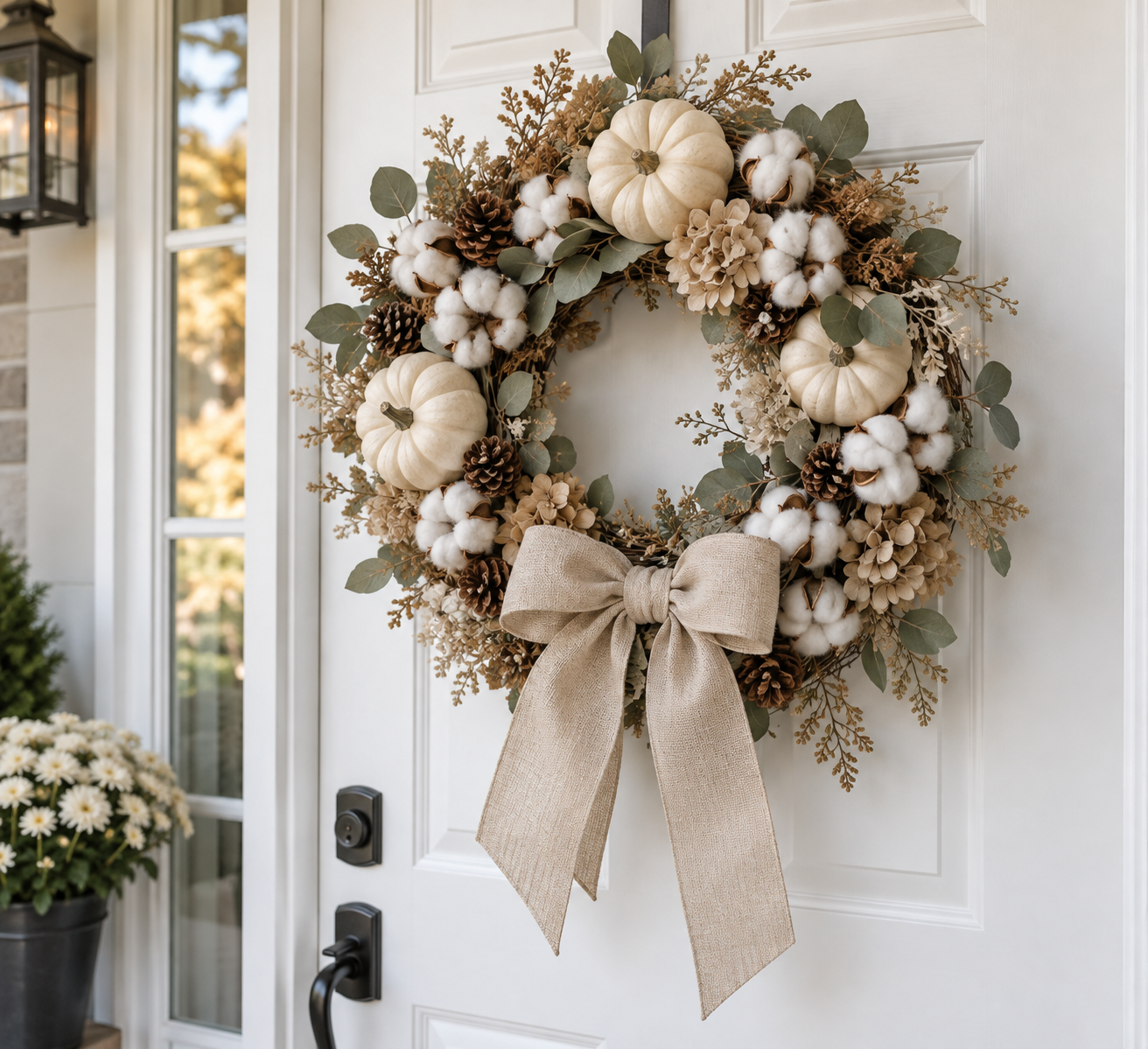
Cost per season, not cost per order
A fresh autumn wreath from a market or lot typically runs $50–90 (USD, as of October 2026) — comparable fresh-farm lines run higher into fall; 1-800-Flowers' fall decor collection, checked October 2026, opens near $60 — and is compost by mid-November, then you buy it again next year. An artificial fall wreath at $40–150 comes out of its storage box every September for years: nothing browns, drops, or sheds wheat on the mat. Amortized across even five autumns, the per-season cost lands well under the fresh-wreath habit, and the style stays identical year over year — useful when the rest of your fall styling is already set. That is the honest pitch: one purchase, many Septembers.
What arrives in the box
Each wreath ships in a shaped box with inner supports holding the ring round; expect about five minutes of fluffing — bending wheat stalks and leaves outward — before it photographs right. That is stated plainly on every listing rather than dressed up. Multi-piece listings carry their piece count in the title and photo captions: a Set of 2 means one wreath and one garland, a single means one wreath.
Assembly checks: glue lines are specified invisible at half a meter, and flower heads, cones, and wheat clusters get a pull test before boxing — the inspection checklist is being published as photography, not fine print.
How to Choose a Fall Wreath
- Pick your season window first. One harvest-neutral wreath covers September through Thanksgiving; if Halloween is a big deal at your address, plan a swap week — black-and-orange in October, neutrals on either side.
- Match the wreath to the door. 22–24 in. on a standard 36-in. door, 18–20 in. on narrow or interior spots, 30 in. on grand entries — the wreath should span half to two-thirds of the door width.
- Pick the base. Grapevine reads rustic and lets sunflowers and cotton sit proud; deco mesh carries saturated color; evergreen gives a dense backdrop for maple leaves and berries.
- Plan the placement. Covered porches take anything; exposed doors favor dense builds, and airy wheat-heavy styles are happier indoors or sheltered.
- Buy for reuse. A sturdy base plus one storage box equals the same door look next September — and check piece counts on sets so you know exactly what arrives.
Frequently Asked Questions
When should I hang my fall wreath — and take it down?
The season runs roughly Labor Day through Thanksgiving: early September for harvest styles, mid-September if you are pacing a Halloween swap, and down after Thanksgiving dinner when the Christmas pieces come out. There is no rule forcing a single wreath for all three months — the common pattern is one warm harvest wreath for September, a black-and-orange piece for October, then either back to the harvest wreath or straight into winter greens. Buy two hangers and the swap is a thirty-second job. The whole point of an artificial base is that every one of these pieces goes back in its box for next year.
What's the difference between harvest, Halloween, and Thanksgiving styles?
Harvest styles lean on neutrals and field materials — wheat, sunflowers, cotton bolls, burlap, buffalo check — and work all season. Halloween styles go explicit: black-and-orange palettes, spider webs, small ghosts, candy-corn accents; they read as costume, so most households run them just two to four weeks. Thanksgiving styles sit back at dressed-up harvest — richer reds, mums, magnolia leaves, deeper oranges — sized up for mantle and table duty. If you are buying one wreath only, buy harvest and let it span all three months; buy two, and the Halloween swap is where the second one goes.
What size fall wreath do I need?
For a standard 36-inch front door, 22–24 inches is the sweet spot — reads from the curb without swallowing the panel. Narrow doors, interior walls, and windows take 18–20 inches. Grand entries, single doors with sidelights and 38–48 inch doors carry 30-inch pieces — that size also layers well with a garland or lights — and 48-inch-plus doors and double doors take 36 inches, or two matching 22–24 inch wreaths hung at identical height, one per panel. Quick rule: the wreath spans roughly half to about seventy percent of the door's width — and the wreath size calculator settles the exact number from two tape measurements. Every product page lists the measured diameter, and each listing photo shows the single wreath flat with a tape reference, so you can confirm the scale before it ships.
Can a fall wreath stay outside all season?
Under cover, yes — a wreath on a porch or door with an overhang will run September through November without complaint, and dense grapevine or mesh builds handle wind better than airy wheat-only pieces. What ends an exposed wreath's season is weather: driving rain, snow, and weeks of direct sun are hard on any artificial botanical. The practical pattern for fully exposed doors is to bring the wreath in during storms and at the season's end, then box it dry. We do not claim weather immunity — treat an exposed wreath like a seasonal flag and it returns for years.
How do I store it until next fall?
Keep the shaped box it arrives in — that is the cheapest storage you will ever get. Let the wreath dry fully if it has been out in damp weather, give it two minutes of fluffing so branches and wheat sit outward, then box it flat with the inner supports in place and store it somewhere dry and cool; avoid hot attics directly under the roof. Nothing shrivels or browns in the box, so next September the piece comes out looking like it did this year. Stored this way, the same wreath decorates the door for many seasons, which is the entire value case for buying artificial.
What are these wreaths made of?
Three components, listed per product: the base ring (grapevine frame, deco mesh ribbon, or evergreen boughs), the harvest dress (fabric and PE blooms, preserved-look wheat, maple leaves, cotton bolls, berries, wired ribbon), and the backing. The collection standard: filler and greenery are cut at the same material grade as the main blooms — the inner leaves and wheat are not a cheaper afterthought, which is where low-grade wreaths get caught at close range. Glue lines are specified invisible at half a meter, with heads and clusters pull-tested before boxing.