

Floor Vases
Floor vases for corner-scale statements — tall ceramic, glass and metal bodies from 18 to 40 inches, weighted and wide-based to carry branch builds that fill the vertical space furniture can't. The format that turns dead corners into architecture, with base width stated on every listing, because a tall vase is a physics problem first and a decor decision second.
Quick answer: Size a floor vase to the wall, not the stems: 18–24 inch bodies flank sofas and consoles, 28–36 inch pieces anchor empty corners, 36–40 inch columns own two-story foyers. Arrangements run 2–3× vase height — a 30-inch vase makes a 6–7-foot statement. Keep the base at least a quarter of vessel height; ceramic bodies at 8–20 lb self-anchor.
Size to the Wall, Not to the Stems
Floor vases fail by proportion more than any other format — an 18-inch piece in a two-story entry reads like a forgotten prop, and a 40-inch column in an 8-foot room wears the room. The placement map, with the heights each zone carries:
The beside-chair and entry-nook band is where most tall-floor searches land; the corner-and-hearth anchors read from across the room; and the near-columnar 36–40 inch statements are for double-height walls where the vessel itself is the room's vertical line. Every listing states height with the base width beside it — the two numbers that decide fit.
The stability spec nobody checks until something tips
A floor vase with a tall branch build is a lever, and every doorway draft pulls the handle. The specs that matter, in order: base diameter — the working rule is at least a quarter of the vessel's height for branch-carrying pieces, so a 32-inch floor piece wants an 8-inch base or better, wider still for homes with children and large dogs, and wider bases win at any height (a 10-inch base carries twice the lean of a 6-inch one). Body weight — thick ceramic at 8–20 pounds largely anchors itself, and weighted composites hold what thin glass can't. Interior ballast — a pebble, sand or river-stone layer in the bottom third adds the mass the design forgot; the tall-glass listings here note their recommended filler weight, which is often just a few pounds. Slammed doors, passing vacuum cleaners and cats are the three real-world load tests; buy for the third one.
Branch and grass stems for tall builds run at loose flower stems; the full engineering logic sits on the vases for artificial flowers page.
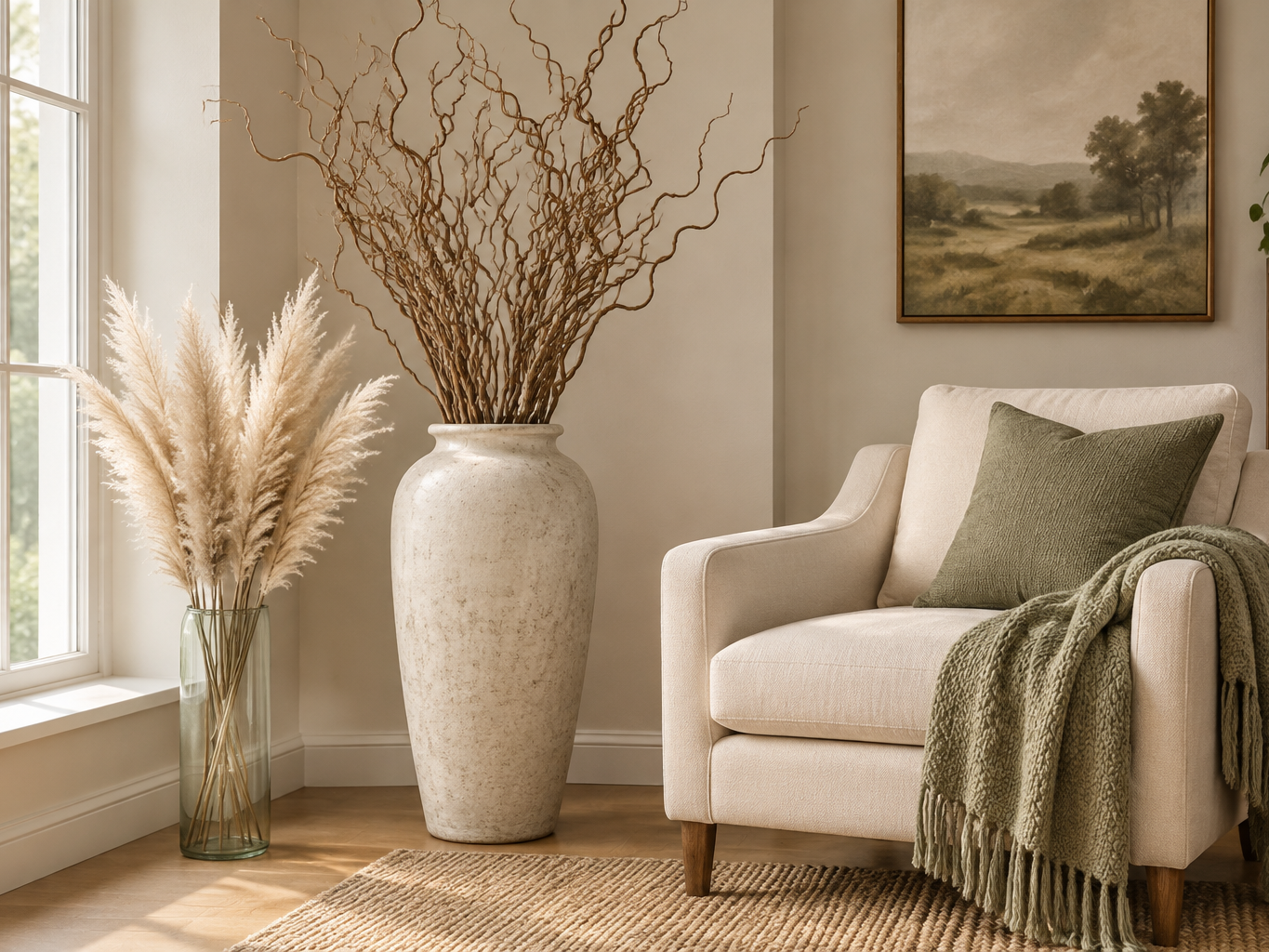
What Goes in a Tall Floor Vase
The question tall-vase shoppers actually ask, answered by scale. Branches first: faux manzanita, curly willow and birch at 4–6 feet are the native content of 30-inch-plus pieces — three to five stems, crossed at the base. Pampas and plumes — one to three stems — turn a corner soft, and the tall vessel's easy-access opening makes de-dusting them a feature. A single oversized branch or lily-cluster topper reads sculptural in a slim neck. What does not work: short-stemmed blooms, which drown below the neck of a deep vessel — a 12-inch riser or an upturned smaller vase inside lifts them back into view — and heavy-headed stems in light tall glass without the weighted filler noted above. Bird of paradise and gladiolus-height botanicals also carry at this scale; thin bloom stems meant for table vases look lost at five feet.
Materials at Floor Scale
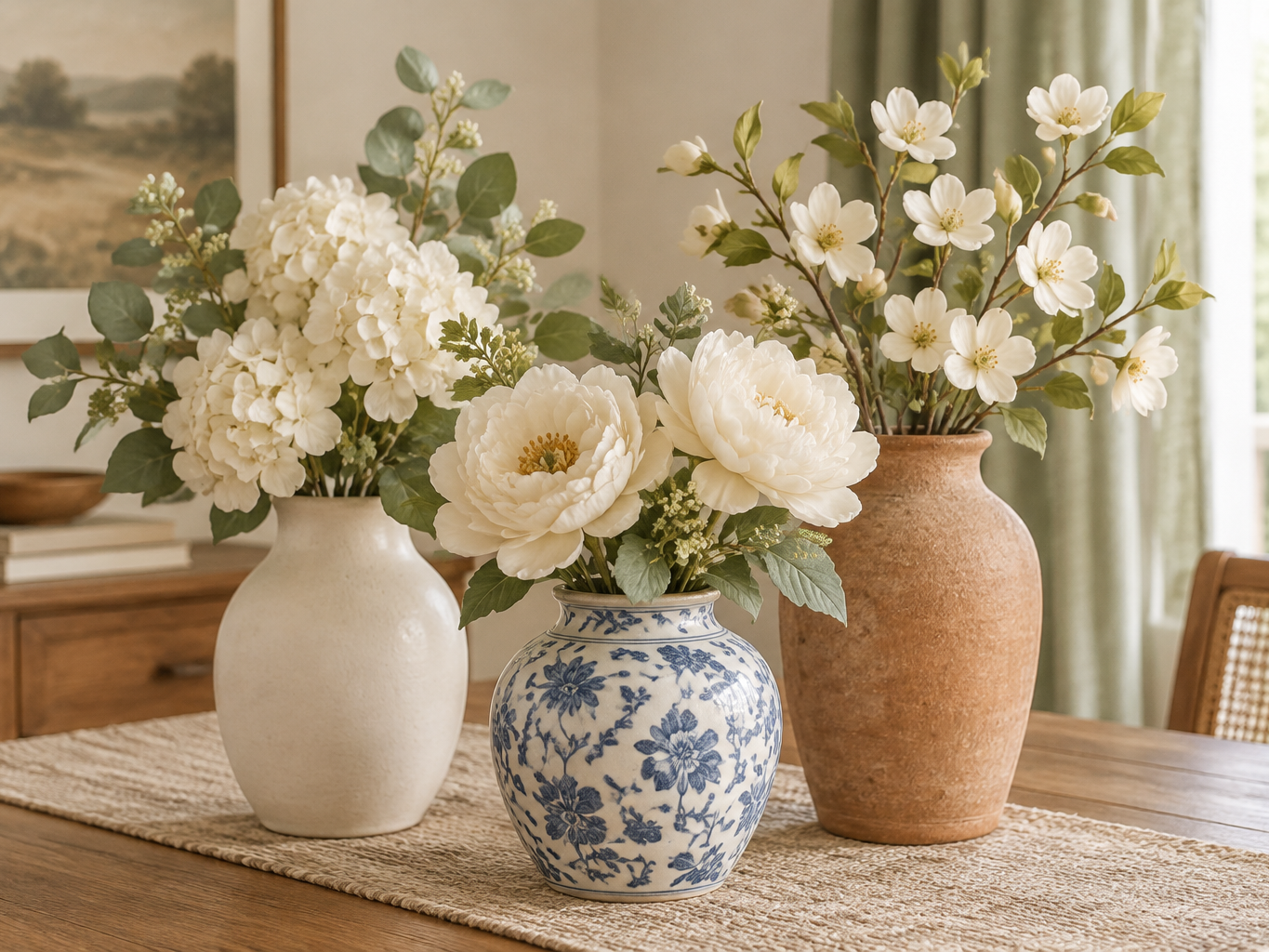
At 30 inches and up, material behavior diverges sharply from tabletop. Ceramic and weighted composites are the structural choice — heavy bodies at 8–20 pounds, opaque (foam and ballast invisible), and the widest stable bases in the family; floor ceramic is its own search family, and the filter serves it. Tall glass columns are the light-play choice and the risk choice: they glow near windows but need the widest bases, careful placement away from traffic, and the stated filler weight at the base — at 30 inches, thin glass stops being an option, and wall thickness is listed per piece. Metal shrugs off knocks — the choice for busy entries. Terracotta-style bodies round out the rustic end, decorative-only and honest about it. Woven seagrass and rattan run beautiful and light — indoor placement only, and they want a liner or a dense foam block because open weaves shed ballast. The all-purpose answer for real rooms with real traffic remains the weighted ceramic body.
The corner formula: one vessel or three. A single 32-inch statement anchors a corner by itself; a trio reads fuller — tallest at 36-plus, a 28 beside, a 20-inch mid stepping forward, triangular footprint, odd numbers doing what odd numbers do. Placement follows architecture: flanking a fireplace, beside the sofa's arm, in a lamp's shadow line. Pieces in this band run $40–120+ USD as of October 2026 — the vessels line's highest band, and the one where base-width and weight numbers earn their print.
The rest of the vase system at table scale: ceramic, glass, cylinder, centerpiece and bud vases.
How to Choose a Floor or Tall Vase
- Measure the corner before the vase. 18–24 in. for beside-sofa and console accents; 28–36 in. for corner and hearth anchors; 36–40 in.+ for foyers and double-height walls. The finished display runs near 2–3× the vessel's height.
- Run the base-width math. Base ≥ 1/4 of height for branch-carrying pieces (32-in. vessel → 8-in.+ base); wider for kids and dogs. Base width and weight print on every listing — the pair that prevents the tip-over.
- Choose content before vessel. Branches (4–6 ft, 3–5 crossed stems) want tall necks and heavy bases; pampas (1–3 stems) wants wide easy openings; short stems need a 12-inch riser or upturned vase inside — match the vessel to what it will actually hold.
- Pick the material for the traffic. Ceramic (8–20 lb) self-anchors — the mid-range default; thick-walled glass for lit columns and console pairings (thickness listed); metal for entries with real traffic; decorative-only terracotta styles for dry stems.
- Plan the freight reality. Large-format pieces ship in oversized protective packaging (spec being confirmed with suppliers, printing per listing once set), and tall glass carries the strictest handling notes in the line — the dimensions are the logistics.
Frequently Asked Questions
How tall should a floor vase be?
Size to the wall, not the stems: 18–24 inches beside sofas and consoles (the band most tall-floor searches land in), 28–36 to anchor a corner or flank a hearth — the room reads these from across the floor — and 36–40 reserved for foyers, stair landings and double-height walls with the ceiling to take a 7-to-9-foot finished arrangement. The failure is always proportion — an undersized piece in a tall space reads like a prop, and an oversized column in a low room wears the room.
What do you put in a tall floor vase?
Content that matches the scale. Branches are the native answer: faux manzanita, curly willow and birch at 4–6 feet, three to five stems crossed at the base of a 30-inch-plus vessel. Pampas and plumes — one to three stems — soften a corner and ask only an easy-access opening. A single oversized branch or lily-cluster topper reads sculptural in a slim neck. What doesn't work: short-stemmed blooms, which vanish below the neck of a deep vessel (a 12-inch riser or an upturned smaller vase inside lifts them back into view), and heavy-headed stems in light tall glass without weighted filler at the base.
How do I keep a tall floor arrangement from tipping?
Three specs, all printed per listing: base width, weight, and (for tall glass) recommended filler weight. The base-width rule — at least a quarter of the vessel's height for branch-carrying pieces — does the geometry; a 32-inch vessel wants an 8-inch-plus base. Weight does the rest: ceramic bodies at 8–20 pounds largely anchor themselves, while slender tall glass wants weighted filler at the base — sand, pebbles or river stones to the listing's stated weight, often just a few pounds. And if the household includes children or large dogs, move up a width band: the rule is a floor, not a target. The real-world load tests are slammed doors, vacuum cleaners and cats; a vase bought for the cat test stays standing through the other two.
Are tall glass vases practical, or is ceramic the safe choice?
Both, for different rooms. Tall ceramic is the default and the physics pick — its 8-to-20-pound body self-anchors, hides filler and risers, and shrugs off the vacuum cleaner. Tall glass earns its place where light matters: a lit-branch display, a console-and-mirror pairing, a bright corner where a column of clear glass disappears and the content floats. Practicality at 30 inches of glass comes down to the specs printed per listing — wall thickness (thin glass stops being an option at this height), the recommended filler weight for the base, and the handling notes. Choose ceramic for traffic, glass for light, metal for entries that see everything.
Should floor vases be used in pairs?
Pairs flank features — fireplaces, doorways, console walls — and want identical builds, because at this scale symmetry is the design. Single statements own corners and dead zones, where a pair would read as clutter. For fuller corners, the trio formula: tallest at 36-plus inches, a 28 beside, a 20-inch mid stepping forward on a triangular footprint. The working composition for large rooms is one corner anchor plus one pair flanking the main feature, rather than singles scattered at every vertical surface.
How do large vases ship — is oversized freight a problem?
Large-format pieces are their own freight lane: oversized protective packaging specified per piece, with the final spec (corner guards, double-walling, crate-for-crate decisions at the biggest sizes) being confirmed with suppliers — it prints on every listing once set rather than being promised here first. Tall glass carries the strictest handling notes in the vessels line, and shipping damage on any piece follows the same route: a photo and the order number brings a replacement or refund, no shards to pack and return. Oversized pieces may carry their own shipping notes at checkout; the $200 free-shipping line applies to the order, with any large-format exception printed at the cart before you pay, not after.