
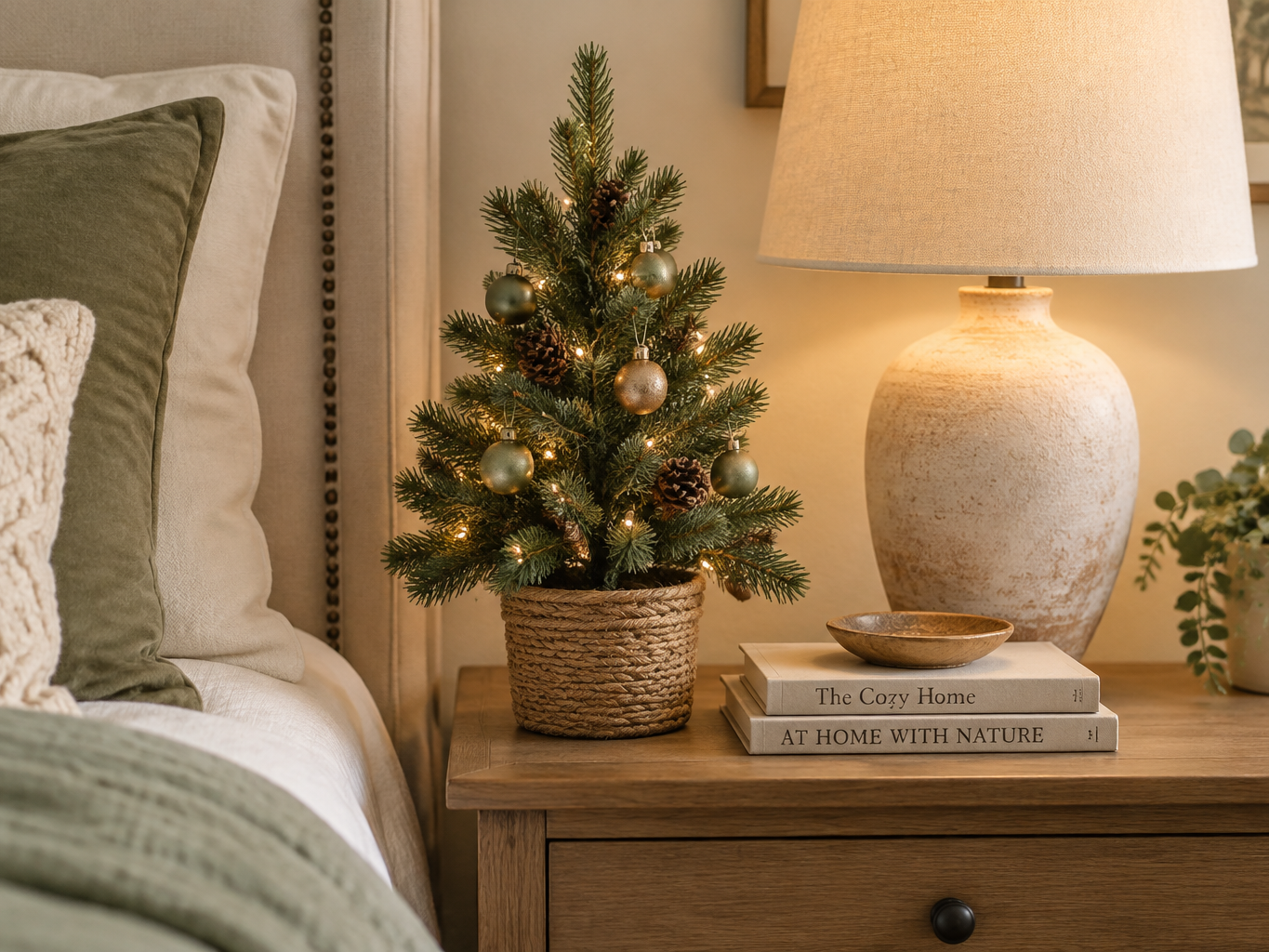
Small artificial Christmas trees from 2 to 4.5 feet: mini tabletop trees for desks, mantels, and side tables; 4 ft trees for entryways and small corners. Pre-lit and unlit styles, from $19, boxed for next December. The photo shows the actual tree at its actual height.
Small Christmas Trees, Explained
One page, every word for it
Small Christmas tree, mini Christmas tree, tabletop tree, 4 ft tree — the searches are four words for one shopping job, and retailers use them interchangeably, which is why size bands beat vocabulary here. This page holds the whole small range in artificial: 2-foot minis for desks and mantels, 3-foot tabletop trees for dining tables and consoles, and 4–4.5 foot trees for floor corners and entryways — everything below the full-size 6-footer. All of it is artificial, stated plainly: no watering, no needle drop, no disposal job in January, and the same tree boxes away and returns next December.
Tabletop trees (2–3 ft)
The tabletop band is where small trees do their best work. Two-foot styles (15–24 in.) are the statement units — one on a desk, a pair flanking a mantel or TV, the tree for a dorm, a studio, or a hospital room; at this size, sets of two and three minis make mantel runs. Three feet is the band's center and the most popular small size on the market: the dining-table centerpiece, the entry-console tree, the covered-porch greeting. Bases at this scale are part of the look — pot and urn bases read planted, burlap-wrapped reads farmhouse, and metal stands read utility — and every listing states which arrives. Battery pre-lit styles (warm-white LEDs at stated counts, timers built in) suit the tabletop band best, because table spots sit far from outlets.
4 ft trees for floor and entryway
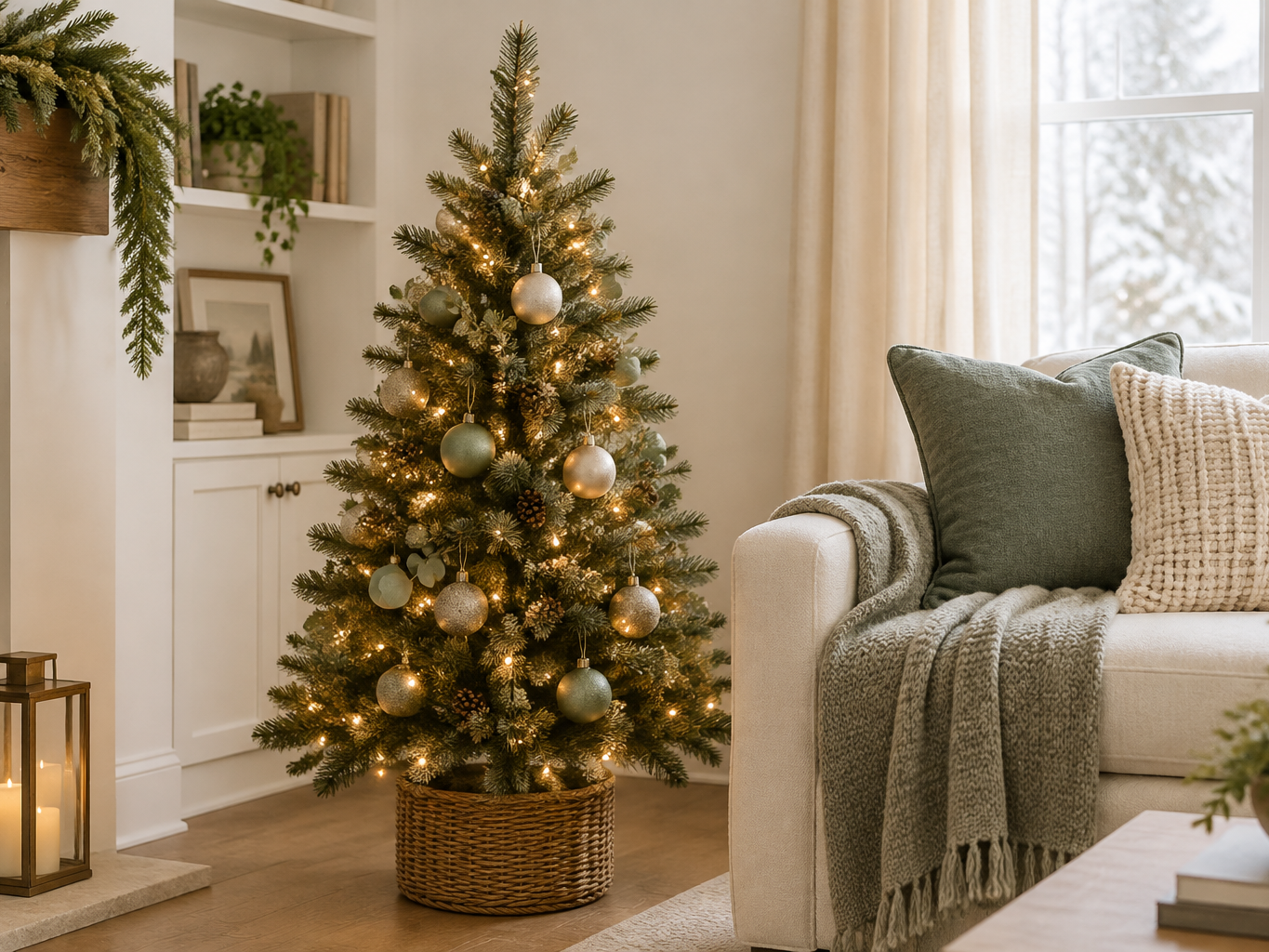
Four to 4.5 feet is the small range's ceiling and its own search word — the 4 ft tree — because it crosses from tabletop to floor. In an apartment corner it reads as the main tree without the 6-footer's footprint or price; in a house it is the second tree for the kids' floor, the playroom, or the covered entry, and in small-business settings it is the reception tree that decorates without blocking. Pre-lit 4-footers carry roughly 100 lights at the standard density; unlit styles take your own strands. Width runs proportionally slimmer than the big trees — around 30 inches across at 4 ft — so the corner it needs is a modest one.
Three jobs small trees do
First, the small-space tree: apartments, studios, offices, bedrooms, and senior living — a real Christmas tree scaled to a room that cannot host a 6-footer. Second, the tabletop decoration: dining tables, consoles, kitchen islands, and reception desks, where the tree is part of the December styling rather than the room's center. Third, the second tree: households with a main tree add small ones to bedrooms, kids' rooms, hallways, and covered porches — the fastest-growing use, and the reason sets and repeat buys dominate this size class. One purchase covers whichever job, and the same tree does a different job next year.
Lights, styles, and what arrives
The light question at small scale: pre-lit trees carry warm-white LEDs at stated counts — about 35 on a 2-footer, 50 on a 2.5, 100 on a 4 — on battery or USB power, which is the small-tree norm; unlit trees cost less and take your own strands. Styles run the four reads: classic green, flocked and frosted snow finishes, decorated styles with berries and pinecones pre-attached, and color trees in white, pink, and tinsel for kids' rooms and themed corners. Branch counts are the listed spec worth checking — more bendable branches, fuller tree after the same fluffing. Every tree ships compressed and needs its branches folded out and fluffed, a few minutes at this scale, and listings state that rather than promising a display-piece arrival.
Reuse, storage, and honest pricing
The small-tree arithmetic is the honest kind. Fresh small trees run cheap but expire; a small artificial tree at $19–149 by size and light option boxes up dry every January and returns — no watering, no needle sweep, no disposal — so year two costs nothing. Storage is the small-tree advantage: one bin holds a 2- or 3-footer whole, and even the 4.5 fits a closet shelf. For the full picture on the category — height spectrums, light options, and how the big-tree specs read — the main tree page carries the guide; and while the season runs, tree-plus-wreath bundles discount in the cart.
How to Choose a Small Christmas Tree
- Name the job first.
Small-space main tree, tabletop decoration, or second tree — the job sets the band before the style does.
- Pick the height band.
2 ft for desks and mantels, 3 ft for dining tables and consoles, 4–4.5 ft for apartment corners and entries — heights stated on every listing.
- Choose the light track.
Battery pre-lit at stated counts (~35/50/100 by size) for away-from-outlet spots; unlit for your own strands and color changes.
- Pick the style read.
Classic green carries any ornament set; flocked reads winter; decorated arrives finished; color trees make the kids'-room statement.
- Buy for the repeat.
$19–149 by size and lights, one storage bin, no disposal — year two is free, which is the whole case for artificial at this scale.
Frequently Asked Questions
What is the most popular small Christmas tree size?
Three feet, by a clear margin — it is the size that fills a dining table, entry console, or covered porch with actual tree presence while staying one-hand manageable. Two-foot styles are the desk-and-mantel statement units and the set pieces for runs; 4–4.5 feet is the fastest-growing band because it reads as a real tree for apartments and second-tree duty. The working rule this page uses: pick the band by the spot, not by preference — the tabletop band (2–3 ft) for surfaces, the floor band (4–4.5 ft) for corners and entries.
What types of small artificial trees are there?
Three axes describe the whole range. Height: 2 ft minis, 3 ft tabletop, 4–4.5 ft floor-and-entryway. Lights: pre-lit (warm-white LEDs at stated counts — roughly 35/50/100 by size — on battery or USB power) or unlit. Style: classic green, flocked and frosted snow finishes, decorated styles with berries and pinecones attached, and color trees in white, pink, and tinsel. Base style is the quiet fourth axis — pot and urn bases read planted, burlap reads farmhouse, metal stands read utility — and every listing states which arrives.
How long do battery lights last on a tabletop tree?
Through the season on a sensible timer routine. Small-tree battery packs run warm-white LED strings at low draw — the stated light counts are modest (about 35–100 by tree size) — so quality sets with the built-in 6-hours-on/18-hours-off timer run weeks to the season on one set of batteries, with brightness held rather than fading progressively. The honest guidance: buy batteries with the tree, switch to fresh at the season's start each year, and treat any specific month-count claim you see anywhere as dependent on the timer discipline — that is what actually sets the runtime.
Do small Christmas trees come pre-decorated?
Yes — that is one of the four standard style reads. Decorated styles carry berries, pinecones, and sometimes baubles attached at the factory, built for the zero-styling buy: out of the box, fluffed, done. Classic green styles are the opposite on purpose — blank canvases for your own ornament sets, which is how many households run a family-decorating ritual on the main tree and a decorated style on the second. Flocked finishes split the difference: a styled look with room to add. Listings state exactly what is attached, so the divide is visible before checkout, not a surprise in the box.
How do I fluff and shape a small tree?
Same ritual as the big trees, scaled down to minutes. Out of the box, fold out each branch and bend it down and out from the trunk, working around the tree once, then pull the branch tips apart so each stem separates — that two-pass fluff is what turns a shipped cone into a full tree. At 2–3 feet it is a five-minute job; at 4–4.5 allow ten. Lights stay on the tree through fluffing; work around them rather than through them. The tree ships compressed because that is how branch goods travel — listings say so plainly, and year two's fluff is a touch-up, not a redo.
Can I put a small artificial tree outside?
Under cover, yes — covered porches and entries are classic spots for the 3–4.5 foot styles, and the pot-based ones read planted out there. Fully exposed placement runs into the honest limits: rain, snow load, and weeks of direct sun are hard on any artificial botanical, and battery packs need protection from weather regardless. The practical pattern is covered placement, storm-night evacuations, and the box at the season's end. Nothing here is sold as weather-proof — treated like a seasonal flag, an outdoor small tree still returns for years.
Shop the Christmas Collection
Christmas Trees
Christmas Wreaths & Garlands
Christmas Greenery & Florals
Tools & Storage
Flower Guides
Ideas by spot — desks, windowsills, entryways, kids' rooms — each with size, lights, and budget tier; the three-jobs page copy expanded card by card.
The two-pass branch method, five minutes at 2–3 ft and ten at 4–4.5 — the full version of this page's fluffing FAQ.
The honest multi-year math — the reuse arithmetic behind 'year two is free', with a price table and three household budgets.
Tabletop trees as centerpieces — the 2–3 ft band's other job.