Artificial Plants
Quick answer: artificial plants do one job no live houseplant can — they hold a full, green silhouette through the dark corner, the vacation week and the low-humidity winter that kills the real ones, at the cost of no growth and an arm's-length texture. Size by spot: table builds run 12–24 inches, floor builds 36–72. As of October 2026, a quality faux statement plant runs $70–150 once (USD), against $40–150 for a live fiddle-leaf fig with a well-documented first-winter failure rate — the faux build is the cheaper path by the second replacement.
Artificial plants are whole plants — a potted fiddle leaf fig, a floor olive tree, a hanging pothos — built stem by stem into a finished form that arrives ready to place. Call them fake plants, faux plants or artificial plants; the search terms all point here, and so does the difference that matters: this page sells the whole plant, pot and structure included, not loose stems for arranging. Every listing states its numbers as ranges — height measured pot included, spread at the widest frond or leaf — so the corner you're filling is the corner you get.
Whole Artificial Plants, Sized and Stated Honestly
Whole plants, not loose stems
The greenery family splits at one line: loose stems and branches are arranging material — they live in our artificial greenery stems collection, sold by the stem for your own vessels. This page is the other side: finished plants. A faux plant ships as its whole self — leaves on structured branches, branches on a trunk or armature, roots in a nursery pot you can drop into any decorative planter you like. Both have their job. Stems are for people who arrange; whole plants are for people who place. Most homes end up owning both, and the collections below link to each other for exactly that reason.
The honest case: what faux plants do and don't do
The strengths first, stated without inflation: an artificial plant holds its exact purchased silhouette forever — no leggy growth toward the window, no yellowing lower leaves, no repotting seasons — and it survives the three things that kill real houseplants (dark corners, vacation dryness, winter heating drafts). The limitations, equally plain: it does not grow, photosynthesize meaningfully, or humidify a room, and its texture reads as botanical from across the room rather than leaf-by-leaf at arm's length. The buyers it serves best already know which side of that trade they need — the windowless bathroom, the north-facing office, the rental staging, the shelf that gets watered exactly never.
The economics make the case concrete. A real fiddle-leaf fig runs $40–150 as of October 2026 and carries a well-documented failure rate in the first winter; replacing it twice makes the $70–150 quality faux build the cheaper path by year two. Live-plant costs that faux eliminates entirely: soil, fertilizer, pots one size up each spring, and the watering calendar itself — and unlike the live plant, its size is guaranteed: the 48-inch ficus you buy is the 48-inch ficus you still have in five years.
Sizing by Spot: The Placement Chart
Plant size follows the spot's scale, with the same logic furniture uses — fill the vertical slot, leave the walking lanes:
The layering rule that makes a room read styled: one plant per visual layer — one floor anchor, one mid-height stand piece, one or two tabletop pieces — rather than five plants competing on one plane. Every listing states the measured height including the pot, because "48-inch ficus" elsewhere sometimes means the plant alone; the number here is the number that stands on your floor.
The species shelves
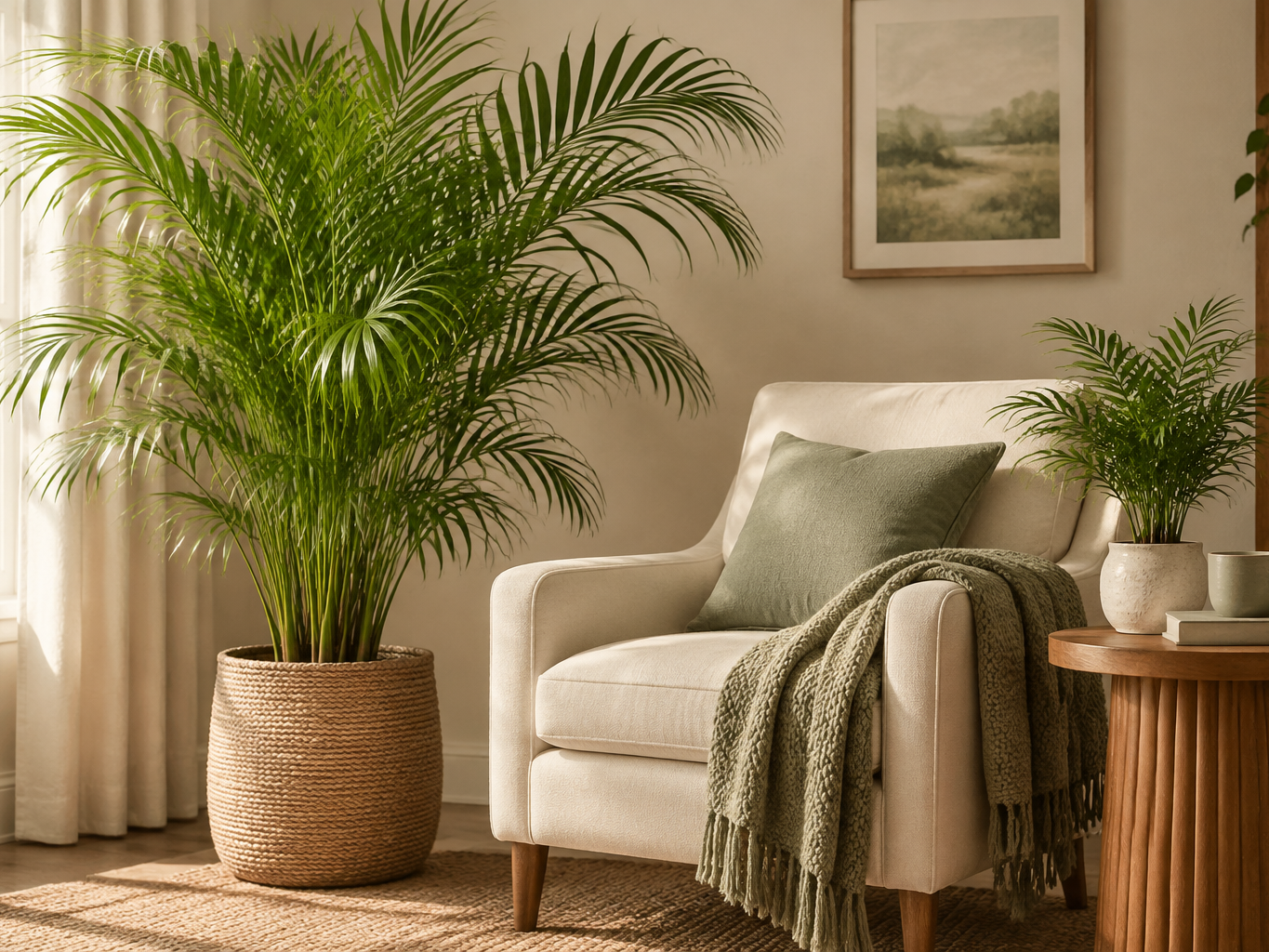
Below the grid, the collection breaks into species shelves so the browsing matches how people actually shop. Statement trees — olive and palm — have their own dedicated pages, where heights, pot styles and indoor-versus-outdoor use get the full treatment. Statement foliage — fiddle leaf figs, ficus and bonsai forms — anchors corners and reading chairs. Soft fillers — ferns and grasses — layer into shelves and console vignettes. Structural smalls — cactus and succulents — take the desk and windowsill spots where watering would be the first thing to forget. Hanging forms trail from shelves and brackets. Each shelf states the size ranges it runs, and listings link back to the shelf they belong to.
The varieties and what each reads as
Plant choice is a style statement more than a horticultural one here. Pothos and philodendron (trailing) read casual and fill high shelves by hanging. Monstera and bird of paradise (big-leaf) read tropical-modern and anchor light, minimal rooms. Snake plant and sansevieria (upright blades) read architectural and fit narrow slots — beside a door, between furniture. Olive and fiddle-leaf fig (tree form) read classic-Euro and contemporary respectively, and both carry the foyer-statement tier. Eucalyptus and fern read soft and romantic. Outdoor-rated versions of boxwood, grasses, and ivy live in the outdoor plants collection, where UV treatment — and its honest "slower, not never" fade boundary — is the spec that matters.
How a whole plant is graded
A finished fake plant earns its listing the same way everything in this store does — by stating what it is. Height is stated pot included, because that's the number your floor-to-ceiling check needs. Spread is stated at the widest point, because that's the number your walkway check needs. Pot diameter is stated, because that's the number your decorative planter check needs. Leaf material is stated — silk blends for soft foliage, PE molding for succulents and cactus where surface detail is the whole point. Our supply for the large-tree forms is being confirmed with manufacturing partners and will be stated per listing as those arrive; what's stated now is the grading rule, and it doesn't bend for any species.
How to Choose an Artificial Plant
- Pick the form before the species.
Floor statements fill empty corners (4 ft. and up). Tabletop pieces sit on consoles and nightstands (under 2 ft.). Hanging forms take the high shelves. The form decides the spot, and the spot narrows the species faster than any inspiration photo.
- Match the species to the light look.
Low-light corners read right with ferns, pothos-style trailers and snake-plant forms. Bright rooms carry fiddle leaf figs, olive and palm trees. Windowsill smalls — cactus and succulents — read at home in the sunniest spot in the house precisely because real ones live there.
- Read the three numbers.
Height pot included, spread at the widest point, pot diameter. Check height against your ceiling clearance, spread against walkways, and pot diameter against the decorative planter you already own. The stated number is what stands on your floor. Ranges are stated per listing — natural-style foliage is built with variation, and the range is the honest version of that.
- Stage one plant per layer.
Floor anchor + stand piece + tabletop; skip the plane of five. A trio at three heights reads styled where a row of same-size pieces reads stocked.
- Plan the spot's conditions.
Silk foliage wants indirect light and distance from radiators; PE-molded smalls tolerate both better. Covered porches and sunrooms want the UV-treated selections — the FAQ below covers what outdoor use honestly means for faux.
- Buy the form factor you can place today.
A potted plant in its nursery pot drops into any planter you like — that's the flexible route. Statement trees in fixed planters trade that flexibility for a finished look out of the box. Both are graded the same way; choose by how much styling you want to do.
Care: the two-minute month
No watering, no feeding, no repotting — the care routine for an artificial plant is placement and dust. A feather duster weekly on visible pieces, or a hair-dryer on its coolest setting held a foot away monthly to blow film out of leaf creases — never heat, which relaxes shaped leaves. Rotate a quarter turn every couple of months so any ambient light exposure evens out. For builds with real soil or moss tops, a light misting of water on the top dressing alone (not the leaves) keeps the "soil" reading natural — that is the only water an artificial plant ever gets. Direct sun through glass remains the one placement to avoid; colors soften on a couple of seasons of strong window light, the same physics as every artificial botanical. That's the whole routine — the reason people trade a watering can for a duster.
Frequently Asked Questions
Do artificial plants look convincing?
At the distances a room is actually viewed from — across the living room, down an entry hall — a quality build with dense, graded foliage reads convincingly, which is why staging professionals fill homes with them. Up close, at arm's length, leaf texture tells the truth, as it does for every artificial botanical. The tier where the gap is smallest: small tabletop pieces (succulents, mini pothos), where leaf detail is naturally small; the tier where it is largest: single large statement leaves (a big monstera leaf at handshake distance is the hardest sell in the category).
Where should I not use a fake plant?
Three placements underperform: on a bright sill right against glass, where the backlight silhouette exposes leaf texture and sun fades the build within a couple of seasons; at arm's-length focal spots — the bedside table you stare past daily — where the texture gap compounds; and as a single lonely piece in an otherwise empty corner, where any plant, real or faux, reads as an afterthought. Everywhere else — dark corners, high shelves, foyers, bathrooms, offices — the faux piece is not the compromise option; it is the one that survives.
What are the best fake plants for low light?
The dark-corner placements are exactly where faux runs the table, because the real-plant alternatives are shortlists — snake plant, ZZ plant, pothos — that merely tolerate low light, while the faux versions of anything (monstera, bird of paradise, olive) hold a full silhouette in a windowless bathroom. The styling note that sells the dark corner: put the plant's light source in the room instead — a picture light or uplight on the piece — because a lit faux plant in a dark corner reads designed, while a shadowed one reads stored.
Fake plants or real plants — which is cheaper over time?
The ledger as of October 2026: a real statement plant (fiddle-leaf fig, olive) costs $40–150 with a well-documented first-winter failure rate; the quality faux equivalent runs $70–150 once, with no soil, fertilizer, repotting or watering calendar. By the second replacement of the live plant, the faux build has cost less. The honest trade is still real: real plants give you growth, change and the ritual of care; faux gives you placement freedom — any light, any schedule — and stillness. Low-light rooms, busy schedules and statement-tree sizes favor faux (real 6-foot olive trees are a gardener's project); windowsills, herb spots and the joy of tending favor real. Many homes run both.
What sizes do artificial plants come in?
The range runs from windowsill to ceiling. Desk and windowsill smalls sit under 1.5 ft. — succulents, cactus, small bonsai forms. Tabletop pieces run 1.5–3 ft. — ferns, trailing pothos, small ficus. Floor pieces start near 4 ft. and run up through statement trees at 6–7 ft. plus. Every listing states height pot included, spread at the widest point, and pot diameter as ranges — measure the landing spot against the height line first, then check spread against walkways.
Can artificial plants be used outdoors?
Only the outdoor-rated builds — UV-treated boxwood, grasses, ivy and flowering pieces from the outdoor collection — because untreated indoor foliage fades fast in sun, and the honest spec on even UV-treated pieces is slower fading, not never. Covered porches and shaded patios are fair game for most pieces; open exposure wants the UV-treated line plus a weighted planter and drainage check, since wind tips tall forms and rain pools in pot bases. The exposure tiers for outdoor pieces — sheltered porch, partial sun, full exposure — run the same as for outdoor flowers: match the piece to its sun face and rotate or replace before the fade reads from the street.
How do I clean artificial plants?
Dust is the whole maintenance burden, and the program is two minutes a month: a feather duster pass weekly on visible pieces, and a hair-dryer on its coolest setting held a foot away monthly to blow the fine film out of leaf junctions — heat is off-limits because warmth relaxes the shaped leaves. For a deeper clean, silk-blend foliage wipes with a barely damp cloth and a drop of dish soap, then air-dries fully; PE-molded succulents and cactus rinse clean under the tap. Two don'ts: no hot water (silk curls) and no direct sun drying (colors shift). For pieces with real soil or moss top dressing, a light water mist on the dressing alone keeps it reading natural. The full method-by-material guide is linked below.
Do artificial plants come in pots?
They come in a nursery pot — a plain, stable base built into the plant's structure — which is the flexible route: drop it into any decorative planter you own, pack the gap with moss or foam if you like, and the plant stands finished. Statement trees and some floor forms ship in fixed decorative planters instead, trading that flexibility for a finished look out of the box. Each listing states which it is and the pot diameter either way, so the planter you're buying for fits before you order.
What's the difference between this page and your greenery stems?
Whole plant versus raw material. Everything here is a finished plant — foliage built onto branches, branches onto a trunk or armature, base included — ready to place as-is. Loose stems, branches and bushes are arranging material: bought by the stem, for your own vases, wreaths and arrangements, and they live in the artificial greenery stems collection linked below. If you want a corner filled today, shop this page; if you want to build something yourself, shop stems. The two collections link to each other because most homes do both.