
Artificial Magnolia Flowers
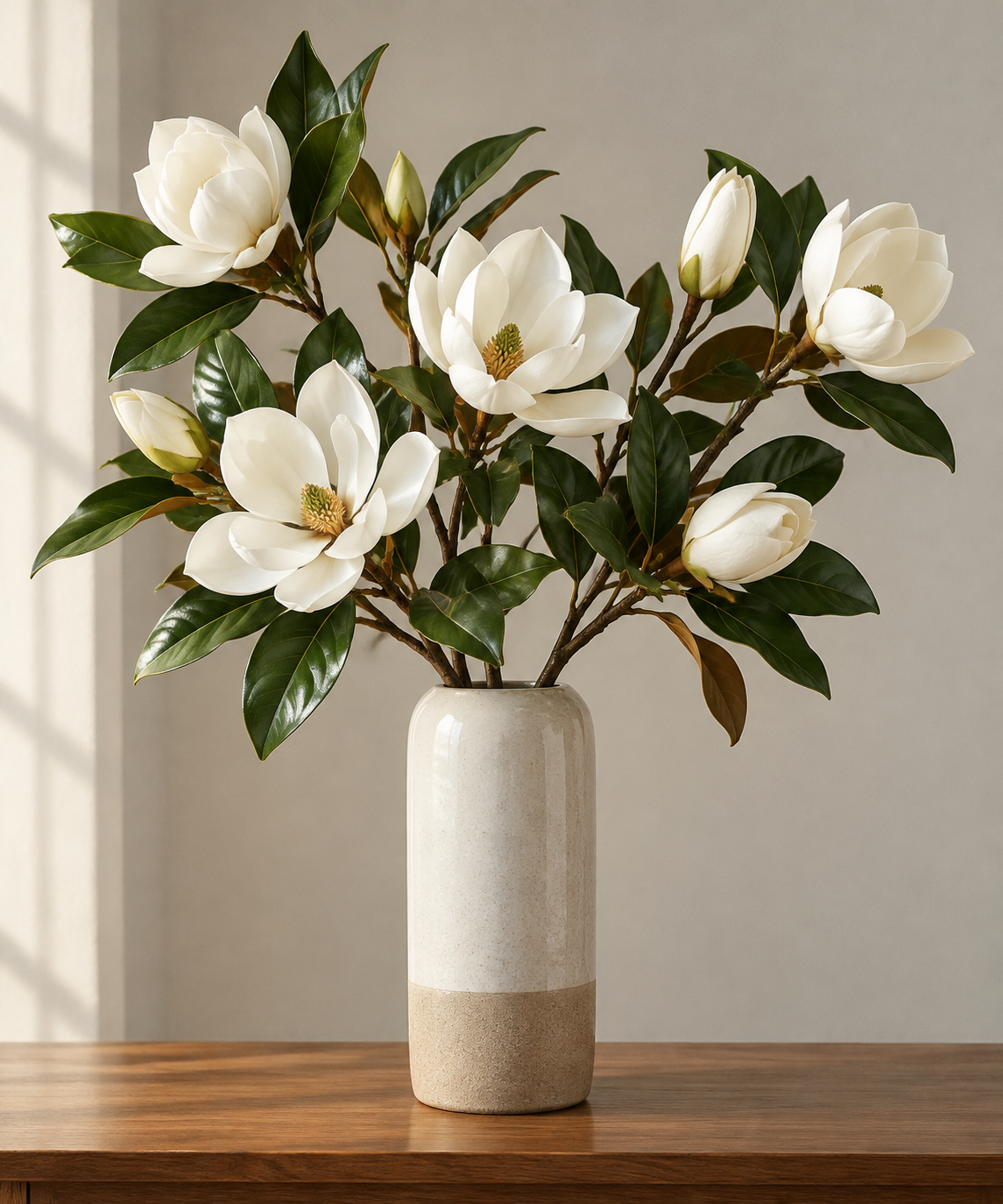
Artificial magnolia branches built the way the species actually looks — thick leathery leaves in deep green with the copper-brown velvet back, carrying cream blooms the size of a hand. Stems run 28 to 40 inches for urns, mantels and entry statements. Magnolia is a foliage-first flower, so leaves here are cut at the same grade as the blooms. Every listing photo shows the exact branches you receive. The leaf work is where magnolia lives: deep green gloss on the face, the copper-brown velvet back that flips in a draft, and buds the size of olives - all three at the same material grade, because a thin leaf under a heavy bloom is the oldest corner-cut in the category. Cream blooms open the width of a hand against the dark foliage. Branches carry entry urns and Christmas mantels in the South-tradition palette; leaf-only stems do the groundwork in garlands and wreath builds.
Quick answer: Artificial magnolia branches reproduce a foliage-first species: thick leathery leaves in deep green with the brown velvet reverse, buds, and hand-sized cream blooms, on stems 28 to 40 inches. Unlike fresh magnolia cuttings, which brown at the leaf edge within days indoors, the leaves hold their gloss year-round for mantels, urns and holiday builds. Buy complete branches, leaf-only stems or bloom-only stems by the job - and check that leaf grade matches bloom grade, the place cheap versions fail first.
Artificial Magnolia Flowers, Explained
What an artificial magnolia is
A magnolia piece is three components on one branch: the heavy deep-green leaves with their copper-brown velvet reverse, the thick buds furred in the same brown, and the cream tulip-shaped blooms that open flat. It is the signature plant of the Southern estate look — the reason magnolia reads 'manor house' the way eucalyptus reads 'spa'. In the language of flowers, magnolia stands for dignity and perseverance, a meaning tied to the tree's ancient lineage and waxy, unhurried blooms; our flower meanings hub carries the full story.
The build standard matters more here than for any bloom-first species: on a magnolia branch the leaves are the main surface. Across this collection the foliage and buds are specified at the same material grade as the blooms — the velvet-backed leaf is where low-grade magnolia gives itself away at arm's length, so it is the first thing our close-up photography shows.
Sizes and forms
Branches run 28 to 40 inches overall — long enough to rise out of a floor urn without crowding it. Forms split three way: leaf-and-bloom branches (the complete magnolia statement), leaf-only stems for garlands, wreaths and greenery builds, and bloom-only stems for wiring into wedding work. Every listing states the branch length, the leaf count and the bloom count as measured flat with a tape reference.
Saucer and star magnolia - the two shapes a branch follows
Two species cover most magnolia stock. Saucer magnolia - the Southern classic, magnolia x soulangeana - makes the cup-and-saucer blooms up to eight inches across, rose-blushed white inside, on the big glossy leaves; this is the branch that carries Christmas mantels and entry urns. Star magnolia flowers smaller and stranger: strap-like petals in drifts of a dozen-plus per bud, on a finer branch, the early-spring look that suits delicate builds. Most artificial branches follow the saucer reading.
A third player is grandiflora - the evergreen Southern magnolia itself - which is less a bloom branch than a leaf architecture: the deepest gloss, the heaviest brown reverse, blooms rare and huge when they come. Leaf-only stems in the list above are the grandiflora reading, and they are the ones to buy for garlands, wreaths and swag groundwork.
Where they work best
Two or three branches in a floor urn carry an entry or a fireplace corner on their own — that is the classic Southern placement, and it needs nothing else. Leaf stems braid into garlands along mantels and stair rails; wreath builders use magnolia as the permanent base layer under seasonal accents. Magnolia also anchors wedding backdrops where the green-and-cream palette must carry a whole wall without color noise.
Colors that pair well
The working palette is already inside the branch: deep green, brown velvet, cream. Build on it rather than fight it — brass and natural-wood vessels, white hydrangea for mass, or a single accent of blush ranunculus for softness. What magnolia does not want is saturated company; reds and bright pinks crowd its low-contrast dignity.
What arrives, and the two minutes after
Branches ship flat in a long box; plan two to three minutes of shaping per branch — spread the leaves so both green and velvet sides show, open the cream blooms a half-turn, and set the natural arch of the stem. Wire cores hold every position. A shaping card ships in every box, and piece counts are stated in every title.
How to Choose Artificial Magnolias
- Check the leaf work first.
The velvet-brown reverse is the species' signature and the first quality tell — every card here pairs its bloom photo with a same-light close-up of both leaf faces.
- Match branch to vessel.
Floor urns take 2–3 branches at 34–40 in; mantel garlands braid leaf stems; wedding wiring starts from bloom-only stems.
- Keep the palette inside the branch.
Green, brown, cream — add brass or wood vessels, white hydrangea mass, at most one blush accent.
- Count pieces before checkout.
Leaf counts and bloom counts are printed per listing; a branch of 12 leaves means twelve, staged flat — not two branches photographed as one.
Buying Loose Stems in Bulk
Loose magnolia - complete branches, leaf-only stems, bloom-only stems - is the kit of the look: branches stand in urns alone, leaves layer into garlands and wreath frames, blooms top gift wraps and table runners. Finished magnolia pieces (wreaths, door swags) are the holiday-ready route where the groundwork is done. Leaf stems at bulk count are the event-decorator buy; finished pieces are the gift and front-door buy.
Frequently Asked Questions
What does a magnolia branch include — leaves, buds or blooms?
Three forms are stocked, stated in every title: complete branches (leaves plus buds and cream blooms — the statement form), leaf-only stems for garlands, wreaths and greenery builds, and bloom-only stems for wiring into wedding work. Leaf counts and bloom counts are listed per listing as measured flat, so a branch of 12 leaves means twelve leaves — not two branches photographed as one.
Why is the brown back of magnolia leaves important?
Because that copper-brown velvet reverse is half of how a real magnolia reads — the leaf flips between deep green and brown as you move past it, and any branch that skips the brown back looks like generic greenery. It is also where quality shows: the collection standard specifies foliage and buds at the same material grade as the blooms, and every card carries a same-light close-up of both leaf faces so you can check the velvet detail before ordering.
How do I shape magnolia branches after unboxing?
Two to three minutes per branch: spread the leaves so both the green face and the velvet-brown back are visible, open each cream bloom a half-turn, and bend the wire-cored stem into its natural arch. Everything holds the position you set. A shaping card with photos ships in every box, and the same steps appear on the product page — a flat-shipped branch always needs this quick set-up.
Are artificial magnolias only for Christmas?
No — magnolia is an evergreen look that carries all twelve months. It peaks twice on decor calendars: the green-and-cream palette slots into Christmas garlands and wreaths alongside evergreen, and the same branches read as Southern-estate spring and summer styling the rest of the year. Unlike poinsettias, nothing about magnolia is season-bound; most of our magnolia customers run the same urn branches year-round and add seasonal accents on top.
What is the difference between a saucer and a star magnolia?
Saucer magnolia carries the big cup-and-saucer blooms - up to eight inches, white blushed rose - on thick leathery leaves; it is the Southern classic that reads Christmas on a mantel. Star magnolia is finer: narrow strap-like petals in clusters, smaller blooms, earlier-spring feeling, suited to delicate builds. Most artificial branches follow the saucer shape; the star look shows in the petal build, not the color.