
Blog
DIY Wedding Arch Flowers: Frame Types, Stem Counts by Arch Size, and 5 Assembly Steps

By Evercombe Team · Updated October 12, 2026 · 7-minute read
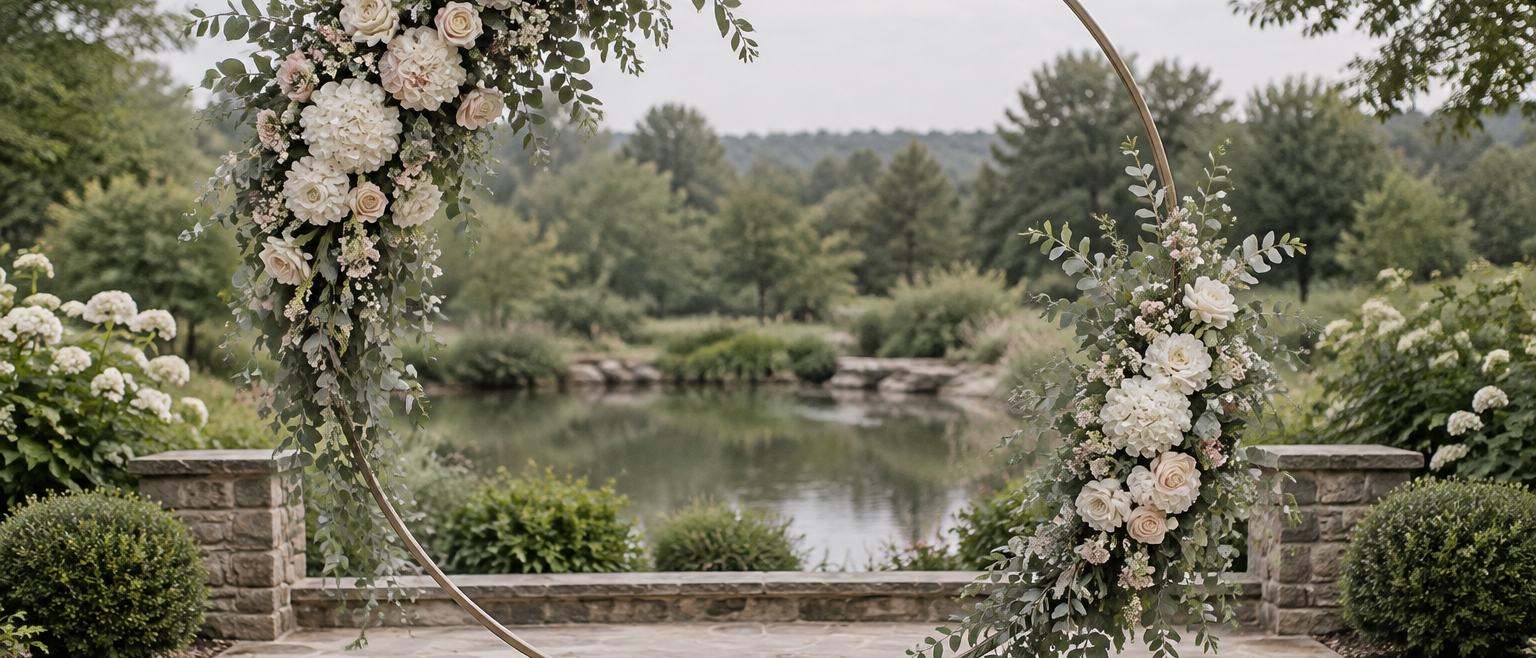
Quick answer: Decorating a wedding arch with artificial flowers is cluster-building, not stem-placing: assemble 8–15 wired clusters on the ground (greenery base + 3–5 blooms each), then anchor them to the frame — 40–60% of your stems go to the two focal corners at head height, the rest trails lighter along the top and down the sides. A typical 7–8 ft arch takes 60–120 stems total (typical market spec). DIY materials run $120–350 against $400–1,200 for finished arch florals and $250–700 for rentals (US ranges, October 2026) — and artificial clusters assembled days ahead hold their shape through the ceremony and the photographs.
The arch is the ceremony’s single most-photographed object after the couple, which is exactly why it rewards a method. The method is zoning: decide where the eye should land (the corners at head height), spend your density budget there, and let the rest of the frame carry lighter garland. Uniform “flowers everywhere” arches are the most common expensive mistake — they use double the stems to produce half the photograph.
Choose the Frame First (It Changes Everything)
| Frame type | Typical size | Flowers go | Build note |
|---|---|---|---|
| Circular (moon) | 7–8 ft diameter | One heavy crescent focal, light counterweight | The most photographed shape; asymmetry is the style |
| Chuppah (square) | 7–7.5 ft, four posts | Corners + canopy edges | Decorate the four post-tops and top rails, not the poles |
| Hexagon / triangle | 6.5–7.5 ft | Top two corners | Modern minimalist; density budget concentrates |
| Freeform garland arch | varies | Along the branch line | Branch arches carry garland, not clusters |
The decision that saves the most grief: confirm the frame assembles and stands before any flowers touch it, and check venue rules on freestanding vs. anchored frames. Frames and pre-decorated options: wedding arch flowers.
The Stem Math by Arch Size
- Small accent arch (5–6 ft): 40–70 stems — 6–8 clusters
- Standard ceremony arch (7–8 ft): 60–120 stems — 8–15 clusters
- Chuppah with canopy: 100–160 stems — corner clusters plus rail garland
Split per cluster: 1 greenery spray + 3–5 bloom stems, wired as one unit (typical market specs). Two-thirds of clusters go to focal zones; one-third stretches thin along connecting runs. Buying in bulk sleeves of 5–12 stems is how the counts stay budget-sane — the wedding flower arrangements line covers pre-clustered options if wiring your own is not the weekend you want.
Five Steps to a Flowered Arch
Step 1: Dry-Fit and Mark the Focal Zones
Stand the frame, mark the two focal corners (head height, where the couple stands between), and run a tape or ribbon line along the connective run. Photograph the dry-fit — the photo is your placement map when the frame comes apart for transport.
Step 2: Build Clusters on the Ground
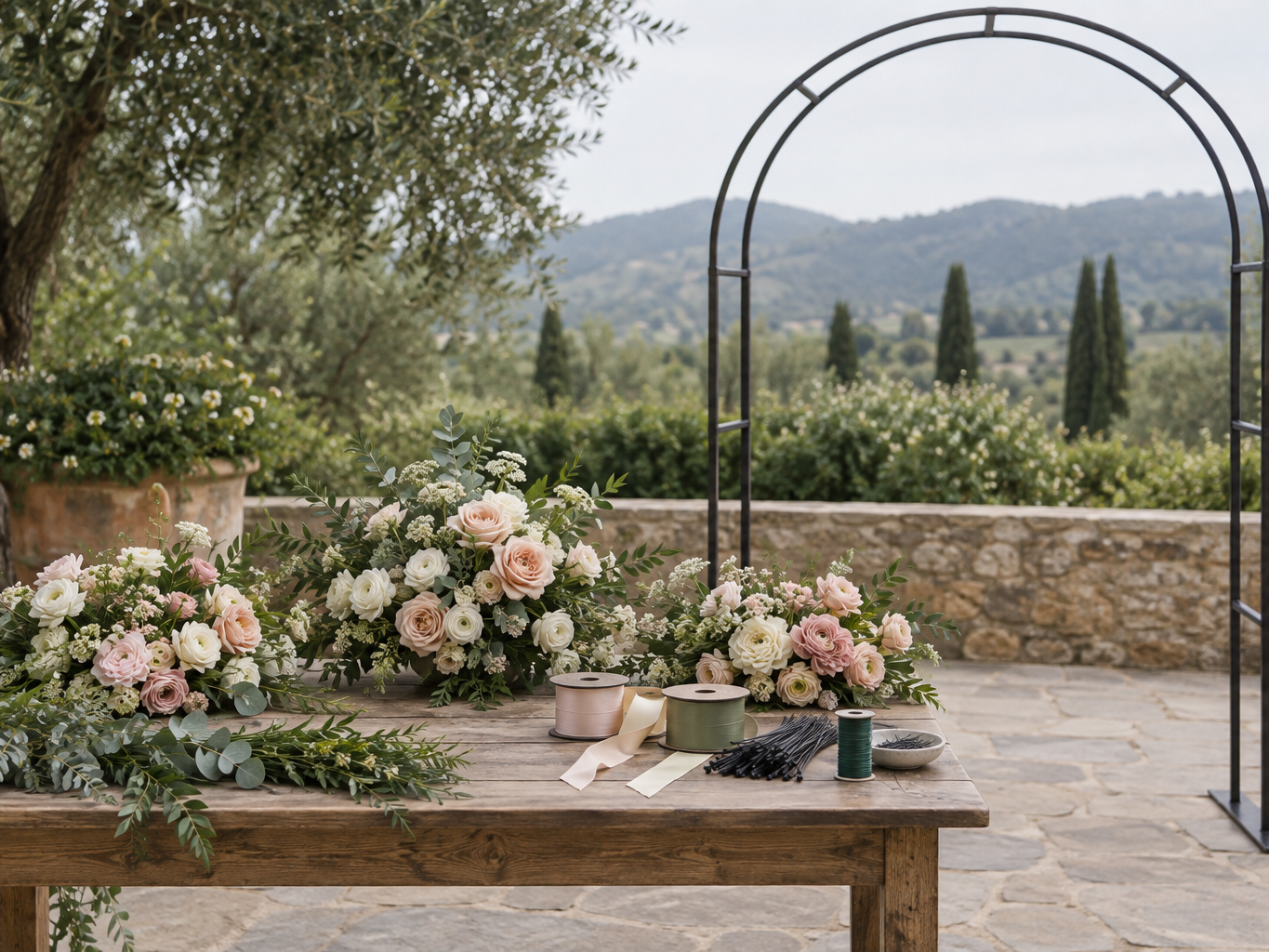
Each cluster: one greenery spray as the backbone, 3–5 blooms layered face-out, stems wired together and wrapped in floral tape or ribbon. Ground-building is the whole trick of this project — clusters made at a table in good light take a third of the time of clusters made on a ladder, and they can be made days ahead, which artificial stems make painless.
Step 3: Anchor the Focal Clusters
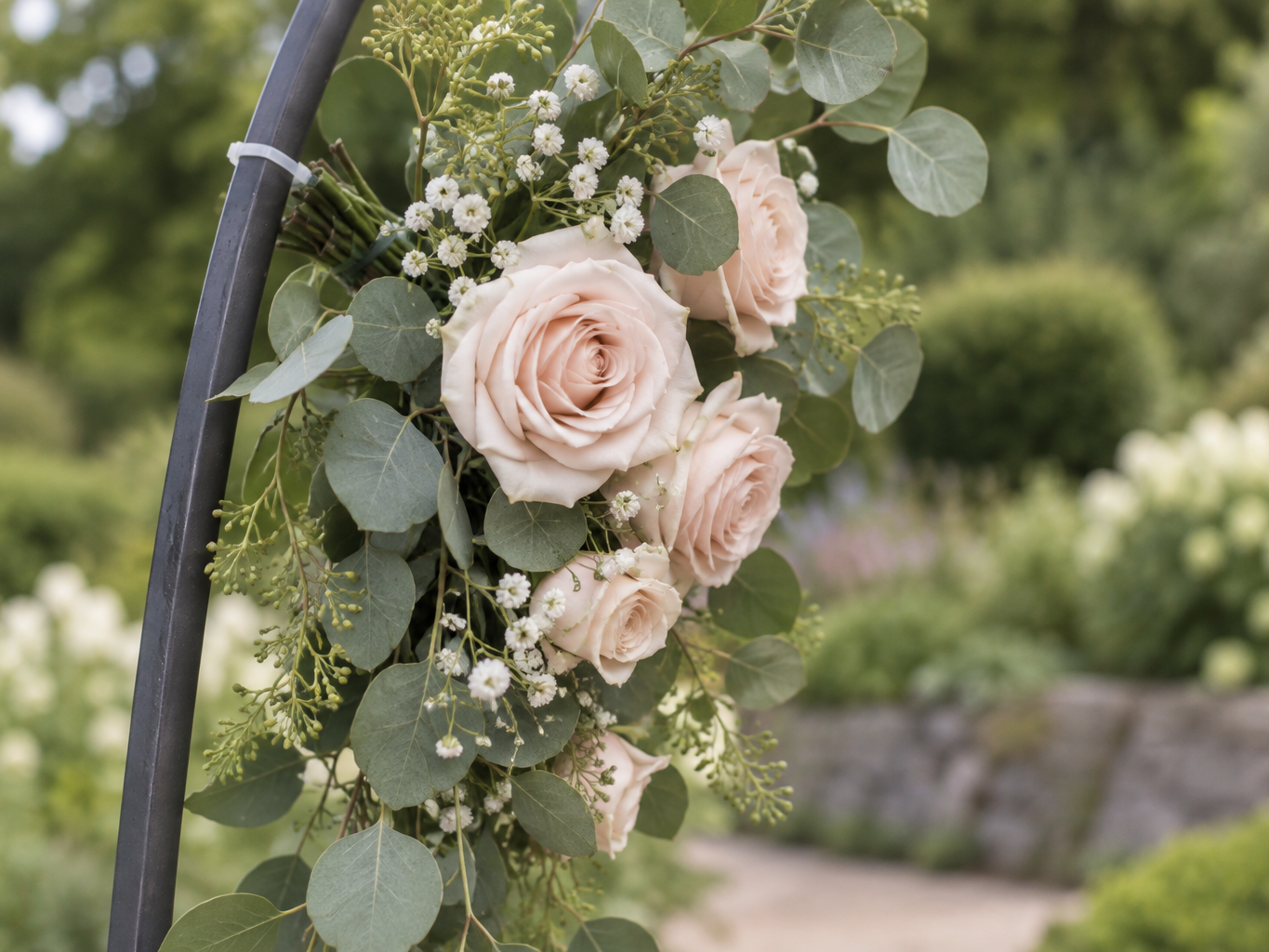
Attach the two focal-corner clusters first, zip ties or wire to the frame, tails cut flush. Then double up: focal zones typically want two overlapping clusters per corner so the mass reads generous from twenty feet. Wired clusters hold their shape through the ceremony and the last dance — no wilting, no droop in afternoon heat, and the photographs at hour three look like the photographs at hour zero.
Step 4: Run the Connectives
Between the focal corners, attach single greenery sprays and the remaining clusters at 12–18 in. spacing, letting them trail and thin — the run reads as a gesture, not a fence. For garland-style frames, wire flexible garland along the whole line first, then tuck bloom clusters into it.
Step 5: Finish the Feet and Transport
Wrap the frame feet or base plates in greenery (photographers shoot low), then break the arch into its transport sections — clusters survive travel better attached to the frame sections than loose in boxes, so split the frame with clusters on it when the design allows. Budget 60–90 minutes of on-site reassembly for a standard arch (typical project times).
Variants on a Budget
- The single crescent — circular arch, one heavy crescent focal, bare frame elsewhere: the strongest photo-per-stem ratio on this page
- The bouquet-wall pair — two tall cluster columns at the frame’s outer legs, echoing the wedding centerpiece palette; reads designed at half the stem count
- The dried-and-silk mix — silk blooms as structure with dried accents, a texture-rich route when the palette runs neutral
What It Costs: Three Routes Compared
| Route | Standard 7–8 ft arch | Notes |
|---|---|---|
| DIY (bulk stems + clusters) | $120–350 materials | Days-ahead build; reusable stems |
| Finished arch florals (buy) | $400–1,200 | Set-and-forget; palette from stock |
| Rental | $250–700 per event | Standard palettes; availability varies |
(US ranges, as of October 2026.) The full wedding-flower budget picture — arch alongside bouquet, centerpieces, and wearables — is broken down in wedding flowers cost.
Troubleshooting
- Clusters spinning on the frame — zip tie through the cluster’s wire backbone, not around the blooms; the wire is the structural member.
- The arch reads sparse in photos — density went uniform instead of focal; move clusters from the connective run to the corners rather than buying more stems.
- Transport damage — split the frame with clusters attached and pad cluster faces with tissue; loose blooms in boxes arrive exactly as battered as you fear.
FAQ
How many flowers do I need for a DIY wedding arch?
A standard 7–8 ft arch takes 60–120 stems — 8–15 clusters of one greenery spray plus 3–5 blooms each — with 40–60% of the total concentrated at the two focal corners (typical market spec). Smaller 5–6 ft accent arches take 40–70 stems.
How do I attach flowers to a wedding arch?
Build 3–5-bloom wired clusters on the ground first, then zip-tie or wire each cluster’s backbone to the frame, cutting tails flush. Attaching single stems directly to a standing frame is the slow path and produces the sparse look; clusters are both faster and fuller per stem.
Is it cheaper to DIY wedding arch flowers?
Yes, at these scales: DIY materials run $120–350 against $400–1,200 for finished arch florals and $250–700 rentals (US ranges, October 2026) — with the trade being a weekend of cluster-building. The cost logic across the whole wedding program is in wedding flowers cost.
Can I decorate the arch the day before?
With artificial stems, yes — clusters hold their shape indefinitely once wired, so the arch can be fully decorated days ahead and transported in sections. This is the single biggest scheduling advantage over fresh arch florals, which collapse into a same-morning build.
What flowers look best on a wedding arch?
Big-headed bloom families carry the frame at distance: hydrangeas, garden roses, and peonies as cluster anchors, with ranunculus and greenery sprays as texture. Choose by palette rather than by flower — the arch should echo the wedding color palettes plan and the bouquet, which is what makes the day read as one design.
The Rest of the Ceremony Program
- Shop the pieces: wedding arch flowers · wedding flower arrangements
- Backdrop scale: how to make a flower wall · Table layer: wedding centerpieces with artificial flowers
- The bouquet build: how to make an artificial wedding bouquet · The money map: wedding flowers cost