
Greenery wreaths built from leaves, not blooms — eucalyptus, boxwood, cedar, magnolia, and fern rings that stay green on the front door every month of the year. No water, no fall cleanup, no dead-July look. Sizes 14 to 30 inches, with the measured diameter on every listing.
Greenery Wreaths, Explained
What a greenery wreath is
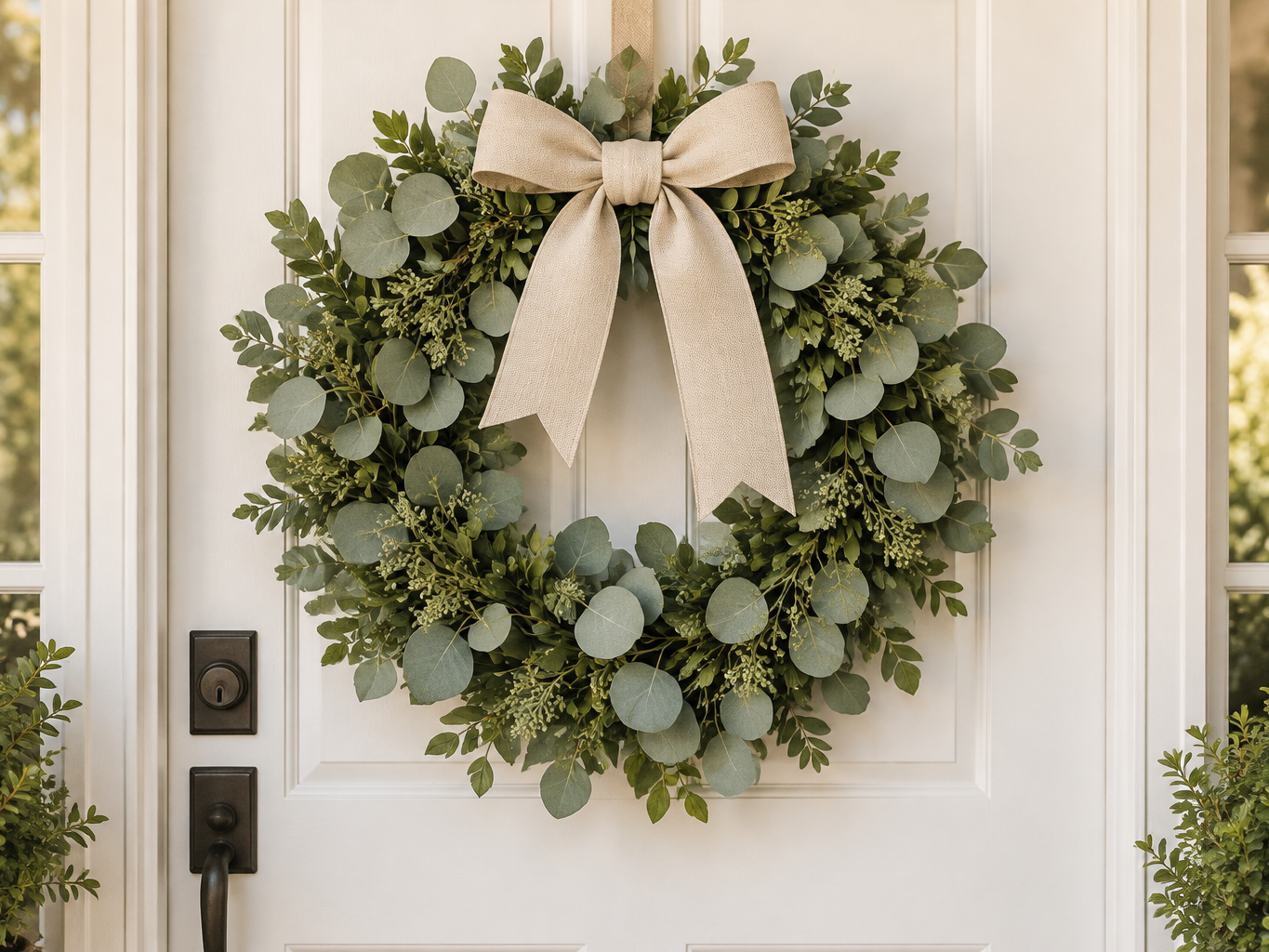
A greenery wreath is a ring built from foliage rather than flowers — the leaf is the whole design. Eucalyptus, boxwood, cedar, magnolia, fern: each variety carries its own texture and tone, and the ring reads quiet and structural where a bloom wreath reads colorful. That restraint is why greenery wreaths cross seasons — the same eucalyptus ring that anchors a December door with berries wired in works bare through spring, and again at Thanksgiving with pods and ribbon. On this page every piece is built to one material standard: the backing and inner foliage at the same grade as the display face, because a leaf-only wreath gets read at close range more than any bloom ring does.
Greenery also means green in the color sense, and this page holds the leaf-material meaning — the full green-by-color inventory lives in the color collection.
Varieties compared: eucalyptus to fern
Eucalyptus reads modern — sage and silver tones, rounded leaves, the quietest ring on the page and the one that pairs with everything. Boxwood reads classic and clipped: dense, small-leafed, the French-garden look that suits painted doors and traditional exteriors. Cedar reads natural, with cascading flat branchlets and the softest silhouette. Magnolia reads Southern and substantial — large leathery leaves, glossy on top, felted brown beneath, the statement variety. Fern reads layered and airy, closer to bohemian, best indoors and on sheltered doors. On durability, all five hold their color and shape indoors and under cover; on price, the band runs from the fern and cedar rings up to magnolia, with eucalyptus and boxwood mid-field — every listing states the size and variety, so the comparison happens on specs rather than adjectives.
The year-round front door
The core reason to buy a greenery wreath is that it does not expire. A fresh wreath greens the door for a few weeks; an artificial greenery ring holds the same spot for years — no water, no browning, no July cleanup — and dresses up or down by season: berries and ribbon wired in for December, eggs and ivy at Easter, left plain through the summer months. Front doors under cover carry these rings all year; exposed doors follow the same honest rule as the rest of the wreath line — bring it in during the worst weather, and expect sun to be the long-term enemy of any artificial botanical. Sized to the door the standard way: 22–24 inches on a 36-inch door, 18–20 on narrower frames, 30 on grand entries.
Care and storage
Care is dust. A cool rinse or a damp pass shakes a year of porch off the leaves; no water in the ordinary sense is ever needed. Storage is the same shaped-box routine as the seasonal line — dry, cool, away from attic heat — and because nothing in the ring expires, a greenery wreath stored in January is the same wreath that re-hangs in March and next December. That is the quiet value case: the door piece you buy once and stop thinking about.
How to Choose a Greenery Wreath
- Pick the variety first.
Eucalyptus for modern and quiet, boxwood for clipped and classic, cedar for soft cascade, magnolia for the statement, fern for airy layers — the leaf is the design.
- Decide how seasonal you want it.
Bare rings run all year; a base you re-dress by season (berries in, ribbon out) turns one wreath into four.
- Size to the door.
22–24 in. on a standard 36-in. door, 18–20 in. on narrow frames and interior walls, 30 in. on grand entries — measured diameters on every listing.
- Match the exposure.
Covered doors carry any variety year-round; exposed doors take denser builds, come in during storms, and lose slowly to sun over years.
- Plan the pairings.
Greenery is the base layer of everything — matching stems, garlands, and swags in the same varieties are linked below for whole-room builds.
Frequently Asked Questions
What is a greenery wreath?
A wreath built from foliage rather than flowers — the leaf is the entire design. Eucalyptus, boxwood, cedar, magnolia, and fern are the common varieties, each with its own texture: sage-silver eucalyptus reads modern, clipped boxwood reads classic French-garden, cascading cedar reads natural, large-leaf magnolia reads Southern and substantial, layered fern reads airy. The look is quiet and structural where bloom wreaths are colorful, which is exactly why greenery rings cross seasons — the same ring anchors a door for years and dresses by whatever you wire into it.
How do I keep a greenery wreath looking good?
For an artificial greenery wreath, care is mostly dust: a cool rinse or a damp pass clears a year of porch, and nothing else is required — no water, no trimming, no browning to chase. Physical handling is the real variable: fluff the foliage outward when it comes out of the box, store it in its shaped box dry and cool away from attic heat, and it returns to the same silhouette. For doors in full sun, expect slow fading over years as the honest limit — no artificial botanical is sold here as fade-proof — and rotate or retire the ring when the tone shifts.
Which greenery is best for a front door year-round?
Under cover, all five varieties here hold a door for years — the choice is the look, not the survival. Eucalyptus and boxwood wear the best visually through the off-seasons: quiet tones that do not read as a missed holiday. Cedar and fern suit sheltered doors and indoor spots, where their airier builds are safe from weather. Magnolia carries grand entries but earns its statement best with occasional re-dressing. On fully exposed doors, denser builds (boxwood, magnolia) outlast airy ones, and the rule across the whole line applies: bring the wreath in during storms, and count sun as the long-term limit.
Eucalyptus or boxwood — which should I pick?
Tone and texture decide. Eucalyptus reads modern: sage and silver tones, rounded leaves, soft movement — the quietest ring on the door and the one that pairs with every palette, which is why it anchors so many modern and farmhouse entries. Boxwood reads classic: dense, small-leafed, clipped and architectural — the French-garden form that suits painted doors, traditional exteriors, and formal interiors. Eucalyptus suits the door you want to disappear into the scheme; boxwood suits the door you want to read as structure. Both sit mid-field on price, and both are listed here with measured diameters and close-up leaf shots.
Can a greenery wreath stay outside in winter?
Yes, with the same honest split used across the wreath line. Under cover — a door with an overhang or a covered porch — these rings run straight through winter, and their dense evergreen silhouettes are exactly what a short-day door needs. Fully exposed doors are a different job: snow load and freezing rain are hard on any artificial botanical, so the practical pattern is to bring the wreath in during storms and re-hang after. Nothing here is sold as weather-proof; treated like a seasonal flag, an exposed greenery wreath still returns for years.
How do I decorate a greenery wreath for the seasons?
Wire, not glue. The bare ring is the base layer: berries and a bow wired in for December come back out in January; dried orange slices or seed pods in fall; small eggs and ivy sprigs at Easter; nothing at all through summer. Wired decorations detach in minutes, so one wreath becomes four looks across a year — and because the base is unchanging, each season's additions are the only purchase. Matching greenery stems and picks for building out the ring are stocked on the stems line linked below.
Shop the Wreaths & Garlands Collection
By Size & Base
Shop by Season
Tools & DIY
Flower Guides
The dust routine that keeps a year-round greenery ring looking new — the care side of never-wilting.
Where foliage fits the room — pairing greenery rings with arrangements and stems.
December dressings for bare greenery bases — berries, ribbon, and pods wired into the rings above.