
Blog
Silk Flowers for Home Decor: A Room-by-Room Guide

By Evercombe Team · Updated October 12, 2026 · 7-minute read
Quick answer: Decorate with silk flowers by matching the arrangement to the room’s viewing distance: tall floor-vase statements (4–5 ft overall) for entryways and empty corners, low runners under 14 in. for dining tables, single stems or bud vases for bedrooms and bathrooms, and layered smalls for shelves. A three-arrangement starter set for one home runs $60–180 across retail tiers (competitor prices as of October 2026). The two rules that do most of the work: keep greenery grade matched to bloom grade, and dust monthly — dust is what makes silk decor read stale, not age.
Silk flowers earn their place in home decor on logistics alone: no watering schedule, no seasonal replacement, no wilt on a warm week, and full color control across the year — an autumn mantel in July, spring branches in February. The craft is in placement. The same stem that anchors an entryway disappears on a nightstand, and the pastel mix that softens a bedroom looks washed out in a sunlit living room. This guide walks the standard rooms one by one, with the heights, container choices, and price bands that fit each.
The Three Rules That Apply Everywhere
- Match the greenery grade to the bloom grade. The fastest way silk decor gets read as fake from across the room is lush fabric blooms on shiny injection-molded leaves. Buy stems whose leaves are the same tier as the flowers.
- Layer heights in threes. One tall (eye line or above), one mid (table-to-eye), one low (seated eye level). Rooms read finished when all three registers exist; a single mid-height arrangement reads temporary.
- Dust is the enemy, not time. A monthly soft-brush or cool-air hairdryer pass keeps stems reading fresh for years — the full routine is in how to clean artificial flowers.
Entryway: The Statement
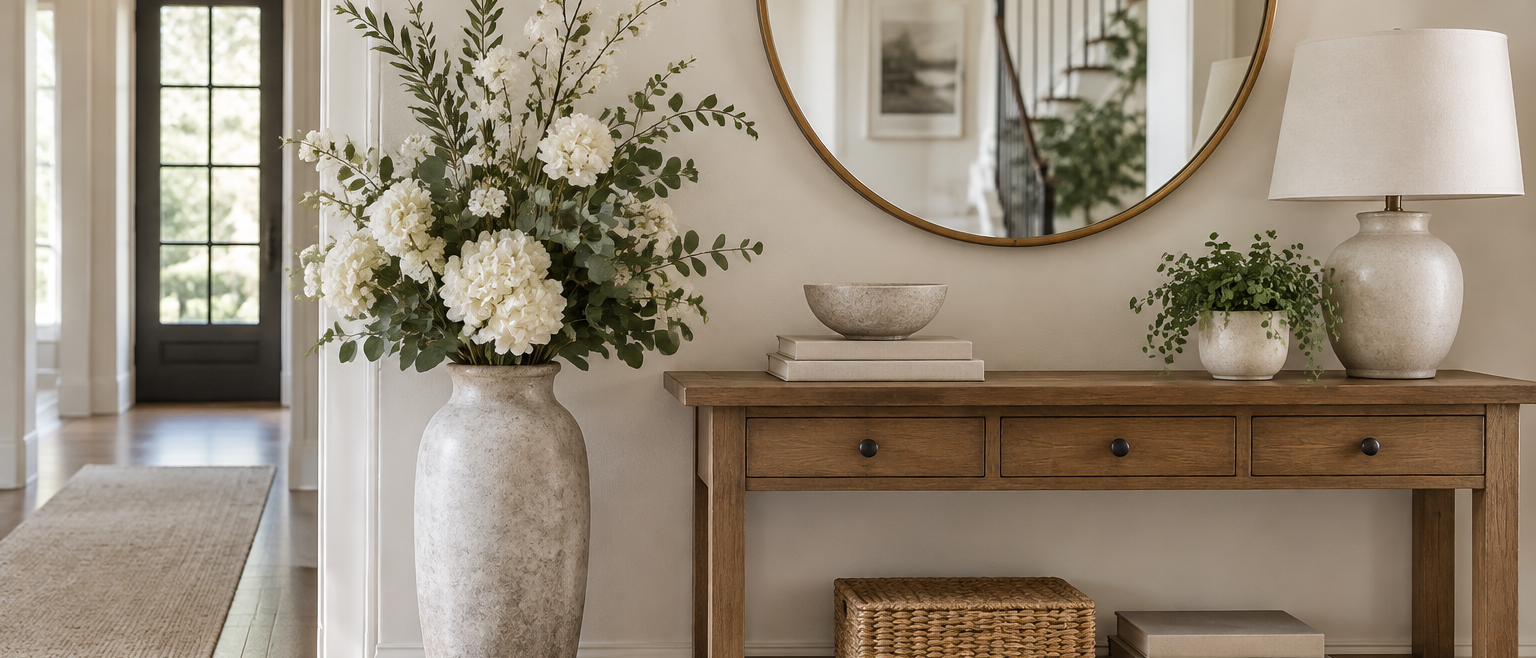
The entry sees people at walking pace and from the farthest distance of any room — this is where the tallest arrangement belongs. A floor vase with 4–5 ft overall height (branchy blossoms, delphinium-scale stems, or a sculptural olive branch scale) fills a corner without furniture. On a console table, an 18–24 in. arrangement opposite a mirror doubles itself.
Container rule: heavier vessels here — ceramic and stone-finish floor vases that cannot be knocked by bags and doors. Budget band: $40–120 for a floor-vase statement, stems included (typical retail ranges, October 2026). Ready-made tall pieces: arrangements.
Living Room: The Layer
Two heights, opposite ends of the sofa. A coffee-table piece sits low — under 12 in., broad, and flat enough to talk over. A side-table piece rises to 16–20 in. with some spread. The living room is also where color gets to work: choose one bloom family that echoes an existing accent (a cushion, a rug band, art) rather than introducing a new color entirely — the arrangement should look like it grew out of the room, not like it was delivered to it.
Container rule: glass and ceramic in equal measure here; the coffee-table piece can go wider than expected — a low bowl with a floral foam grid holds a broad, flat spread. Budget band: $25–80 per spot.
Dining Table: The Low Runner
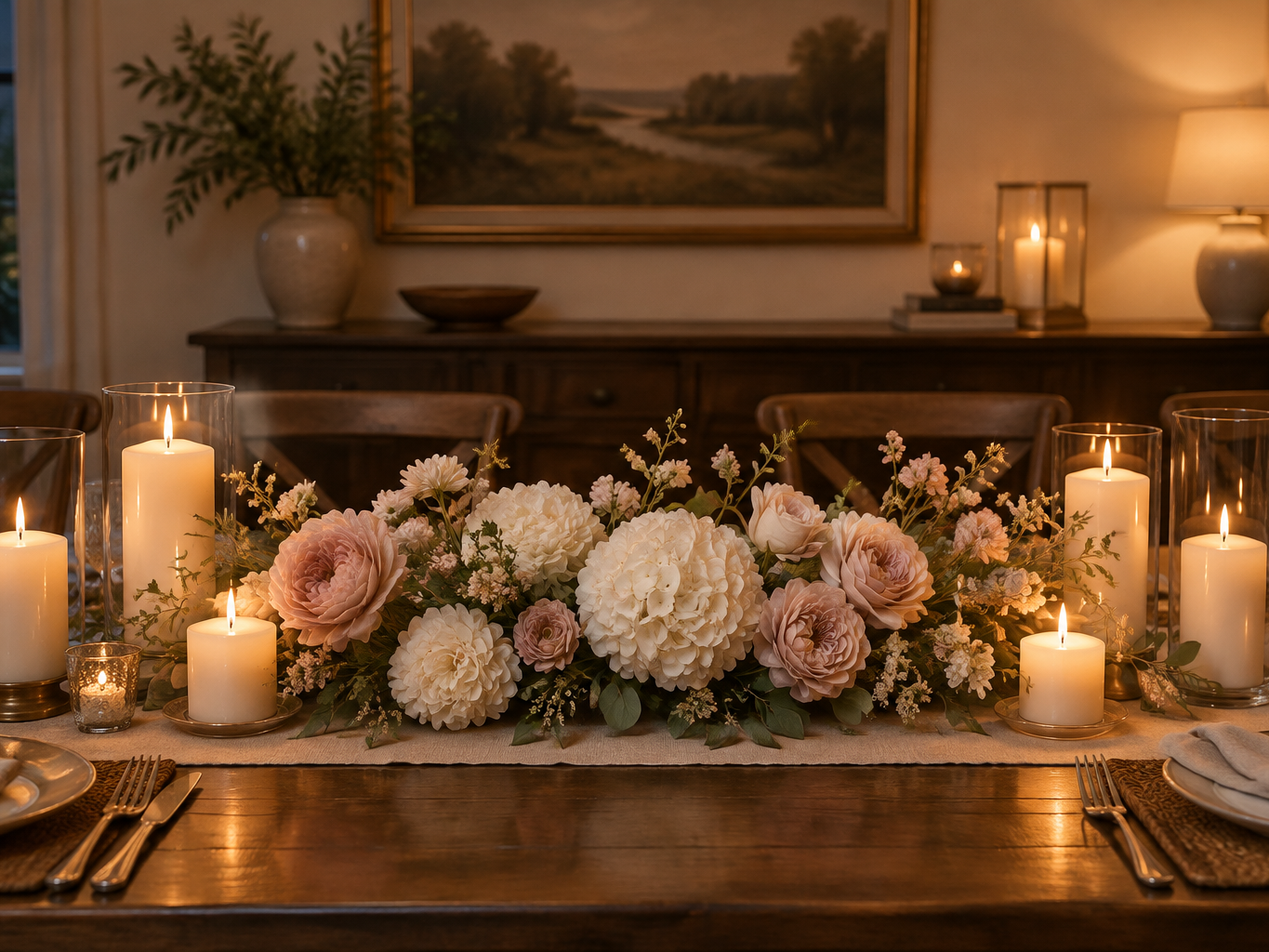
Heads must see each other over it — that constraint settles most decisions. Runners of 10–14 in. height in a line of two or three low vessels carry candles without blocking sightlines, or a single long trough centerpiece does the same job. For weeks when the table is working (homework, tax season), the runner compresses to one small vase at the center and nothing is lost.
Container rule: low and weighted — cylinders and troughs at 4–6 in. height. Budget band: $30–90 for a full runner set. Pre-styled vase-and-stems sets: artificial flowers with vase.
Bedroom: Small and Soft
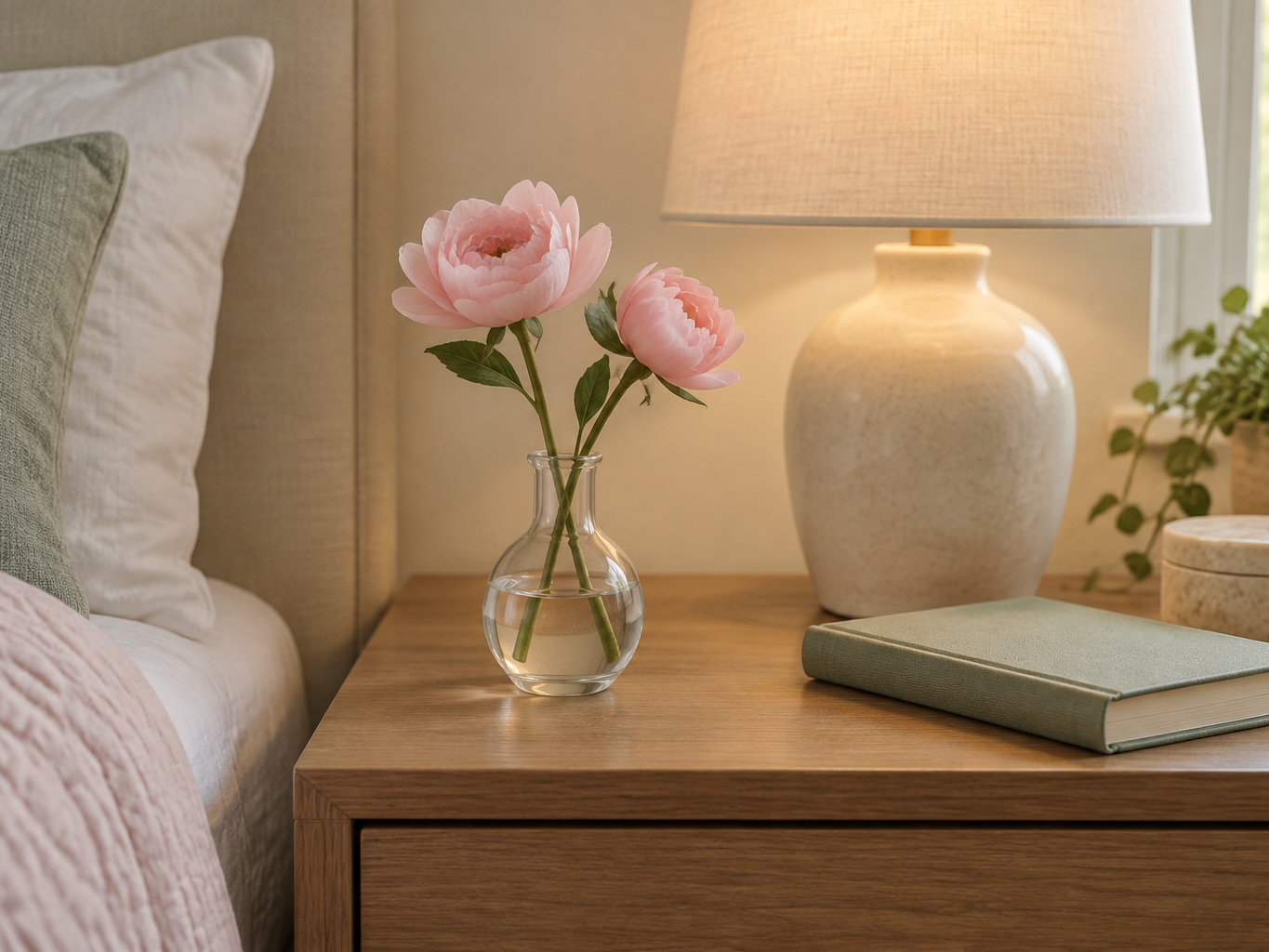
Bedside silk should be small enough to move with one hand when the phone charger needs the surface — a bud vase with one or two stems, 8–10 in. overall, in the room’s quietest palette. This is the room for pastels, whites, and single-species stems; mixed arrangements at small scale go busy. On a dresser, a slightly larger 12–14 in. piece can stand alone if the rest of the surface stays clear.
Container rule: bud vases and small glass — nothing that competes with the lamp. Budget band: $10–35 per nightstand.
Bathroom: The One That Surprises People
Bathrooms are hostile to fresh flowers (steam, temperature swings, no attention span) and neutral to silk — which makes them the highest-return silk spot in the house. A single orchid stem or a small two-stem vase on the vanity holds up for years where fresh flowers last four days. Keep stems off windowsills where direct sun hits daily; constant UV degrades synthetics — slower indoors than out, but “slower, not never.”
Container rule: small glass or ceramic that handles humidity wipes. Budget band: $8–25.
Shelves and Mantels: The Layering Game
Small potted stems and single blooms in 3–5 in. pots fill the gaps between books and objects — the flowers in pots line is built for exactly this layer. Mantels take garland-scale greenery with a few bloom accents rather than vase arrangements; seasonal swaps (winter greens, spring blossom branches) re-costume the room for $20–40 a season.
The Price-Band Table
| Room | Piece | Height guide | Budget band |
|---|---|---|---|
| Entryway | Floor-vase statement | 4–5 ft overall | $40–120 |
| Entryway | Console arrangement | 18–24 in. | $25–60 |
| Living room | Coffee-table low | under 12 in. | $25–80 |
| Living room | Side-table | 16–20 in. | $20–50 |
| Dining table | Runner set (2–3 vessels) | 10–14 in. | $30–90 |
| Bedroom | Nightstand bud vase | 8–10 in. | $10–35 |
| Bathroom | Vanity stem or pair | 8–12 in. | $8–25 |
| Shelves | Potted layering stems | 3–5 in. pots | $6–20 each |
(Competitor retail ranges, US, as of October 2026.)
Two Honest Notes
Light shifts colors over years, not weeks. A stem that sits in a west-facing window daily will eventually shift — the honest move is rotation, same as you’d rotate a rug. Pets remain pets. Silk stems are not chew-proof, and scattered petals are the classic cat outcome; hanging and high placement is the fix, not a different flower.
FAQ
Are silk flowers good for home decor?
They suit decor work better than fresh for three practical reasons: no maintenance schedule, full seasonal color control, and consistent height — a shelf composition stays as arranged for years. The trade is texture: at close range, silk reads as silk. Match placement to viewing distance and the trade disappears.
How do I make silk flowers look good in a vase?
Three moves: bend stems into a natural lean instead of standing them straight (wired stems hold the bend), cut stem heights into a dome rather than one flat line, and add one branch of quality greenery for every two or three blooms. Pre-balanced vase-and-stem sets: flowers with vase.
How much should I spend to decorate one room?
One room typically needs one statement piece and one or two supporting pieces — $35–90 at mid-tier retail for a bedroom or bathroom, $60–180 for an entryway or living room layered properly (ranges, October 2026). Concentrate budget on the piece guests stand closest to.
How long do silk flowers last in home decor?
Years, with monthly dusting and rotation out of direct sun — the material itself does not have a fixed expiry; the finish slowly dulls under accumulated UV and dust. Maintenance specifics: how to clean artificial flowers.
Which rooms should I skip?
Rooms with daily direct sun on the same spot, and reachable-by-toddler-or-cat surfaces — anywhere a $6 pot-stem can do the job instead of a $60 arrangement, let it.
Where to Start
- Browse ready arrangements by scale: flower arrangements and the full artificial flowers range
- The buying-decision companion: best artificial flowers · Vase pairing ideas: artificial flowers with vase ideas
- Keep them fresh: how to clean artificial flowers