
Blog
Wedding Centerpieces with Artificial Flowers: 16 Ideas by Table Shape and Style

By Evercombe Team · Updated October 13, 2026 · 6-minute read
Quick answer: Match the centerpiece to the table, not the theme alone: round tables take one tall statement (24–30 in.) or one low mound (under 14 in.); long tables take continuous low runners; the head table takes layered height behind the seated line. Artificial builds make the tall styles practical — wired stems hold their shape through the full ceremony and the last dance, nothing wilts during a warm outdoor reception, and every table can be assembled days ahead. Centerpiece budgets land around $20–60 per round table and $40–90 per long table with artificial stems (typical project ranges, October 2026).
The centerpiece decision is really a sightline decision: guests must find each other over the flowers at dinner. Everything else — style, color, vessel — follows from the table shape in front of you. These 16 ideas are grouped by table type first and style second, because that is the order that actually prevents expensive mistakes. For the color side of the decision, the wedding color palettes guide covers palette-building; this page is about what sits on the tables.
Round Tables: Tall or Low, Nothing Between
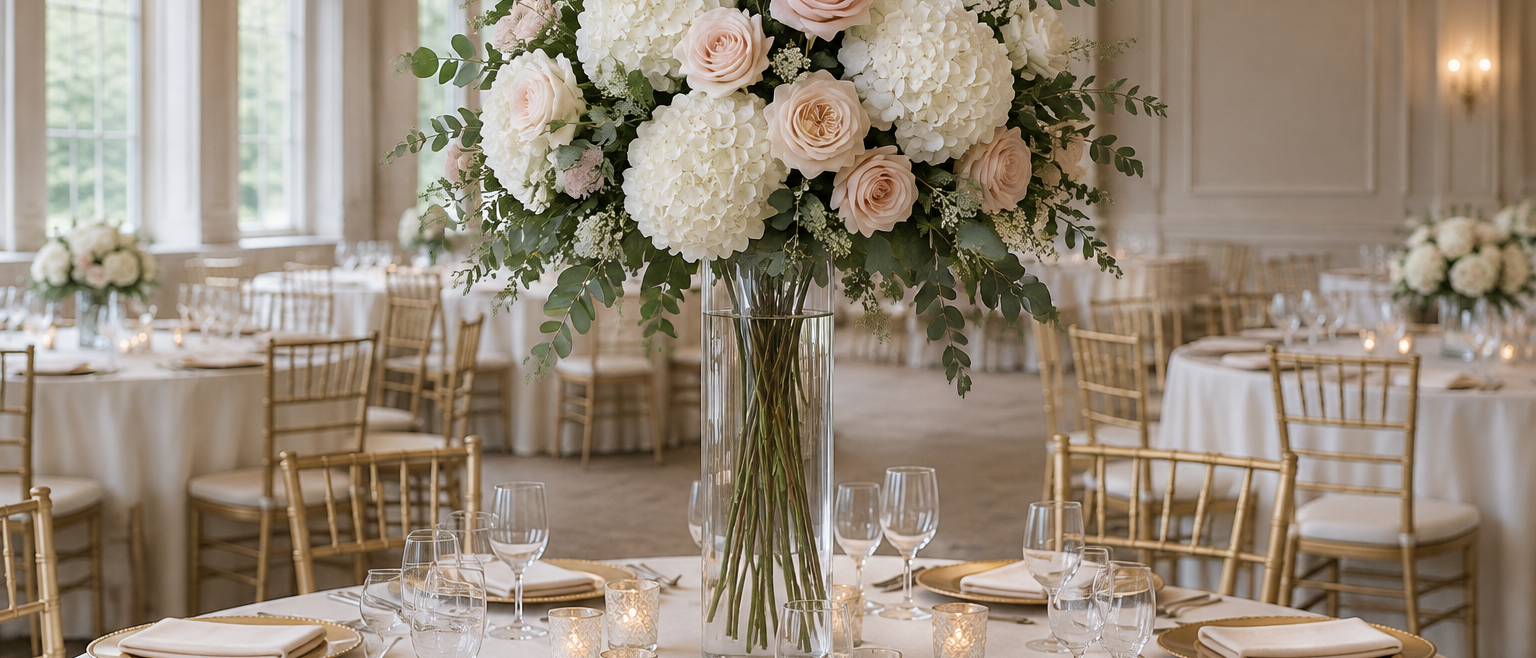
The two safe heights for round tables are tall enough to clear sightlines entirely (24–30 in. above the tabletop) or low enough to talk over (under 14 in.). The middle zone — 15–23 in. — blocks exactly the wrong view, and it is where most regretted centerpiece budgets go.
1. The Single Tall Cylinder — one 24–30 in. cylinder vase with a dome of hydrangeas and garden roses clearing the sightline. One vessel, one decision, done well: the most repeatable idea on this page when you have 15 identical tables to dress. Stem count runs 8–12 blooms per dome (typical market spec). Shop the build: flower centerpieces.
2. The Kissing Ball Standard — a hanging-scale sphere of blooms on a tall standing branch or slim tripod, so the flower mass floats above conversation height and the base stays visually light.
3. The Low Mound — a wide low bowl with a tight dome peaking at 10–12 in.; identical stem budget to a tall piece, delivered intimate instead of grand.
4. The Trio Clusters — three small vessels (5–8 in.) clustered off-center, one bloom family each. Reads collected rather than decorated, and packs flat for transport.
5. The Footed Urn — a ceramic urn with trailing greenery and a loose asymmetrical arrangement; the classic for garden and vintage styles, where ceramic vases do half the styling.
Long Tables: The Low Runner
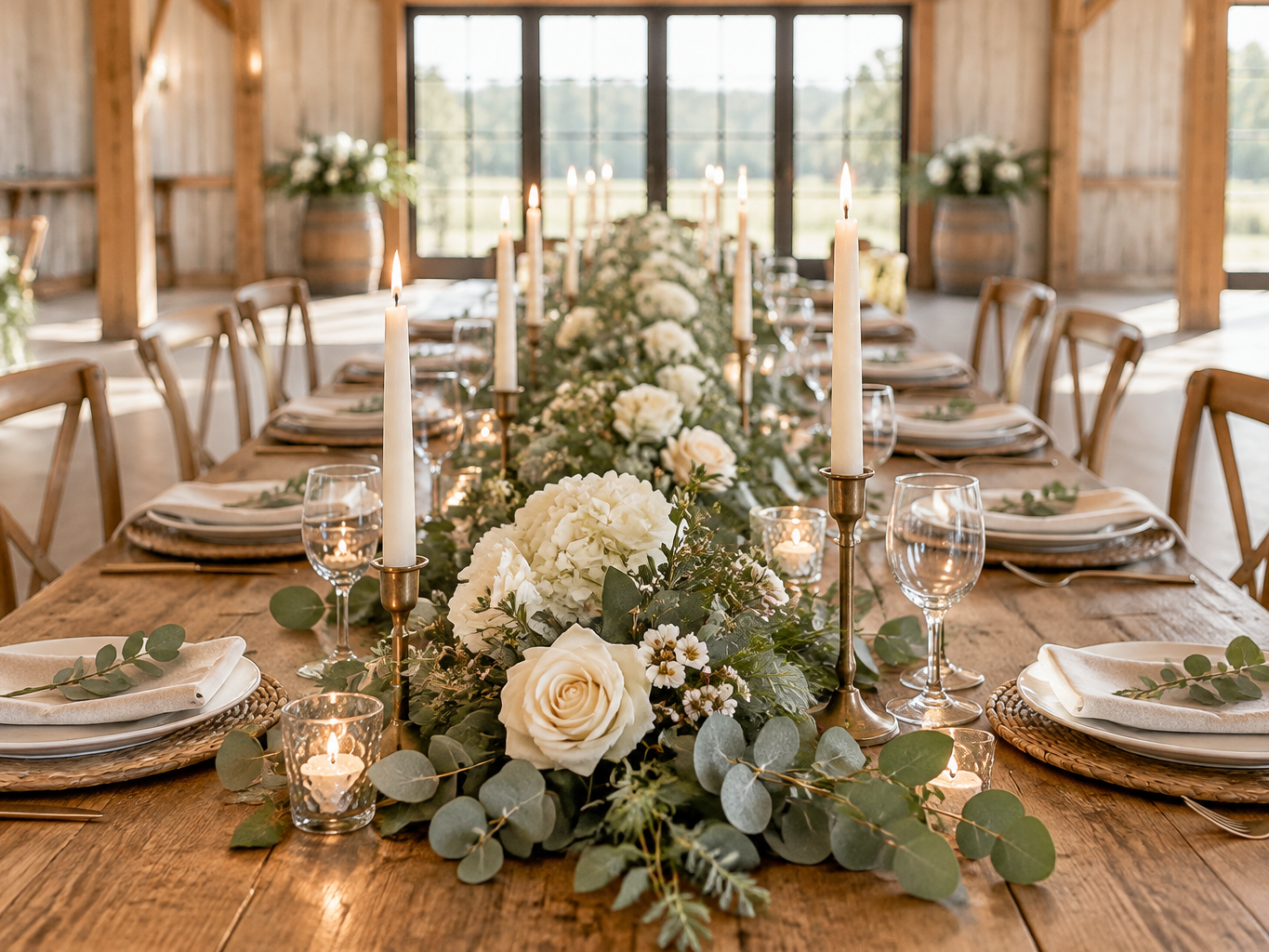
Long tables want continuity — a line the eye travels down, with candles for the evening layer. Runners sit 10–14 in. high, never taller, so the two sides of the table remain one dinner party.
6. The Continuous Greenery Runner — a base of eucalyptus-and-vine garland down the center with blooms set into it every 18–24 in.; the most forgiving runner, because gaps read as intentional.
7. The Trough and Candles — one or two long troughs of blooms alternating with candle clusters; the trough contains the flowers so the line stays clean across 8 ft.
8. The Bud Vase Line — a repeating rhythm of small cylinder vases, each with one or two stems, running the table’s full length. The cheapest per-table spend on this page ($25–40 in materials per 8 ft) and the easiest for a small crew to set out.
9. The Meadow Mix — loose low arrangements in mismatched glass, three heights under 12 in., styled to look gathered rather than arranged. Best matched to rustic and outdoor settings.
10. The Single-Species Line — one bloom (all ranunculus, all roses) repeated down the table in low glass. Repetition does the styling; works strongest with the palettes in wedding color palettes.
The Head Table: Height as a Backdrop
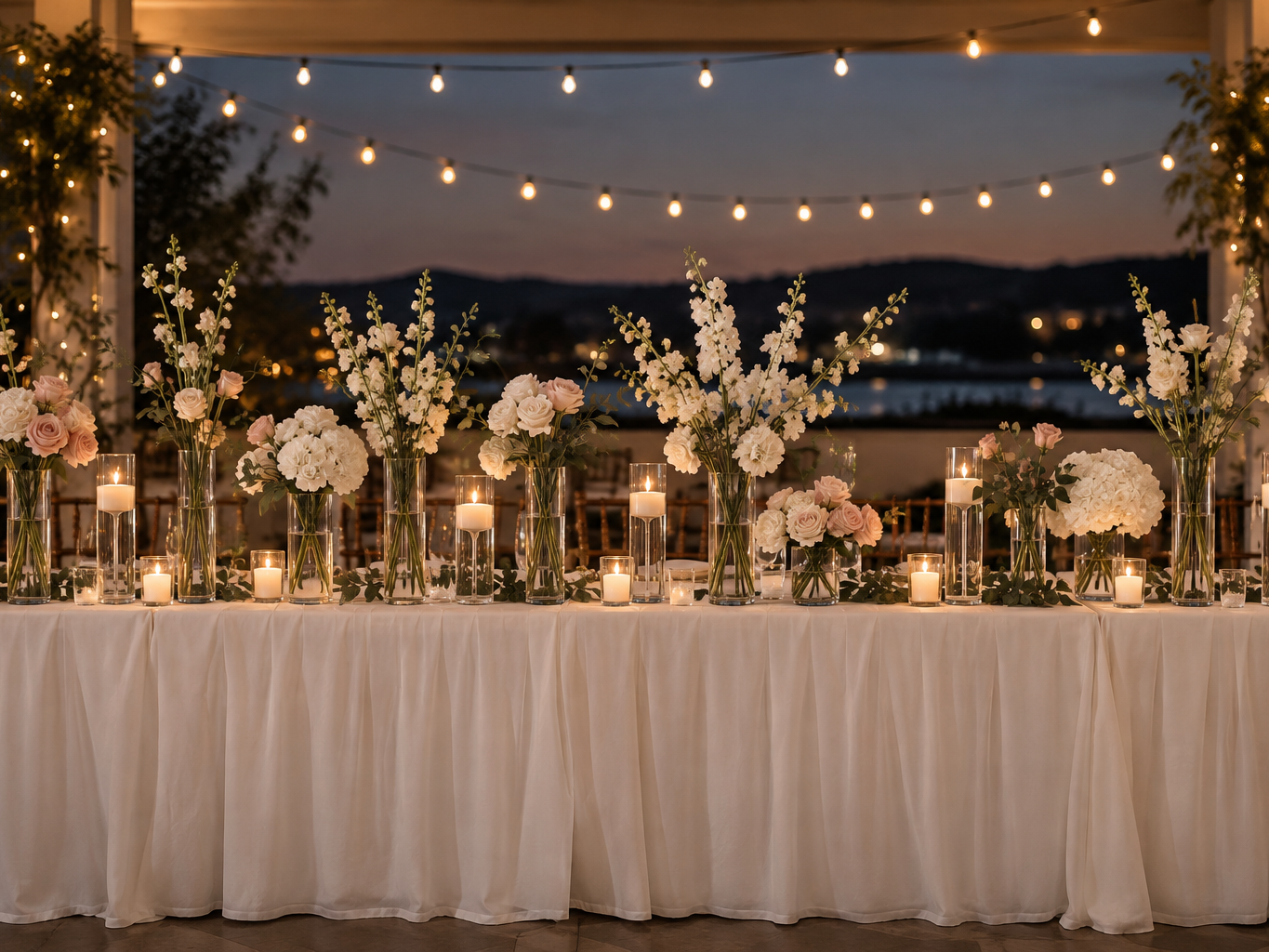
The head table is the one place at the reception where flowers block nothing and gain everything — height behind the seated line turns the table into the room’s focal point.
11. The Layered Cylinders — three cylinder heights (12/18/24 in.) in a staggered line, each with a single-floriferous dome. The scale that photographs best behind the couple.
12. The Backdrop Wall Pair — the head-table arrangement doubled as a pair of tall columns flanking a flower wall backdrop — the ceremony-to-reception double-duty move, since both halves relocate easily when nothing wilts.
13. The Arch Echo — head-table pieces that repeat the ceremony arch’s flowers and colors; see DIY wedding arch flowers for the arch side of the echo. The repetition is what makes the decor read as one designed day.
Outdoor and Minimal: Two More Registers
14. The Lantern-and-Stems Mix — flowering stems tucked into lanterns and hurricane vases weighted for wind; the honest outdoor note is weight, and artificial stems allow heavy bases that fresh arrangements can’t spare budget for.
15. The Candle-Forward Minimum — mostly candles, with two or three stems per table as accents. The $15–25 per table end of the range, right for evening receptions where candlelight does the work.
16. The Potted Line — small potted blooms (5–7 in. pots) down the tables, doubling as guest favors at the end of the night.
The Cheat Sheet
| # | Idea | Table type | Height | Relative spend | Notes |
|---|---|---|---|---|---|
| 1 | Tall cylinder | Round | 24–30 in. | $$ | Most repeatable at scale |
| 3 | Low mound | Round | 10–12 in. | $$ | Intimate register |
| 4 | Trio clusters | Round | 5–8 in. | $ | Packs flat |
| 5 | Footed urn | Round | 18–24 in. | $$$ | Garden/vintage |
| 6 | Greenery runner | Long | 10–14 in. | $$ | Most forgiving |
| 8 | Bud vase line | Long | 8–10 in. | $ | Cheapest per table |
| 10 | Single-species line | Long | 10–12 in. | $-$$ | Strongest with one palette |
| 11 | Layered cylinders | Head | 12–24 in. | $$ | Photographs best |
| 12 | Wall pair | Head | Tall | $$$ | Ceremony double-duty |
| 15 | Candle-forward | Any | low | $ | Evening receptions |
Height guidance and stem counts are typical market specs; project ranges as of October 2026.
Why Artificial Changes the Math
Three practical effects, beyond the per-stem savings covered in wedding flowers cost: the schedule un-crunches — centerpieces can be assembled days before, not the morning of; outdoor heat stops being a risk — nothing wilts at a 2 p.m. August ceremony; and tall styles become repeatable — a wired dome holds its shape through the full ceremony and the last dance, on every table, identically. The rest of the wedding-flower program — boutonnieres, the bouquet — follows the same logic.
FAQ
How many flowers do I need for a wedding centerpiece?
A round-table tall dome takes roughly 8–12 bloom heads plus greenery; a long-table runner uses 15–25 stems per 8 ft at runner density; bud-vase lines run 2–3 stems per vase with 8–10 vases per 8 ft (typical market specs). Artificial bulk sleeves of 5–12 stems are the standard way to buy at these counts.
How tall should wedding centerpieces be?
Either 24–30 in. above the tabletop (over the sightline entirely) or under 14 in. (well below it). The 15–23 in. middle blocks guests’ view of each other and is the one zone to avoid on round tables.
Are artificial flowers acceptable for wedding centerpieces?
At centerpiece distance — across a table, in evening light — quality artificial builds read convincingly, and they solve the two failure modes of reception flowers: heat wilt and same-day assembly crunch. The honest caveat is proximity: pieces guests handle directly (boutonnieres, the bouquet) deserve the closer-passing real-touch builds, covered in the boutonniere guide.
What is the cheapest wedding centerpiece that still looks designed?
The bud-vase line (#8) or the candle-forward minimum (#15) — $15–40 per table in materials (October 2026 ranges), with the design carried by repetition and candlelight rather than flower volume.
Can I mix artificial and fresh in the same centerpiece?
Yes — the standard mix puts artificial stems in the structural layer (the dome base, the greenery) and any fresh accents on top where guests touch and smell closest. The cost logic of mixing is laid out in wedding flowers cost.
Related Reading
- Shop the pieces: artificial flower centerpieces and arrangements
- The money question: wedding flowers cost · The color system: wedding color palettes
- Wearables: wedding boutonniere guide · The bouquet build: how to make an artificial wedding bouquet
- Backdrop scale: how to make a flower wall · DIY wedding arch flowers