
Quick answer: Artificial poppies are reproduction field poppies - one crinkle-petaled bloom on a fine leaning stem, 18 to 26 inches - sold as single stems, budding sprays and seed-pod stems. Fresh cut poppies shed their petals within a day or two of cutting, which is why florists rarely stock them; the reproduction keeps the papery bloom year-round for cottage jugs, wildflower posies and remembrance displays. Red, orange, coral and pink; buy in threes and fives, the scale the species keeps.
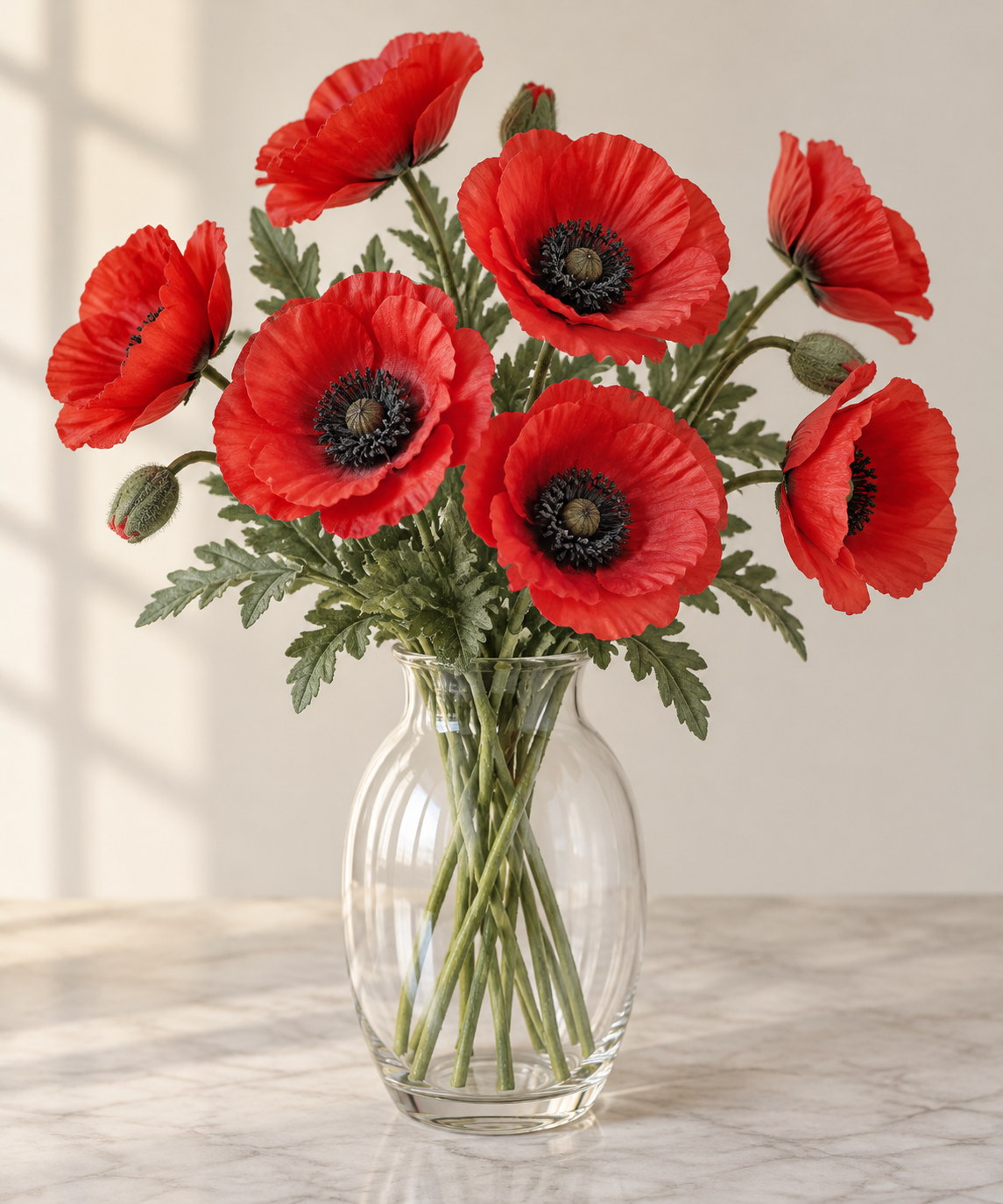
Artificial poppies in the species' honest form — one crinkle-petaled bloom on a fine, leaning stem, with a dark center and sparse bud. Red, orange, coral and pink, 18 to 26 inches, for wildflower jugs and cottage rooms. Fresh poppy petals fall within a day or two of cutting; these keep the papery bloom indefinitely. Every listing photo shows the exact stems you receive. The petal is the whole test here: the crepe-paper crinkle that catches light at the folds, the dark blotch at the petal base, the fine hairy stem that leans rather than stands at attention. Red covers the remembrance reading and the classic cottage jug; orange and coral run hot through summer tables; pink sits softest in bedroom posies. Three stems in a jug is the whole arrangement - the species does not ask for company.
Artificial Poppies, Explained
What an artificial poppy is
A poppy piece reproduces the lightest bloom in the cut-flower world: four to six wide, crinkled, paper-thin petals around a dark seed center, on a hairy, slightly crooked stem usually carrying one bud. It is the wildflower of meadows and roadside verges — and, in its red form, the remembrance flower of November, worn and laid in wreaths for over a century. In the language of flowers, poppy stands for both sleep-consolation and, in the red form, enduring memory; our flower meanings hub holds the double story.
The fresh cut poppy is famously short: petals shatter within a day or two in the vase, which is why florists bud-cut them and hope. The artificial version keeps the papery bloom open indefinitely — the strongest case for silk in any small species.
Sizes and forms
Stems run 18 to 26 inches with blooms of 3 to 4 inches — the single-bloom scale the species wears in the wild; anything larger reads as a peony that lost its way. Forms split between single stems (one bloom, optionally one bud), budding sprays (a main bloom plus two or three buds for naturalistic builds), and seed-pod stems — the dry pod on its own, the arranger's late-season detail. Bloom and bud counts are stated in every title, measured flat with a tape reference.
Oriental, Icelandic and field poppies in three lines
Oriental poppies carry the big blooms - five to six inches, dark blotch at each petal base, on stout hairy stems; they are the garden perennial and the fullest of the reproduction builds. Icelandic poppies run smaller and cup-shaped, in cream and soft yellow as often as red, on finer stems. The field or corn poppy - Flanders red, paper-thin, the remembrance flower - is what most single stems copy and what a November window wants. Seed pods, stocked as their own stem here, are the late-summer reading of the same plant.
Where they work best
Poppies belong in loose, casual builds: kitchen jugs with daisies and wheat, cottage borders in vase form, the wildflower layer of a farmhouse table. Their thin stems and airy scale make them the filler that loosens an arrangement — three or five poppies bent at different heights turn a tight bouquet into a meadow. The red form also carries November remembrance displays, where a permanent stem suits year-on-year reuse.
Colors that pair well
Red is the anchor and needs restraint — two or three stems maximum in a mixed jug, or it takes the room. Orange and coral poppies run warmer, pairing with marigold tones and late-summer palettes; pink and white soften spring builds. With every poppy, the dark center does the contrast work, so companion flowers can stay pale and quiet.
What arrives, and the minute after
Petals ship gently cupped; a minute per stem opens them — lift each petal from the center, give the stem its natural slight crook, and the crinkle sets itself. The wire core holds the lean you bend. A shaping card ships in every box, and bloom and bud counts are stated in every title.
How to Choose Artificial Poppies
- Keep the scale small.
True poppy blooms run 3–4 in on 18–26 in stems; the charm is the single airy bloom, not mass. Oversized versions read as the wrong flower.
- Check the petal crinkle.
The paper-thin, crinkled petal is the species test — every card pairs its bloom photo with a close-up showing the crinkle and dark center.
- Buy in threes and fives.
Poppies work bent at different heights among daisies, wheat and grasses; a single stem reads lost, a massed dozen reads wrong.
- Restrain the red.
Two or three red stems per mixed jug, or switch to coral, pink and white for warmer, softer builds — the dark centers carry contrast on their own.
Buying Loose Stems in Bulk
Loose poppy stems are the only sensible form of the species - a finished poppy arrangement contradicts the wildflower scale it lives by. Singles and budding sprays build jugs and posies three to five stems at a time; pod stems extend the display into late summer without a second flower purchase. The bulk route is for remembrance wreath-makers and event posy-builds; the home buy is a handful of stems.
Frequently Asked Questions
Why don't florists sell fresh cut poppies?
They do, cautiously — cut poppies are one of the shortest-lived flowers in the trade, with petals that shatter within a day or two of opening, so florists cut them in tight bud and even then the window is hours, not days. That fragility is exactly why the artificial version earns its place: the papery bloom stays open indefinitely, which no fresh poppy can do. For remembrance displays and wildflower-style rooms alike, permanence is the whole point.
What does a red poppy symbolize?
Enduring memory. The red poppy became the remembrance flower of November through the First World War — it bloomed over the battlefields of Flanders, and it has been worn and laid in wreaths for over a century since. Beyond remembrance, the flower's older meanings run to sleep, consolation and imagination, tied to the opium poppy's history. Our flower meanings guide keeps both stories, and August birthdays claim the poppy as a birth-month flower.
How do I shape the petals after unboxing?
About a minute per stem. Petals ship gently cupped for protection: lift each one outward from the center, and the material's own crinkle does the rest — no pressing or smoothing needed, which would flatten the very texture you bought. Bend the fine wire core into its natural slight crook. A shaping card ships in every box, and the same steps appear on the product page.
How many poppy stems per arrangement?
Three to five, bent at different heights, inside a looser mix of daisies, grasses or wheat — poppies are the airy accent, not the mass. A dozen massed poppies reads wrong for the species. Bloom and bud counts are stated in every title, so the count you order is the count that arrives. That restraint is what makes a poppy build read like a meadow instead of a flower shop.
Shop Artificial Flowers
By Species
Bulk & Wholesale
Stems & Craft Basics
Flower Guides
The gladiolus and the poppy — why August birthdays reach for these stems.
Remembrance, sleep and consolation — the poppy's double story beside every species.
Dusting paper-thin petals without flattening the crinkle — care by material.