
Blog
“Fall Wedding Flowers: Three Palettes, the Full Bloom List, and the Faux Advantage”

By Evercombe Team · Updated October 14, 2026 · 6-minute read
Quick answer: Fall wedding flowers run on three palettes — rust and terracotta with cream, deep burgundy with blush, and harvest neutral (creams, wheat, eucalyptus). The signature blooms are dahlias, chrysanthemums, marigolds, celosia, amaranth and dahlias’ cousin the dahlia-style daisy — and the faux versions of most fall blooms are excellent, which matters because peak-fall fresh pricing rises with September and October demand.
A fall wedding is the one season where the flowers can do the theming by themselves — no pumpkin required. But “fall flowers” as a search returns walls of inspiration photos with no palette logic and no bloom list, so couples end up saving pictures they can’t brief a florist (or a shopping cart) with. This guide is the reverse order: three palettes with their formulas, the full bloom list, and notes on which fall flowers are worth buying fresh versus where faux matches or beats them.
Palette 1: Rust and Terracotta (The Signature Fall Look)
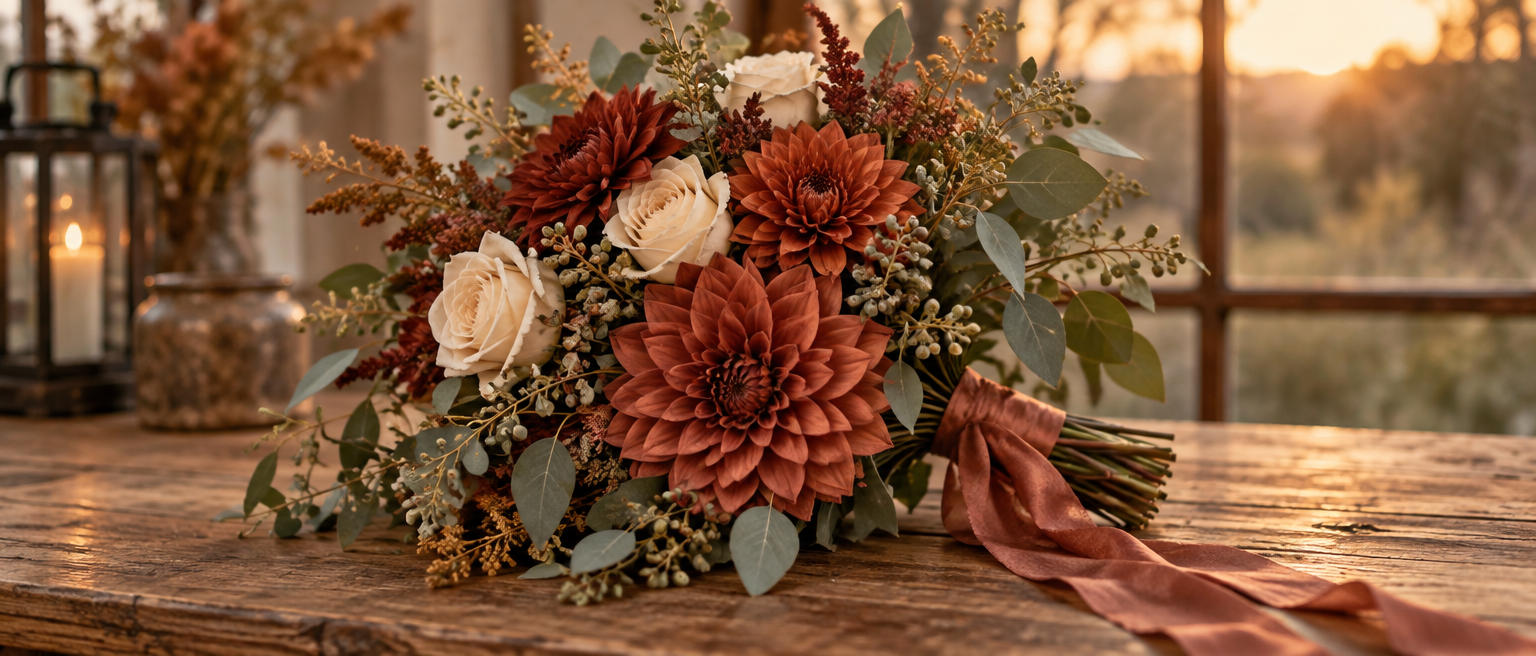
Formula: rust dahlia or garden rose (dominant) + terracotta chrysanthemum or marigold (secondary) + cream bloom to open it up (rose, ranunculus) + seeded eucalyptus or ruscus (green). One dominant warm tone, one echo, one light, one green — the four-part formula most “effortless-looking” fall bouquets share.
This palette photographs golden-hour warm and works against navy, sage, and dusty blue bridesmaid dresses. Faux sourcing: rust is one of the best-covered colors in artificial stems (it’s a permanent retail color, not a seasonal dye run) — start with flower arrangements and the deep-toned end of red artificial flowers.
Palette 2: Burgundy and Blush (The Moody Route)
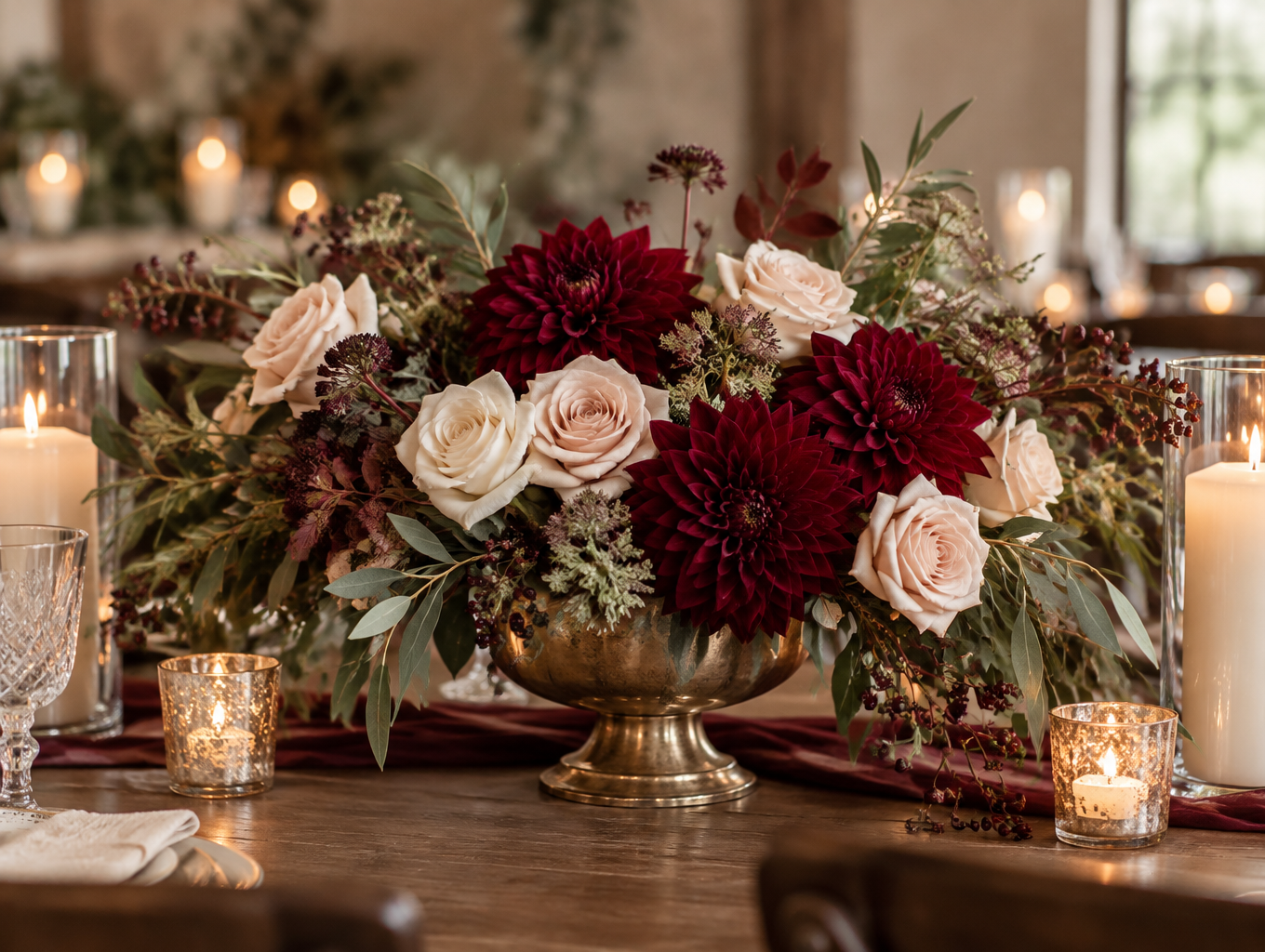
Formula: burgundy dahlia or dahlia-style bloom (dominant) + blush garden rose (relief) + burgundy-veined greenery or olive (bridge) + the occasional deep purple accent (scabiosa, calla). Darker overall, reads wine-cellar-elegant, made for candlelit October evenings and estate venues.
Burgundy is the strongest faux category of the entire fall list — fresh burgundy varieties bruise and brown visibly by hour four, while quality faux burgundy holds its wine depth all night. This is the palette where going faux genuinely upgrades the event photography, not just the budget.
Palette 3: Harvest Neutral (The Understated Route)
Formula: cream rose or ranunculus (dominant) + wheat or bunny-tail grasses (texture) + eucalyptus (green) + one small warm accent (dried orange slice, blush berry). The least “fall-themed” fall palette and the one that survives trends — if you’re marrying in fall but don’t want the wedding to look like a fall festival, this is the line. Also the cheapest faux build: its components (cream roses, wheat, eucalyptus) are commodity stems year-round.
The Fall Bloom List (Fresh vs Faux, Honestly)
| Bloom | Fall role | Faux quality note |
|---|---|---|
| Dahlia | The fall statement flower | Two-tier market: quality faux dahlias are excellent, cheap ones read plastic — order samples |
| Chrysanthemum | Volume filler, holds texture | Faux matches fresh almost exactly (mums are dense and uniform) |
| Marigold | Rust accent, harvest texture | Faux beats fresh — real marigolds shatter within days |
| Celosia (cockscomb) | Sculptural oddity, texture | Decent faux; the velvet texture is the tell of the good ones |
| Amaranth (love-lies-bleeding) | Draping drama from bouquets/arches | Faux drapes convincingly; no pollen drop on dresses |
| Sunflower | Bold rustic statement | Faux excellent; fresh droops fast and stains |
| Wheat & grasses | Neutral texture, filler | Faux = permanent, no shedding |
| Eucalyptus/olive | The green in every formula | Faux seeded eucalyptus is a commodity — indistinguishable at 2 feet |
The pricing reality behind that list: fresh dahlia demand concentrates into September-October, and peak-season wholesale pricing reflects it — the “fall look” premium. The same shapes in faux carry no seasonal price cycle at all: a rust dahlia stem costs the same in March as in October. For the budget arithmetic on full weddings — where the faux-versus-fresh crossover lands — see wedding flowers cost.
Uses: Ceremony to Tables
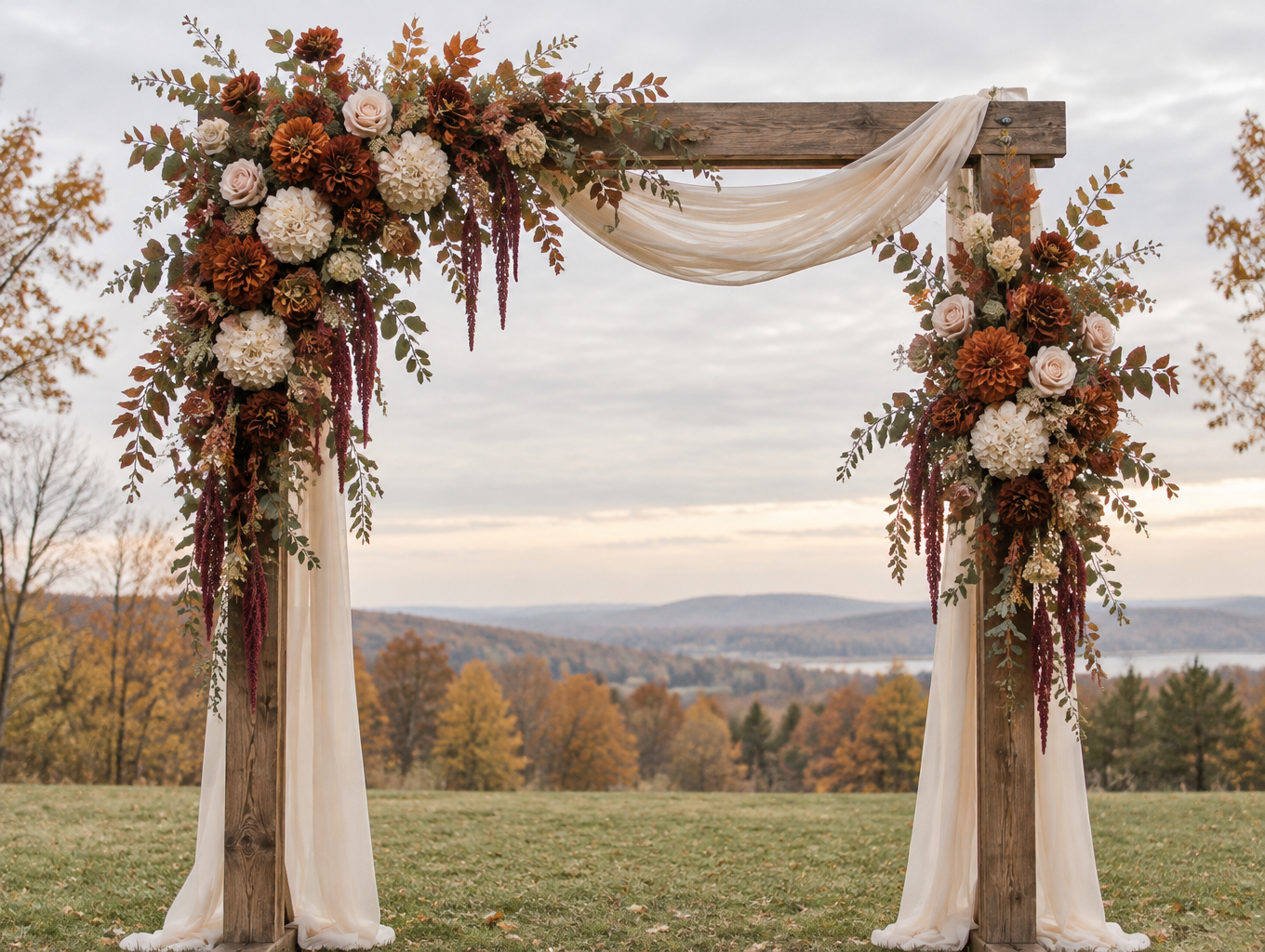
Bouquets carry the palette at maximum density — build or buy from artificial wedding bouquets in your palette’s formula, and keep the binding (ribbon color) consistent across all of them. Arch and ceremony florals want volume over precision — clusters of the secondary blooms and greenery at 60-70% density look full at distance, where a bouquet’s fine detail disappears; the build logic is in arch flowers. Guest-table centerpieces should drop one register of drama from the bouquet — same palette, calmer execution — and the sizing rules by table type are covered in our centerpieces guide. Count every piece before ordering: the per-role worksheet (bouquets, worn florals, arrangements, arch) is the wedding flower checklist.
And if you’re still upstream deciding the whole room: the palette-level decision framework (fall palettes versus other seasons, with dress and linen pairings) is its own guide at wedding color palettes.
FAQ
What are the most popular flowers for fall weddings?
Dahlias (the signature September-October bloom), chrysanthemums, marigolds, celosia, amaranth, sunflowers, and cream roses with eucalyptus for the neutral route. Of these, marigolds, sunflowers and wheat are genuinely better in faux; dahlias are the one to sample before buying in bulk.
Are faux flowers acceptable for a formal fall wedding?
Current-generation faux reads as fresh at conversation distance — the tells to avoid are single-tone dye jobs and too-perfect petal symmetry. Fall palettes, dominated by dense blooms (dahlia, mum, marigold), are among the most convincing faux categories. Judge samples in daylight against your fabric swatches.
How much do fall wedding flowers cost?
Fresh floral service for a mid-size wedding typically runs $1,500-3,500 with peak fall dates at the top of the range; the same coverage in faux runs roughly $300-800 in materials (DIY) or $600-1,500 premade — with zero seasonal premium and full reuse or resale value after. The full itemized comparison is in our cost guide linked above.