
Wedding Flower Arrangements & Packages
Wedding arrangements are the venue's florals — everything that dresses the room rather than the people: the centerpieces guests talk across, the altar pair framing the vows, the urns marking the aisle mouth, the blooms on the cake. Silk versions turned this category's economics inside out: no wedding-morning install windows, no cooler logistics, no compost line at midnight.
Quick answer: Artificial wedding flower arrangements are the staged venue pieces — centerpieces, altar arrangements, statement urns, cake florals — as opposed to the carried and worn program. A 100-guest wedding lands at roughly 35–45 arranged pieces all-in. Three budget routes: DIY stems at $300–800 in materials, pre-arranged sets at $600–1,500, comparable fresh florist work at $1,500–3,500 (2026 US averages, as of October 2026). Order everything in one batch — same order, same dye lot.
Wedding Arrangements, Explained
The three jobs: carried, worn, staged
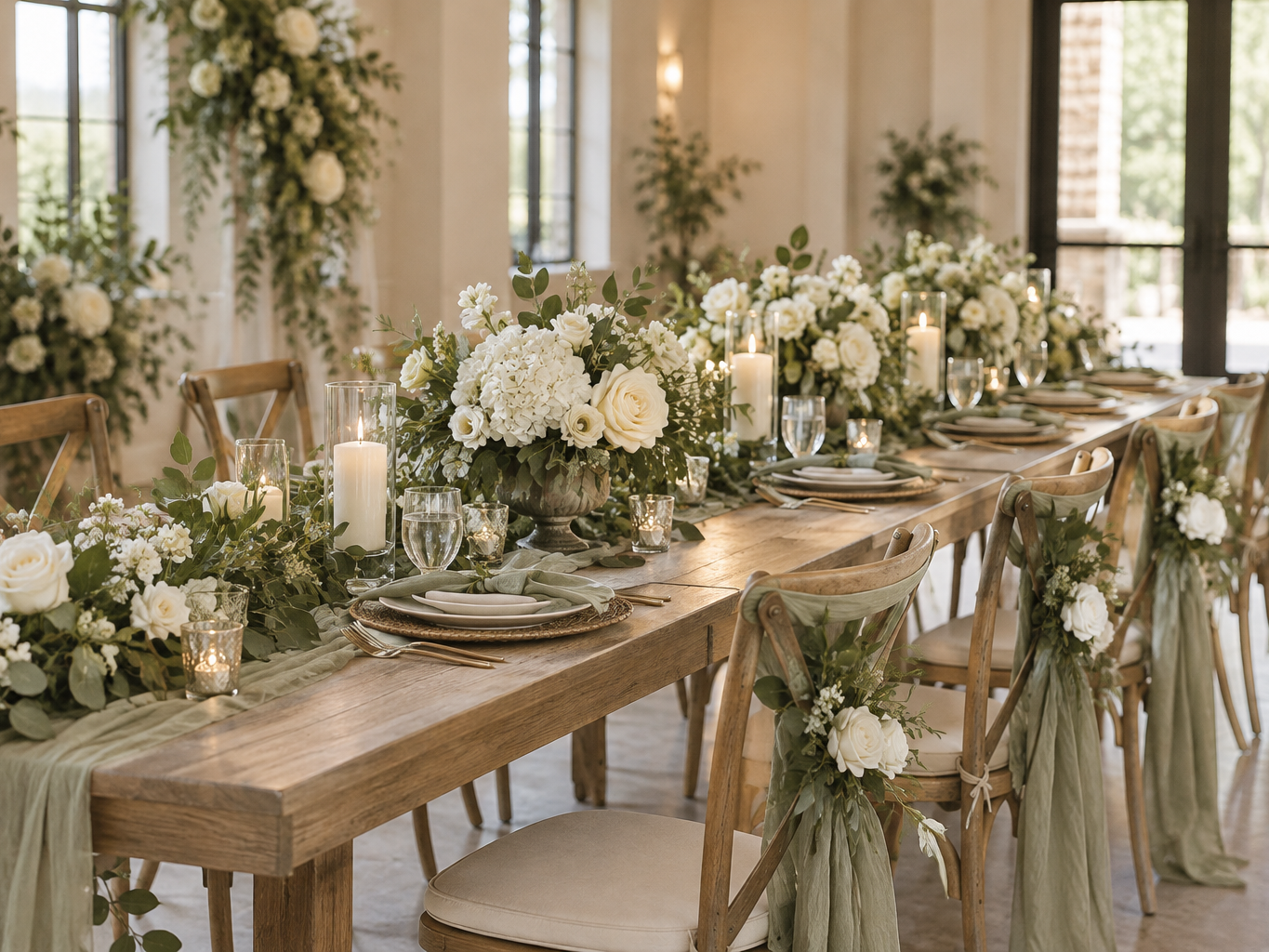
Every wedding flower purchase belongs to one of three jobs, and counting by job is how the order stays sane. Carried: the bridal bouquet, toss bouquet, and bridesmaids' posies — 4 to 8 pieces in a typical party. Worn: boutonnieres for the groom's side (8–14 pieces) and corsages for mothers and honored guests (2–6). Staged: the piece count that scales with the guest list — centerpieces run one per guest table plus two to four for the head and vendor tables, ceremony arrangements anchor the arch and aisle ends, and a signage table wants one small posy. A 100-guest wedding with 10 tables lands at roughly 35–45 arranged pieces all-in, and every set listing here states its exact count against that math.
The artificial route's structural advantages are timeline and survival: pieces arrive weeks early (not the florist's 48-hour window), wired builds hold their arranged shape through ceremony, photo line and reception without water or refrigeration, and nothing needs preserving afterward. The honest trade, as throughout this category: no scent, and arm's-length texture that reads botanical from viewing distance rather than petal-by-petal.
The venue's floral map
The dye-lot discipline, venue-wide
Venue arrangements sit beside the bouquets and wearables in every photograph, at distances where dye-lot drift shows hardest. The rule that keeps the whole program coherent: every piece — carried, worn, and placed — orders in one batch from one colorway system, the same discipline running through the wedding color collections. Between different retailers or different order months, the same-order-same-batch guarantee disappears, which is the quiet argument for ordering the full party's flowers in one place. Split orders are how two blushes end up sharing a head table. On build grade: greenery and filler are specified at the same material grade as the focal blooms — the eucalyptus behind a peony is not cheaper material, which is where low-grade wedding florals fail in exactly the photos that get framed.
The Wedding Flower Count Worksheet
The Three Budget Routes
Route one — full DIY with artificial stems: buy loose stems and build everything; $300–800 in materials for the full worksheet above, plus two assembly afternoons with your party. Route two — pre-arranged sets: buy finished bouquets, boutonniere sets and centerpieces from collections like this one; $600–1,500 for the same count, one afternoon of staging. Route three — florist fresh: $1,500–3,500 for comparable scope (2026 US market averages, as of October 2026; fresh florist packages for 100 guests commonly quote $1,800–2,500 in mid-market metros). The routes are not exclusive — the common hybrid is pre-arranged artificial for carried and staged pieces with a single fresh order for the bride's own bouquet where scent matters to her.
Why Silk Arrangements Took the Venue
- The install calendar flips. Fresh centerpieces install in the hours before guests; silk installs the day before or the day before that — venue access permitting — with zero risk riding on the timeline.
- Heat stops being the enemy. August ceremonies, tented receptions, outdoor vows in full sun: conditions that wilt fresh arrangements by cocktail hour leave silk exactly as placed.
- The afterlife is real money. Centerpieces re-home as guest gifts, altar pairs restyle into first-home decor, and everything resells — the wedding DIY program covers the resale-and-reuse planning.
- Budget shifts from logistics to flowers. No cooler, no install crew, no per-piece rush fees — the spend lands in visible blooms rather than invisible logistics.
Timeline: When to Order What
Artificial wedding florals run on parcel timelines, not florist windows, and the schedule that removes risk: order color samples or one preview piece 3–4 months out (photograph it against fabric swatches in daylight — the single most useful color check in the category); place the full order 6–8 weeks out once the guest count and table map lock, in one batch for the same-batch color rule; and stage a full assembly rehearsal — bouquet build, centerpiece mock, boutonniere pin — 2–3 weeks out, which is when a wrong color or short count is still fixable. That final fortnight is also the arrival buffer: two to three weeks before the date covers the full unbox, fluff and dry-run placement, plus the daylight color check against linens before anything is final. Fabric blooms ship compressed and need a day out of the box plus a minute of fluffing per piece to sit at their photographed shape.
Frequently Asked Questions
How much do wedding flowers cost with artificial stems versus a florist?
For a 100-guest wedding with the standard worksheet — 6 bouquets, 12 worn pieces, 12–14 centerpieces, ceremony staging — the artificial DIY route runs $300–800 in materials; pre-arranged artificial sets run $600–1,500; comparable fresh florist work runs $1,500–3,500 (2026 US averages, as of October 2026, with mid-market metro packages commonly quoted at $1,800–2,500). The structural difference beyond price: artificial pieces arrive weeks early and hold through the whole day without water, while fresh concentrates every risk into the florist's 48-hour delivery window and wilts across a long photo schedule.
How many wedding arrangements do I need?
Count the room by job: one centerpiece per guest table plus two to four extra for the head and vendor tables (a 100-guest wedding with ten 8-top tables lands at 12–14 centerpieces), an altar pair or arch build for the ceremony, 2–4 aisle markers at the aisle mouth and entrance, a head-table run, cake florals and a signage posy — roughly 35–45 arranged pieces all-in. The most-missed piece is the count itself: confirm table counts before ordering, and buy 10 percent over on small pieces; silk stores indefinitely and the shortage has no same-day fix.
Low or tall centerpieces?
Sightlines decide. Reception centerpieces stay under 12–14 inches wherever guests converse across tables, with height carried by candlesticks instead; tall formats (24 inches plus, on stems or risers) belong in rooms with high ceilings where tables read lost without height. Long-king's-table formats run garland or runner arrangements measured to the table length instead of per-table counts. Mixed runs — tall on the head table and long tables, low on rounds — are the planner's standard compromise.
Will artificial wedding flowers look convincing in photos?
At the distances cameras and guests actually work — the photo line at six feet, reception tables across the room — same-grade builds read convincingly, and wired construction means each arrangement holds its photographed shape through hours of carrying, hugging and dancing instead of wilting out of it. What the material honestly does not do: scent, and petal-by-petal texture at arm's length. The mitigation many couples choose is the hybrid — pre-arranged artificial for everything staged and worn, one fresh bouquet for the bride where scent is part of the memory.
When should I order artificial wedding flowers?
Preview first, full order second: get a sample piece or color swatches 3–4 months out and photograph them against your fabric swatches in daylight; place the full order 6–8 weeks before the wedding once guest count and table map lock — as one batch, because same-order pieces leave from the same production batch and read as one palette in photos; and run the full assembly rehearsal 2–3 weeks out, the arrival window that catches a wrong tone or short count while it is fixable. That schedule replaces the florist's 48-hour delivery window with a month of slack.
How do I keep all the flowers one consistent color across different pieces?
Order everything in one batch from one shop. The stated fulfillment rule that makes palettes cohere: same order, same batch — pieces in one order leave from one production run, so the blush in the bouquet, the boutonnieres and the table runners read as one color family in the photographs. Split orders across retailers or order months break that guarantee; within the wedding color collections, each palette is built to hold the whole program.
Can I reuse or keep artificial wedding flowers afterward?
Yes, and reuse is where the artificial budget math compounds: the bridal bouquet boxes flat as the keepsake (no preservation service needed — the piece already lasts), centerpieces restyle into home arrangements for the couple's first apartment, and ceremony sprays re-home to family or the venue sign-in table. A two-minute fluff restores the photographed shape after a day of wear. Stored dry and out of sun, the color holds for years — the honest answer to "what happens to the wedding flowers": with fresh, nothing; with artificial, the house.