
Quick answer: Silk flower stems are loose blooms sold by the piece — single stems, multi-bloom sprays, bushes, and picks — the raw format every arrangement is built from. Buying stems instead of finished arrangements cuts per-bloom cost by roughly half and hands you the palette control florists charge for. The trade is an arranging hour; the skills are bending, layering, and one honest fluff.
This is the builder's aisle — every flower on the site in its loose form, priced by the piece and waiting to become whatever you can picture. Finished arrangements are someone else's decisions; stems are yours, and the difference in cost funds the vase.
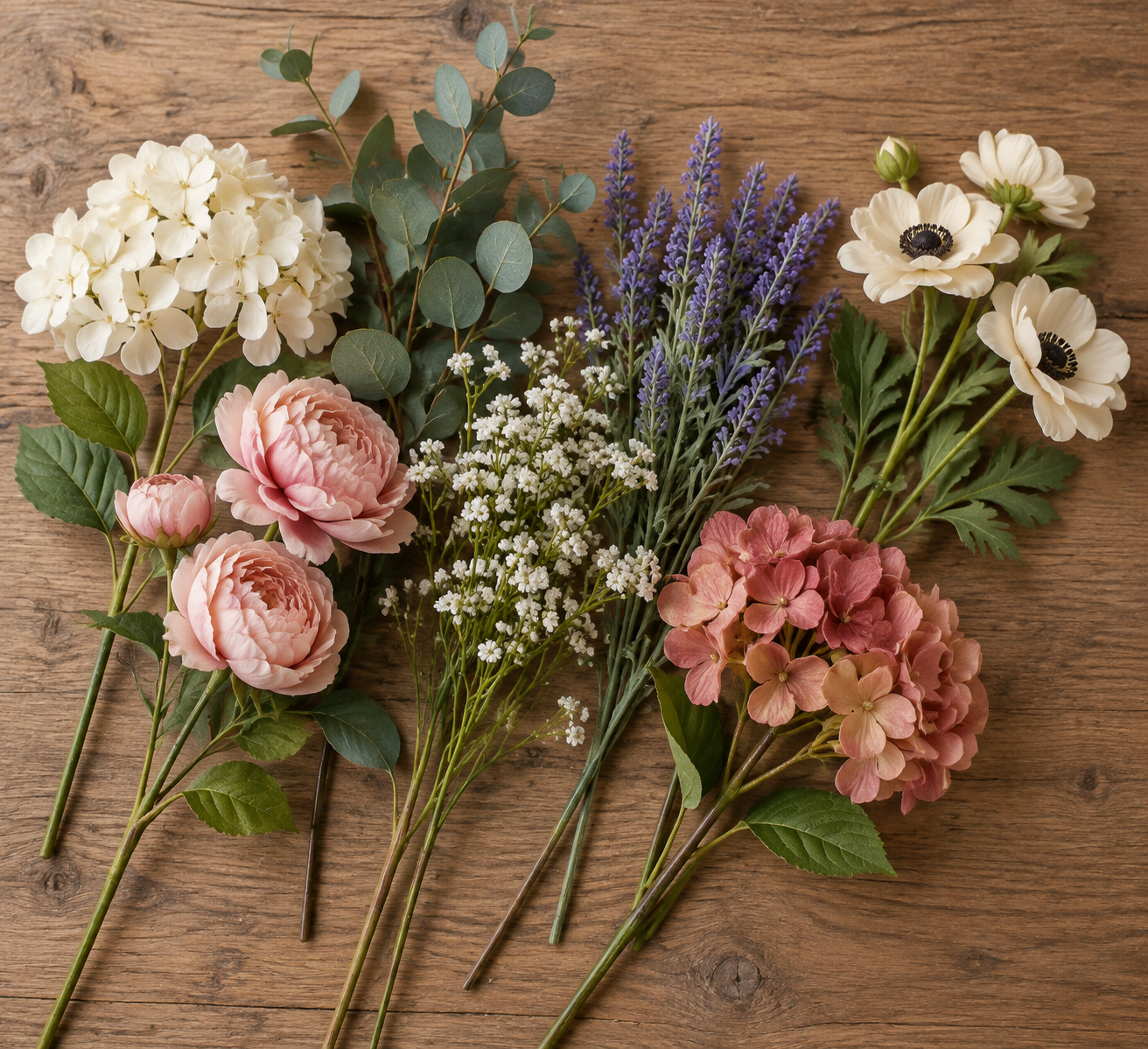
Stems and Sprays, Explained
The four loose formats
| Format | Carries | Best for |
|---|---|---|
| Single stem | One bloom, one full-length stem | Face flowers — roses, lilies |
| Spray | One stem branching into several blooms | Layered fullness at lower per-bloom cost |
| Bush | Multiple heads on one base — hydrangea bushes the classic | Volume: aisles, arches, large builds |
| Pick | Small clusters on short stems | Wreaths, garlands, detail work — the picks program |
The starter build, learned once

Three layers, built in order. Greenery skeleton first — the tallest lines and the rim collar from the greenery program. Face flowers second — the blooms the arrangement exists for, at staggered heights, each bent just below its head so faces turn outward. Filler third — sprays and small elements closing the gaps. The one skill that separates results: bend, don't just place — every real stem curves, and wire cores hold whatever lean you give them.
Why Buy Loose
- Economics: per bloom, loose stems run roughly half of finished-arrangement pricing — the assembly is what you were paying for, and the arranging hour is yours to give or skip.
- Palette control: one dye lot, one order, exact color — the discipline behind every professional build and impossible with pre-made pieces from different makers.
- Scale: weddings and events buy stems because counts multiply — the wedding DIY program and bulk lots exist for exactly this.
- The overage never spoils: leftover stems store indefinitely — the spare becomes next season's refresh, not waste.
What Single Stems Cost
The stem aisle prices by build, and the ladder is consistent across every seller that shows numbers:
| Build | Market range | Examples |
|---|---|---|
| Budget singles | $1.87–$5.95 | Craft-retailer mini blossoms, rose bud stems, wisteria stems |
| Mid silk | $4.49–$9.98 | Open-rose stems, real-touch hydrangeas at $7.79–$8.99, the big-box silk lines near $10 |
| Branches and wholesale packs | $12.59–$46.99 | Six-packs of open roses ($12.59), magnolia branches ($32), thistle 12-packs at $46.99 |
Two market facts sharpen the value case for buying loose. First, materials: a quality stem discloses its composition, and the honest numbers are unglamorous — one supplier's published breakdown for a floral stem runs 55% plastic, 25% polyester, 10% wire, 10% glue. That is what "silk flower" means at retail; the differences that actually matter are the polyester grade and the wire gauge, not the word silk. Second, the rental alternative exists: wedding stem rental programs start around $180 — pitched as roughly a third of the fresh-flower equivalent — which makes buy-loose the middle path with the better ending: own the stems, and the second arrangement costs nothing but the arranging hour.
Frequently Asked Questions
How many stems do I need for a vase?
The three-layer ratio: 2-3 greenery, 3-5 face flowers, 2-3 filler sprays for a standard 8-to-10-inch vase. Massing flowers count lower (5-7 hydrangea or peony stems do the whole job), face flowers count higher (9-12 roses). Bud vases take exactly one — the minimal end of every species.
Are loose stems really cheaper than finished arrangements?
Per bloom, roughly half — you are deleting the assembly and design labor from the price. The honest total includes your arranging hour, which is real but not billable: builders who enjoy the table work save fully; builders who do not should price the finished arrangements line against the stems before deciding.
Can I cut and extend silk stems?
Both, with the right tools: cut with wire cutters (never scissors — the wire core chews and frays), and extend with wooden floral picks or taped overlap when a tall build needs length the stem lacks. Cut long when uncertain — length never grows back, and foam builds seat better with a touch of spare.
What is the difference between a stem, a spray, and a bush?
One bloom on one full-length stem; a spray branches several blooms off one stem at lower cost per bloom; a bush stacks multiple heads on one base for maximum volume coverage. Stems for precision, sprays for fullness, bushes for scale — most builds run all three.
What are artificial flower stems made of?
The typical retail stem is a fabric-and-wire composite — one supplier's disclosed breakdown runs 55% plastic, 25% polyester, 10% wire, 10% glue. "Silk" is the trade word for the polyester petal fabric; the plastic carries structure and molded details; the wire core is what lets you bend and shape each stem. Quality differences live in the fabric grade (thickness, print, edge finish) and the wire gauge — a thin core goes limp under a heavy bloom head, which is the most common failure in budget multipacks and the reason face flowers are worth buying at the mid tier.