

Deco Mesh Wreaths
Quick answer: Deco mesh wreaths are built from wide polypropylene ribbon — 10-inch and 21-inch rolls — ruffled, poufed or braided onto a work wreath frame. The volume no flower base matches: one 10-inch roll covers a full 18-inch wreath, and a 20-inch mesh build out-shouts a 24-inch evergreen. Rain flattens the curls until re-shaped in seconds; the honest trade is sun, which grays mesh fastest.
Deco Mesh Wreaths, Explained
The material system
Three wreath bases, split cleanly
Evergreen is the classic dense silhouette — quiet at close range, authoritative from the curb. Grapevine is the rustic see-through ring. Deco mesh is craft-forward: color-first, dimension-first, and unapologetic at maximum volume. Mesh is also the lightest large wreath in the line — the ruffles pass air — which makes it a practical choice for windy doors where a dense 24-inch evergreen would sail. The trade is sun: mesh holds its curls in rain, but its colors are the most sun-sensitive of the three bases.
Three techniques, three looks
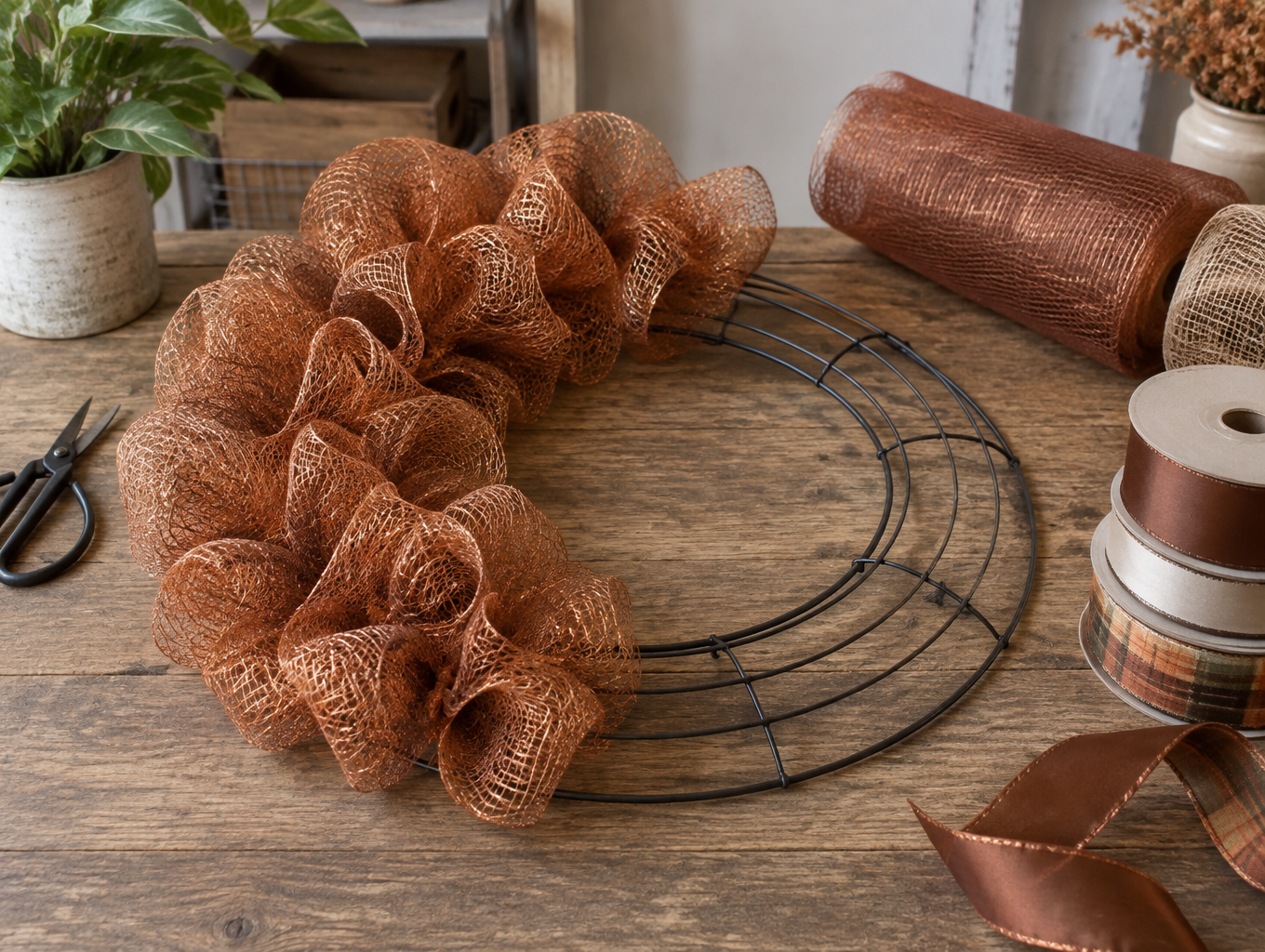
The ruffle is the beginner's technique — mesh gathered into curls and tied to the frame's tinsel points, an hour to a finished wreath. The pouf cuts mesh into squares, bunches each into a burst, and ties densely for maximum volume. The criss-cross braids full-width mesh over and under the frame rails for the smooth, tailored look the technique's name promises. Every tutorial video on the subject teaches one of the three; every finished mesh wreath is some combination of them. This page carries both halves of the hobby: finished designs arrive built and hang-ready, with colorways named per listing and photos of the single wreath that ships; for makers, the material side — mesh rolls by color and width, work rings, ribbon and picks — sits one link away in wreath making supplies. A first build takes a ring, 2–3 mesh rolls and an evening.
Why Mesh Owns the Porch
- Rain-proof by material. Poly mesh dries in place with no wilting or staining — a storm flattens the curls only temporarily, and fingers re-shape them in seconds. Storm recovery is trivial.
- Volume economics. A roll of mesh prices below florals and delivers more visual square footage than any botanical — a 20-inch mesh build out-shouts a 24-inch evergreen at craft-supply budgets.
- The wind advantage. Ruffles pass air: on windy doors where a dense evergreen would sail, mesh is the practical large-wreath choice. The honest cost is sun — mesh colors are the most sun-sensitive of the three bases, so covered and shaded doors keep saturation for seasons while open west-facing doors gray them fastest.
- The refresh habit applies here too. Cut the ties, strip the frame, re-tie next season's colors — the work frame serves year after year beside the grapevine rotation.
- Hybrid builds are the current look. Mesh base plus silk picks and a sign — the craft-fair standard that combines mesh volume with botanical detail.
How to Choose a Deco Mesh Wreath
- Buy the volume you mean. Mesh is the loudest base in the line — a 20 in. mesh build out-shouts a 24 in. evergreen. Pick color and volume first, size second.
- Read the door's sun card. Mesh colors are the most sun-sensitive of the three bases — shaded and covered doors keep saturation; open west doors gray them fastest.
- Exploit the wind advantage. Ruffles pass air: on windy doors where a dense evergreen sails, mesh is the practical large-wreath choice.
- Finished or DIY? Hang-ready designs here; or a ring, 2–3 mesh rolls and an evening — materials in wreath making supplies, rings in wreath forms.
- Store it loose. Mesh crushes and re-fluffs by hand — the one wreath type with no box discipline; rain-flattened curls re-shape in seconds.
Frequently Asked Questions
What is a deco mesh wreath made of?
Wide open-weave polypropylene ribbon — the material called deco mesh — gathered into curls, poufs and spiral loops and wired to a work ring, usually layered with contrasting ribbon and ornaments. The mesh itself is plastic, which is exactly why it holds a curl and passes wind; it is not trying to read as botanical. Every listing names its colorway and photographs the single wreath that ships, so you judge the actual colorway, not a mood board.
How long do deco mesh wreaths last outside?
Split by hazard. Rain: mesh's best case — curls flatten temporarily and re-shape by hand in seconds, drying in place with no staining, so storm recovery is trivial. Sun: the real limit — mesh colors are the most sun-sensitive of the three wreath bases, so covered and shaded doors keep saturation for seasons while open south- and west-facing doors gray the colors fastest. Wind: mesh's second best case — ruffles pass air, so large mesh builds handle windy doors better than dense evergreen. Placement is stated per listing; there is no blanket outdoor rating.
How much mesh do I need for a wreath?
One 10-inch-by-30-foot roll covers a standard 15-to-18-inch work frame in the ruffle or criss-cross technique; poufs run denser and want a roll and a half, or a single 21-inch-by-10-foot roll in wide-strip work. Layered colorways double or triple the count — most two-color wreaths run one full roll plus a second color at half coverage.
Which is better — ruffle, pouf, or criss-cross?
Ruffle for beginners and soft, curvy volume — an hour to learn and finish. Pouf for maximum density and the big statement door. Criss-cross for the tailored, smoother look that suits modern doors. All three attach to the same work frame with the same ties; start with a ruffle, and the other two are variations you will pick up from one video each.
Can I make my own deco mesh wreath?
Yes — and the material side of the hobby is stocked for it. A first build takes a work ring (wreath forms), 2–3 mesh rolls in your colorway, wired ribbon for accents and floral wire or pipe cleaners to tie (all in wreath making supplies), plus one evening. The three basic techniques — ruffle, spiral and pouf — cover most beginner patterns, and the how-to guide linked from the supplies collection demonstrates each. Finished designs on this page are for everyone who would rather skip to the hanging.
Are deco mesh wreaths tacky?
That is a style question with an honest answer: mesh is a statement material — craft-fair tradition, high color, high volume — and it does not pretend to be botanical the way evergreen builds do. Homes that love it love it loudly (Halloween and team-color season are its natural habitat); homes that want quiet use evergreen or grapevine instead. The line's three bases exist precisely because doors differ. If you are mesh-curious but cautious, single-color builds without signs read closer to classic than the multi-color statement pieces.
How do I fix a crushed mesh wreath?
Fingers, mostly. Mesh holds curl memory: re-shape flattened ruffles by pulling them gently back through your hand, and crushed spirals re-roll around a finger or a dowel. No steam, no heat, no tools — this is the one wreath type where shipping crush and storage crush are non-events. It is also why mesh is the easiest wreath to store: no shaped box required, crushable and stackable, and it fluffs back by hand in about a minute.
How do I attach signs and picks to a mesh wreath?
Signs mount on the frame through their pre-drilled holes with zip ties or pipe cleaners run through the mesh gaps; picks and silk stems hot-glue or wire into the mesh at its tie points, where the structure is densest. Place signs first, mesh colorwork around them, botanical accents last — reversing the order buries the sign the first time the door slams.