
Staircase Garlands
A staircase garland is a strand built for the spiral — greenery or flowers on a wired spine, measured not against the railing it runs but against one and a half times that length. This page is the stair rail's own buying guide: the run × 1.5 arithmetic that every other garland page references, the install itself, the two-piece overlap method for standard lengths, and the lighting and anchoring choices that make a stair garland the one install in the house guests walk past at arm's length.
Quick answer: Stair garland length = railing run × 1.5 — a 10-foot rail needs about 15 feet, built from two 9-foot pieces overlapped and zip-tied where the splice hides in a swag. Anchor every 12-18 inches, start from the top, battery lights over cords. Market bands as of October 2026, USD: plain greenery $25-60 per 9 feet, decorated $50-130, pre-lit $70-180 — and stair garlands are a November product (40,500 monthly lookups at peak, against 5,400 the rest of the year): buy the rail run by early November, because the good builds clear before the first decorating weekend.
Staircase Garlands, Explained
What a staircase garland is
A staircase garland is a wired-spine strand installed in a spiral around a stair rail — and the definition matters because the spiral changes the shopping arithmetic. A garland laid flat along a mantel needs its own length plus drape; a garland wrapped around a railing consumes extra length with every turn, which is why the rail's measured run is only two-thirds of the answer. The stair install is also the most-scrutinized garland in the house: a mantel garland is seen from across the room, but a stair garland is walked past at arm's length, seen from above and below, and grabbed by children — so the underside matters (bare-spine budget strands show wire where guests look up), and the anchoring matters more than anywhere else. Search behavior confirms the November identity: "staircase garlands" runs 5,400 lookups a month and peaks at 40,500 in November — the strongest seasonal concentration of any garland placement, because the stair spiral is the signature install of the December decorating weekend.
Every listing states its measured length — 6, 9 and 12 feet are the standard retail sections — and the photo shows exactly one garland unless the title says a set.
The formula: railing run × 1.5
The arithmetic that sizes every stair install, and the reasoning behind it: a garland wrapped in a spiral around a railing travels the diagonal, not the rail's length — every turn around the rail's girth adds inches, and the swag loops between anchors add more. Field arithmetic lands at one and a half times the measured run: measure the rail from newel post to the bottom turn (or wall, if the rail runs into one), multiply by 1.5, and buy to that number. A 10-foot rail needs about 15 feet. An 8-footer needs 12. A 12-footer needs 18. The formula assumes the standard spiral-with-loops install; a tight flat wrap (no loops, the strand hugged to the rail) runs closer to 1.2×, and a heavy deep-swag style on a wide rail can eat 1.7× — but 1.5 is the number that has held across every rail width and loop depth in normal residential work, and it is the number to take to the checkout page. Buy under it and the install runs short at the bottom turn — the single most common stair-garland mistake, visible from the front door.
The two-piece overlap: how 15 feet actually ships
Retail garlands ship in 6, 9 and 12 foot sections, and almost no residential rail's × 1.5 number matches a section exactly. The standard method is the two-piece overlap: two 9-foot pieces for the common 10-foot rail (18 feet of strand against a 15-foot need), overlapped by two to three feet at the joint, the splices zip-tied to the rail where the join hides inside a swag loop. The overlap is not a compromise — it is how fullness is built, because a doubled section reads as the run's densest moment, which is why the joint is placed at the bottom turn or at a post rather than mid-run. Start wrapping from the top: the splice lands at the bottom where traffic is lowest, and any surplus drops off the last newel as a finishing swag. Three-piece runs (long curved staircases needing 20-plus feet) chain the same way, staggered so the two joints sit at different points on opposite sides of the rail.
The install, in order
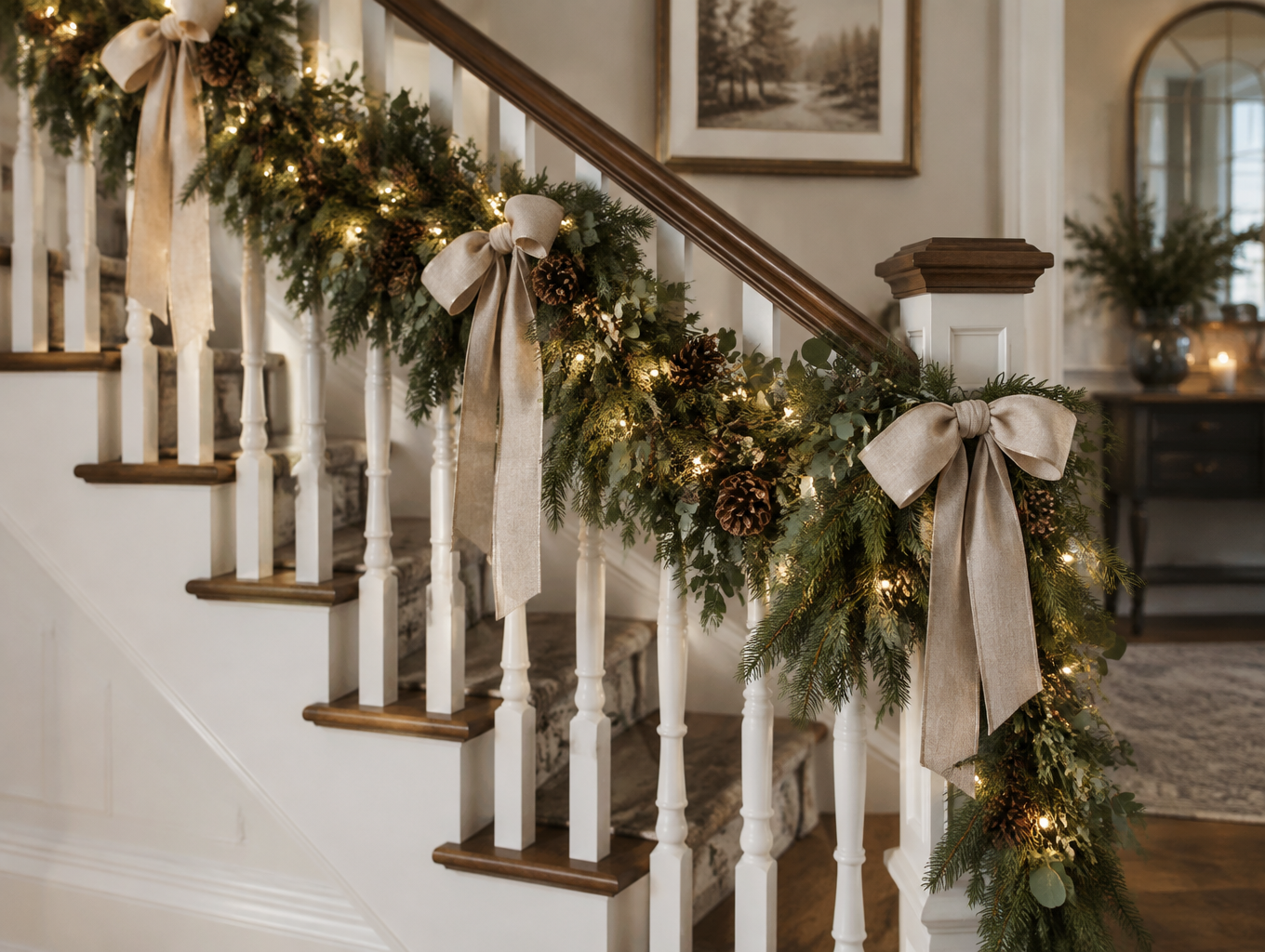
Fluff the strand fully on the floor first — every branch bent out in alternating directions — because a fluffed-on-the-rail garland always has one flat side. Anchor from the top newel down, one anchor per swag crown every 12-18 inches: zip ties in green or brown (the January-you will thank the December-you — they release in seconds and cut cleanly), rail hooks where the rail is too smooth to trust friction, or florist wire wrapped at each rise for the traditional look. Let the strand fall in natural loops rather than pulling it flat — the loops are the fullness, read from across the room. And hang the swag bottoms clear of the walking line: a loop that swings into the stair's path is a grab hazard all season, and the fix is a deeper anchor pull at that loop only.
Rail lengths to garland buys: the working table
Lights on stairs: battery over cords, and the honest pre-lit question
A stair garland and a light cord down a staircase are a bad pairing — cords on stairs are the obvious trip and snag hazard, and the outlet is always at the wrong end of the run. The working answer is battery: battery micro-LEDs woven into the spiral (packs tucked inside the swag crowns, most on built-in timers), or pre-lit garlands specified as battery-powered — the stair builds among them typically carrying 100-200 warm-white lights per 9 feet. The honest pre-lit caveat is the same one the mantel pages make, sharpened by the stair's geometry: the light string is the component most likely to fail across years, and on a two-piece stair run a dead section means diagnosing which piece went dark. Unlit strands plus your own battery strings keep the diagnosis trivial — swap the string, not the garland. Households running the same anchors every year usually land on unlit strand plus two sets of battery timers, replaced as strings age, with the garland itself outliving several generations of lights.
Underside, density, and what stair shopping checks that mantel shopping doesn't
Three stair-specific checks. Underside coverage: the garland is seen from below by everyone who climbs the stairs, so the build needs greenery on both faces — the collection standard here is one material grade throughout, back-side and inner branches cut at the same grade as the display side, and the listings state it. Density-per-foot: loops compress visibly where anchors pull them, and an airy strand that reads full on a mantel reads thin on a rail — dense-tip builds (cedar, pine, eucalyptus at close spacing) hold the spiral's silhouette. And grab tolerance: stair garlands get touched — by guests, by children, by the dog — so component pieces (berries, cones, ornaments) are pull-tested before boxing, and anything wired on rather than clipped should be wired to survive a curious hand at child height.
What the market charges, and the November window
The bands as of October 2026, USD, per 9 feet: plain greenery runs $25-60; decorated builds (cones, berries, ribbon wired in) $50-130; pre-lit $70-180. A standard 10-foot rail's two-piece buy prices at two strands, not one — the arithmetic that surprises first-time stair buyers — and the decorated two-piece runs land in the $100-260 range against the rail's length. The November window is the timing that matters: stair searches peak at 40,500 monthly lookups (against 5,400 baseline) in November's first weeks, the decorated and pre-lit two-piece builds clear with the decorating weekend, and January's teardown boxes the strand for four or five seasons of the same rail.
Teardown, and the anchor system that outlives the strand
January teardown is the install run backwards: zip ties cut cleanly one per swag, the strand fluffed flat and coiled loose into its bag or a tote, cool room, no weight on top. Two habits pay for themselves within a season or two: photograph the install before teardown (loop depths, anchor points, which piece overlapped which — the following November's install takes twenty minutes with the photo), and leave the rail hooks in place if the rail will run garlands year-round — the same anchors carry the outdoor line's porch runs and every seasonal restyle, and the garland collection keeps the strand families on the same spine so the anchors never re-drill.
How to Choose a Staircase Garland
- Measure the rail and multiply by 1.5.
Measure newel-to-bottom-turn, multiply by 1.5, and buy to that number: two 9-foot pieces for the standard 10-foot rail, overlapped 2-3 feet with the joint hidden at the bottom turn. Under-buying the bottom turn is the mistake visible from the front door.
- Buy for the underside and the grip.
Both-face greenery at one grade throughout (guests see the strand from below), dense-tip builds that hold the spiral's silhouette, and pull-tested components — stair garlands get touched at child height all season.
- Plan battery lighting, skip cords.
Battery micro-LEDs woven in with packs in the swag crowns, or pre-lit builds specified battery-powered (typically 100-200 lights per 9 feet). Unlit strands keep a dead string a ten-second diagnosis instead of a garland replacement.
- Anchor for January at install time.
Zip ties in green or brown every 12-18 inches, one per swag crown; they release in seconds where wire needs tools. Photograph the finished install — next year's re-run takes twenty minutes with the photo.
- Buy in the first week of November.
The 40,500-lookup November peak clears decorated and pre-lit two-piece builds with the first decorating weekend. Verify stated length and piece count — one garland per photo unless the title says a set.
Frequently Asked Questions
How much garland do I need for a staircase?
Multiply the railing's measured run by 1.5 — the spiral around the rail and the swag loops between anchors consume the extra, and a straight lay at 1:1 looks sparse. A 10-foot rail needs about 15 feet, which in practice is two 9-foot pieces overlapped by 2-3 feet; an 8-foot rail takes one 12-footer; a 12-foot rail takes two 12s or three 9s staggered. Deep-swag styles on wide rails can run to 1.7×, and a tight flat wrap closer to 1.2×, but 1.5 is the number that holds across normal residential work.
How do I hang a garland on a stair rail?
Fluff the strand fully on the floor first, then anchor from the top newel down: zip ties in green or brown every 12-18 inches, one per swag crown (rail hooks on smooth rails, florist wire at each rise for the traditional look). Let the strand fall in natural loops rather than pulling it flat — the loops are the fullness read from across the room. Keep swag bottoms clear of the walking line, and place the two-piece overlap's splice at the bottom turn or a post where the joint hides inside a swag.
Can I use one long garland instead of two overlapped pieces?
You can if the arithmetic lands — a 12-foot rail at 18 feet takes two 12-foot sections cleanly, and a single 12-foot section handles an 8-foot rail's need exactly. But most residential runs land between section lengths, and the overlap is the designed answer, not a workaround: a doubled section of two to three feet reads as the run's densest, most deliberate moment, which is why even exact-fit installs often shift the joint into a swag on purpose. Three-piece runs on curved staircases chain the same way, joints staggered to opposite sides of the rail at the landing posts.
What kind of lights work on a staircase garland?
Battery, always, in one of two forms: your own micro-LED strings woven into the spiral with the packs tucked inside swag crowns (most have built-in timers), or pre-lit garlands specified as battery-powered — the stair builds typically carrying 100-200 warm-white lights per 9 feet. Cords down a staircase are the obvious hazard and the outlet is always at the wrong end of the run. The honest note on pre-lit: the light string is the component most likely to fail across years, so unlit-plus-battery-strings keeps a dead section a string swap rather than a garland replacement.
How do I keep a stair garland from looking thin?
Three checks. Density: an airy build that reads full on a mantel reads thin on a rail — dense-tip cedar, pine and close-spaced eucalyptus hold the spiral's silhouette where wide-spaced constructions gap. Loops: let the strand fall in natural loops instead of pulling it flat; an anchor-pulled-flat install halves the visible volume. Layer: a second, shorter accent strand woven through the swag bottoms only — berried or lit — adds the density where the eye lands, without buying a second full run's length.
How much does a stair garland cost?
Per 9 feet as of October 2026, USD: plain greenery $25-60, decorated builds $50-130, pre-lit $70-180 — and the stair surprise is that a standard 10-foot rail buys two strands, not one (two 9s against the 15-foot need), landing a decorated two-piece run in the $100-260 range. Fresh garland for stairs costs a comparable season's spend and browns by early January; the boxed artificial run returns for four or five seasons of the same rail.
When should I buy and install a stair garland?
Buy the first week of November — stair searches peak at 40,500 monthly lookups that month against a 5,400 baseline, tracking the December decorating weekend, and the decorated and pre-lit two-piece builds clear with it. Install late November through the first December weekend, after the door's wreath decision is made so the two read as one palette. Teardown runs the weekend after New Year's: ties cut, strand coiled loose, install photographed for next year's twenty-minute re-run.
Do stair garlands damage the railing?
Not when anchored for the rail's finish. Zip ties (the standard) contact the rail at each swag crown and release without a mark; rail hooks sit over the rail's top edge and leave nothing when removed; florist wire is the traditional look and is fine on painted and stained wood when wrapped loosely rather than twisted tight. What damages rails is the shortcut list — nails, staples, adhesive hooks on varnish, and wire twisted down through the finish. On smooth metal rails, zip ties plus one rail hook per flight is the reliable pairing; on historic or irreplaceable balustrades, ribbon ties at the swag crowns are the zero-contact option.