
Artificial Garlands


Quick answer: Artificial garlands are linear florals — greenery and bloom strands sold by measured length in 6, 9 and 12 foot sections, for mantels, staircases, head tables and arches. Greenery runs do the everyday work; flowered and seasonal strands carry weddings and holidays. Buy 110–120 percent of the run for droop; silk installs days early and holds where fresh garland wilts by morning.
The garland is decoration's connective tissue — the strand that turns a flat mantel into a scene, a staircase into an entrance, a plain table into a wedding. Silk versions made it a year-round medium: no wilting clock, no water tubes, no wedding-morning install panic — just the strand, the zip ties, and whatever architecture needs dressing. Every piece here is sold the honest way: by measured length, one garland per photo, no intertwined pairs shot to look twice as thick — each listing states the exact length and piece count you receive, and the coverage math to plan with.
Artificial Garlands, Explained
The four strand families
The four families split along one line: greenery-only runs on one side, and flower garlands — strands carrying wired bloom clusters — on the other. The table below is the whole vocabulary; "artificial flower garlands" as a search (about 1,300 lookups a month) lands on the second and third rows, which is why both exist as dedicated builds rather than one flowered category.
Buying by the foot
Garland math is line-length plus 10 to 20 percent for droop: a 6-foot mantel takes 7 feet of strand, a head table takes one 9 ft. run over a standard 8 ft. table with scallop slack (a 12 ft. piece does the same with room to drape over the edges), and a staircase rail gets its measured length plus 3–4 ft. for the bottom swag — an 11 ft. rail reads best as a 12 ft. run. Arch beams want 1.5× the beam length for a full wrap. Buy 110–120 percent of your measured run in every case; joints between pieces hide in the slack, and six-foot sections join with floral wire, staggered so the seams disappear. The density check that matters: greenery-per-foot — quality strands carry fullness on both faces, budget strands front-load and show bare wire underneath stair rails where guests see the underside.
Where Garlands Work
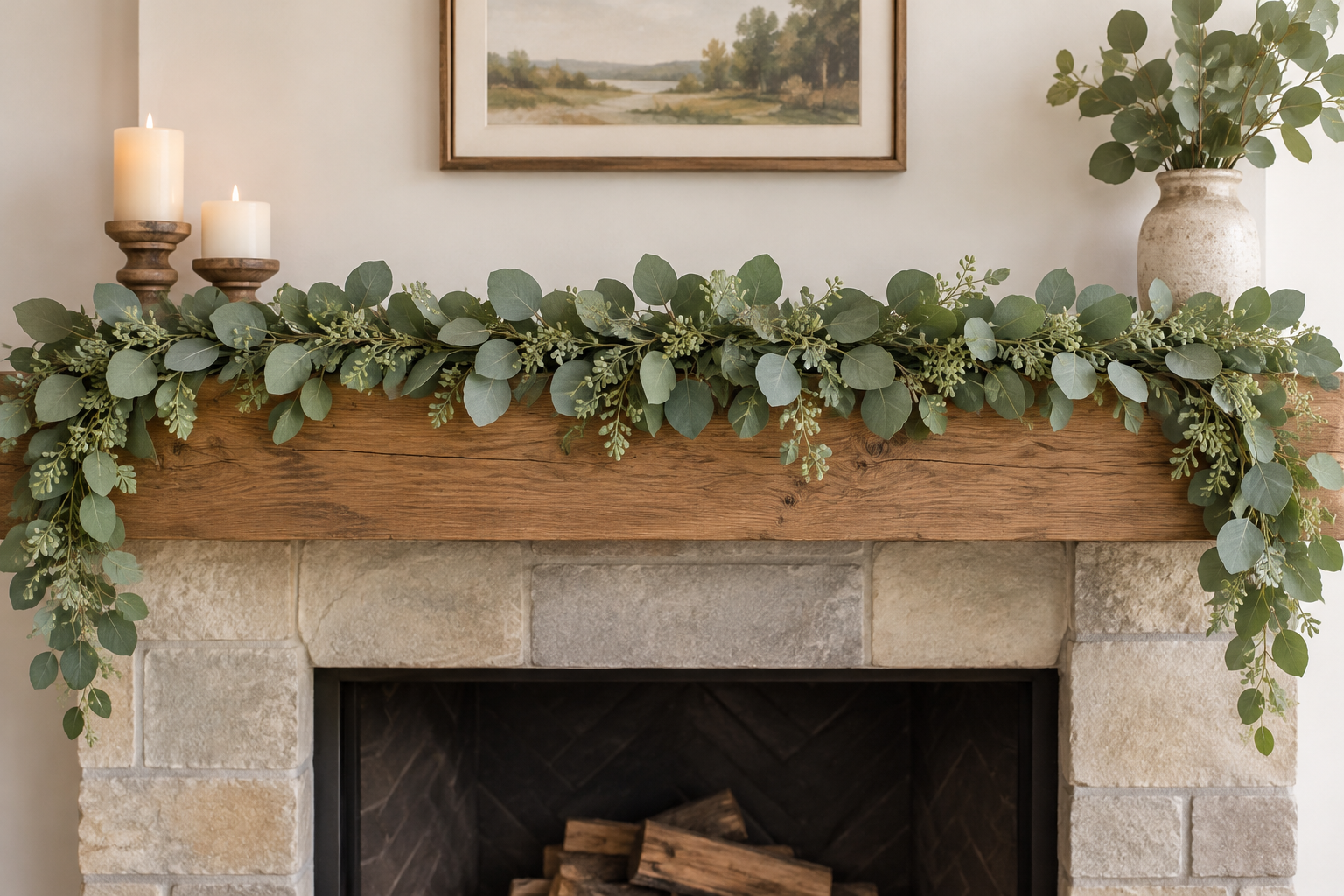
- Mantels, the year-round home: greenery strand plus seasonal picks — refreshed per season — one garland serving four looks a year.
- Staircases and entry rails: the December classic — cedar or pine strand with the wreath line matching at the door.
- Outdoor porches: UV-rated strands on covered entries run seasons; see the outdoor collections for open-exposure grades.
Wedding orders: the two-week dry-lay
Wedding garland orders deliver at least two weeks before the date, with the buffer built into checkout — garlands keep indefinitely, so early costs nothing. The two weeks is for the dry-lay: run the actual lengths on the actual table or stairs, settle joint positions, fluff everything once, and note where the zip ties go. Event crews who dry-lay once run setup day in half the time, and any replacement still fits the calendar. And because garlands carry the same colorway names as the bouquets and arch swags, ordering garlands, arch pieces and bouquets in one checkout keeps the whole palette on one dye batch — mixed builds (greenery garland + blush clusters) name their exact split per listing.
Frequently Asked Questions
How long are these garlands, really?
Each piece is the length its listing states, measured — a 9 ft. garland is nine feet of garland, and the listing photo shows exactly that one piece, shot solo and flat. Multi-piece listings show the exact count: a pack of 2 means two garlands in the box, each at the stated length. No intertwined pairs shot to look thicker, no "styled with" greenery that doesn't ship — the measurement on the listing is the measurement in the box.
How much garland do I need for a head table or stairs?
Head table: one 9 ft. run covers a standard 8 ft. table with scallop slack; a 12 ft. piece does the same with room to drape over the edges, or plan the table's length plus a foot of drop at each end. Stairs: measure the rail and add 3–4 ft. for the bottom swag, then round up to whole pieces — an 11 ft. rail reads best as a 12 ft. run. Arch beams: 1.5× the beam length for a full wrap. Buy 110–120 percent of your measured run in every case; joints between pieces hide in the slack, and surplus garland wraps the next rail or frames the door.
Why does my garland need fluffing?
Because it shipped compact — that's stated on every listing here rather than hidden in fine print. Branches are bent in against the spine for transit, and a few minutes of bending them back out and fanning the foliage restores the full silhouette; flowered clusters get a gentle reshape by hand. The unboxing clip on each listing shows the process on that exact piece. What we don't promise is an untouched-by-transit display piece — we'd rather the fluffing was scheduled than discovered.
How far in advance should garlands arrive?
Wedding orders deliver at least two weeks before the date, with the buffer built into checkout — garlands keep indefinitely, so early costs nothing. The two weeks is for the dry-lay: run the actual lengths on the actual table or stairs, settle joint positions, fluff everything once, and note where the zip ties go. Event crews who dry-lay once run setup day in half the time, and any replacement still fits the calendar.
Can artificial garlands stay outside?
Covered porches, indefinitely — silk garland has no water clock, and silk-blend greenery holds its silhouette through fair-weather outdoor conditions that would wilt fresh garland in an afternoon. Constant direct sun and storms are hard on any artificial botanical: open-air fabric fades over a season or two (UV-rated strands stretch that to years), and the structural strand holds regardless, so open-air aging is cosmetic, not failure. Open-air sites get doubled tie points and a wind plan, garlands come in overnight at the end of the event, and festival strands stored after the event serve for years. For fully exposed railings through a whole season, the UV-stable line is listed separately.
Do garlands match the bouquets and arch pieces?
Same order, same batch — that's the palette rule across the wedding collection. Garlands carry the same colorway names as the bouquets and arch swags, multi-item orders state dye-lot behavior at checkout, and mixed builds (greenery garland + blush clusters) name their exact split per listing. Order garlands and arch pieces in one checkout with the bouquets to keep the whole palette on one dye batch.
How do I hang a garland without damaging the mantel?
Zip ties around rails, clear removable hooks on painted surfaces, and chafing wire joins between sections. Mantels usually need nothing — the strand's weight holds itself in place with a light floral-wire anchor at each end. Skip nails and staples; the venue-damage fees exceed the garland.
How do I make a garland look fuller?
Two moves double apparent density: fluff every stem off the central wire in opposite directions (shipping flattens strands flat), and layer two strands — one full base, one stripped and laid loose on top with stems interlaced. Wired-in pick clusters every 18 inches add focal points that read as volume, not just greenery.