
Blog
How to Make Artificial Flowers: 6 Steps from Template to Stem (Paper and Fabric Methods)

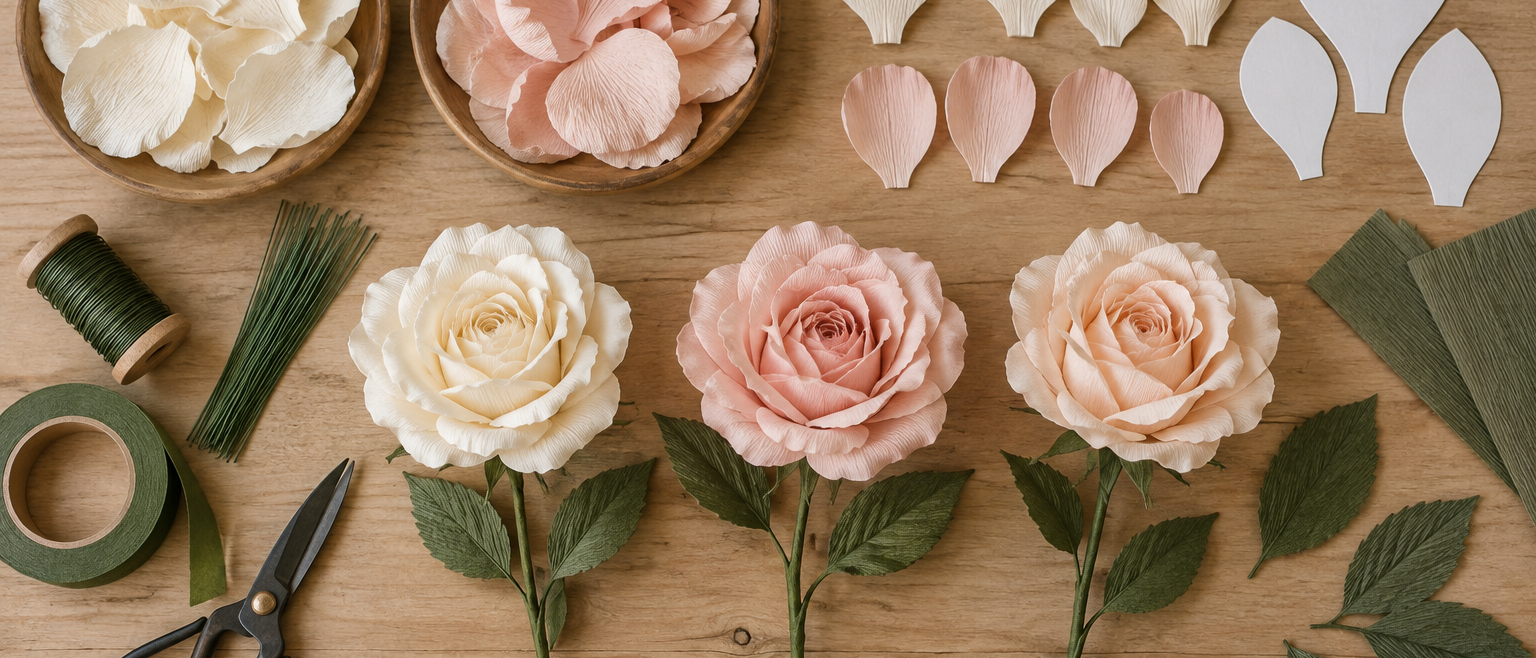
By Evercombe Team · Updated October 12, 2026 · 6-minute read
Quick answer: Every handmade artificial flower follows the same four-part build: a petal template, shaped petals (crepe paper or fabric), a center or stamen, and a wire stem wrapped in floral tape. Six steps get you there: template, cut, shape, center, assemble, wrap. A starter rose takes about 20–30 minutes once your template exists; the first one takes longer, and that is normal. Materials run $15–30 for a batch of stems (craft-store prices as of October 2026).
Making a flower that holds its shape is less about craft talent and more about the sequence: shape each petal before anything gets glued, and build from the center outward. The method below works for both mainstream routes — crepe paper flowers and fabric (silk-method) flowers — because the architecture is identical. Only the shaping tool changes: fingers and a gentle stretch for crepe, heat and a foam pad for fabric.
Materials (With the Specs That Matter)
- Crepe paper, 60 g and 140 g weights — the 60 g stretches for petals, the 140 g holds structure for centers and leaves (typical market spec)
- Fabric for the silk route — lightweight silk or a silk-blend; heavy fabric refuses to hold a cupped shape
- Petal wire, 26–28 gauge — thin enough to bend by hand, stiff enough to hold a petal’s edge
- Stem wire, 18–22 gauge — the backbone; 18 for tall stems and heavy heads, 22 for small blooms
- Floral tape — stretches when pulled, is slightly tacky, and bonds to itself as you wrap
- Hot glue gun (low temp) or craft glue
- Scissors plus a craft knife for clean template edges
- A petal template — cardstock cutouts in three sizes per flower (small, mid, outer)
The honest shortcut: template sets cost a few dollars, and they remove the single most common failure — petals cut in the wrong proportion to each other.
| Material | Spec to buy | What it does | Batch cost |
|---|---|---|---|
| Crepe paper | 60 g + 140 g rolls | Petals / structure | $8–14 |
| Stem wire | 18–22 gauge, pre-cut | Stem backbone | $4–7 |
| Floral tape | Green, stretchable | Wraps and locks layers | $2–4 |
| Petal wire | 26–28 gauge | Petal edge support | $3–5 |
(Craft-retail ranges, US, as of October 2026.)
How to Make an Artificial Flower, Step by Step
Step 1: Cut the Petal Template Set
Draw one petal shape in three sizes on cardstock — roughly 4 cm, 6 cm, and 8 cm for a rose-scaled bloom — and cut them out. The set is reusable, so precision here pays across every future flower. Petals do not need to be identical; real petals aren’t.
Step 2: Cut the Petals With the Grain
Crepe paper has a grain that runs along the roll. Cut petals with the grain running petal-tip to base, and the paper will stretch wide — the direction you want. Against the grain, it tears when shaped. For fabric, fold the material and cut pairs so each petal has a matched front and back.
Step 3: Shape Every Petal
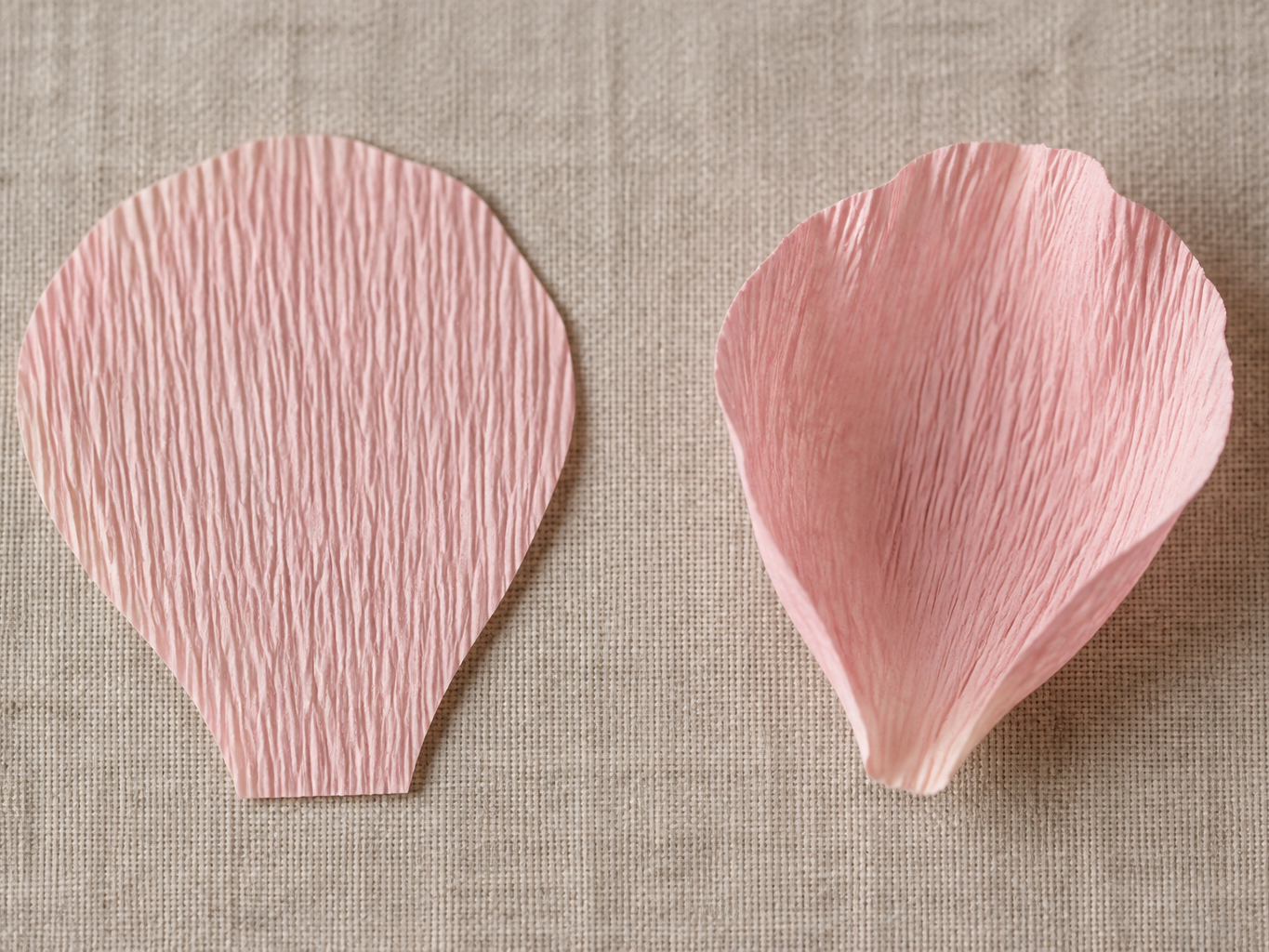
This is the step that separates a flower from a crumpled cone. For crepe: place the petal between thumb and forefinger and stretch the center gently — the edges curl into a natural cup. For fabric: press the petal over a foam pad with the rounded end of a marker or a flower-shaping tool, ideally with a touch of heat from an iron set low. Shape every petal before assembly. A petal shaped after gluing never sits right, and the flower reads handmade from across the room — in the wrong way.
Step 4: Build the Center
Take a small strip of 140 g crepe or a few fabric scraps and wrap it tightly around the top of the stem wire to form a bud shape; secure with floral tape. If you want stamens, cut a fringe into a paper strip, curl it with the blade of the scissors, and wrap the fringe around the center before the petals go on.
Step 5: Assemble the Flower onto Its Stem
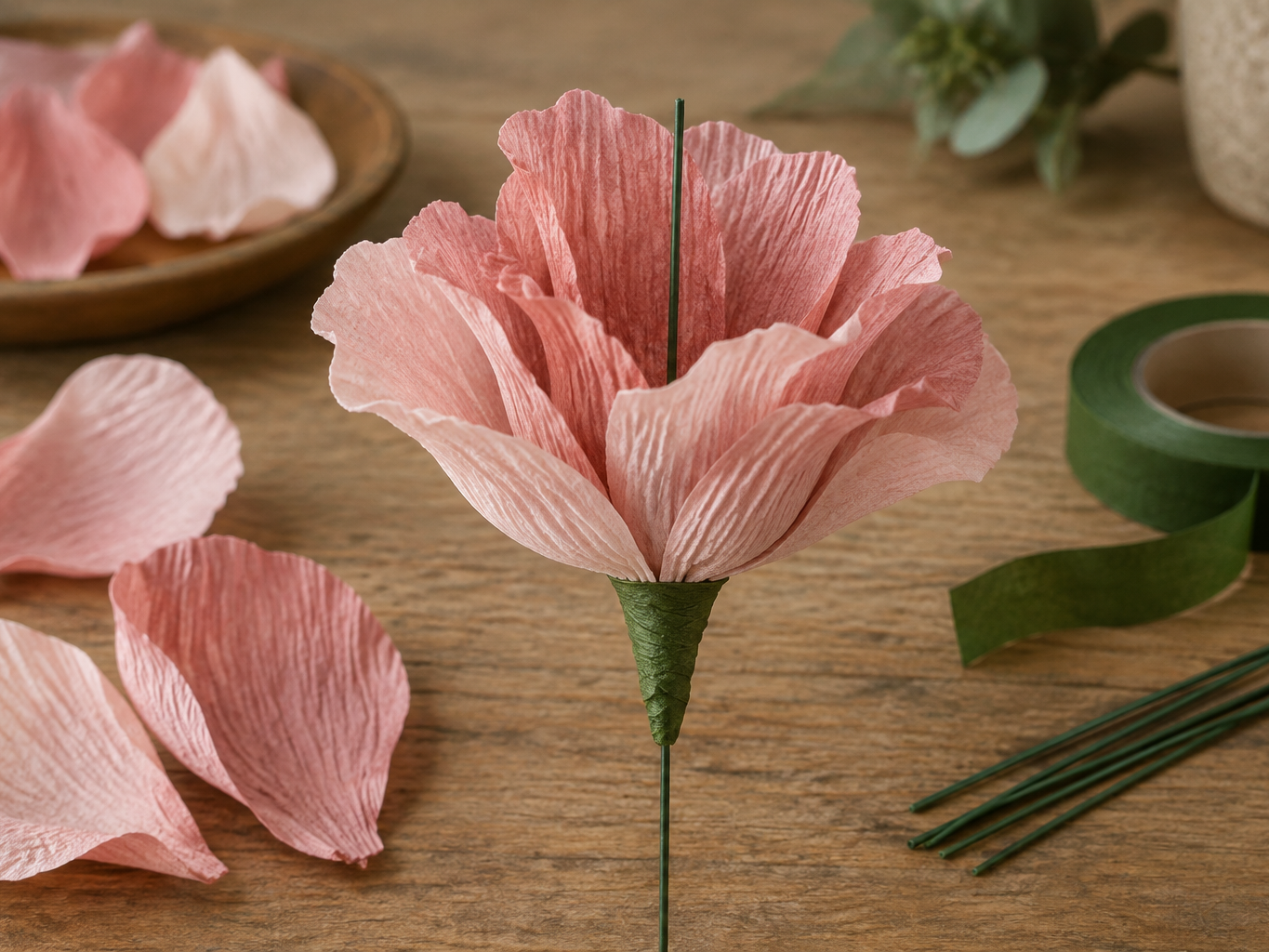
Start with the three smallest petals: dab glue at each petal base and press them around the center, slightly overlapping. Add the mid-size petals in the next ring, rotating a third-turn each time so gaps close. Finish with the outer ring, angling those petals slightly outward — the outer row is what gives the bloom its open face. Three rings, three petals each, is the starter formula; fuller flowers just add rings.
Step 6: Wrap the Stem and Add Leaves
Stretch the floral tape slightly as you spiral down the stem wire from the bloom to the base — the stretch is what activates the tack. Add leaves by laying a shaped leaf against the stem with a dab of glue and wrapping over its base. Cut the tape, press the end down, and the stem holds everything locked.
Three Starter Flower Types
- Rose — the template above; the most forgiving first flower because overlapping rings hide small errors
- Peony — wider, looser outer petals and a fuller center; crepe’s stretch does most of the realism work
- Tulip — only six petals, one ring, no overlap; the simplest build but the least forgiving, since there is nowhere to hide a misshapen petal
What It Actually Costs: Making vs. Buying
A materials batch at $15–30 yields a dozen or more handmade stems. Finished manufactured stems at craft and decor retail run roughly $3–12 per stem depending on flower type and build (competitor prices as of October 2026). The honest math: handmade wins on customization — an exact color match to a swatch, a specific petal count, sizes that don’t exist in shops — and loses on time once that time is worth more to you than the difference. Many people make the first flowers for the satisfaction, then buy finished stems for volume. Both are correct answers; see where to buy artificial flowers when you cross that line.
Troubleshooting (The Three Usual Failures)
- Petals won’t hold their cup — the shaping was done after gluing, or the crepe was cut against the grain. Shape first, always.
- Flower flops on its stem — the head is too heavy for the gauge. Step down from 22-gauge to 18-gauge stem wire, or run a second wire beside the first and tape them together.
- Tape unwraps itself — the tape wasn’t stretched while wrapping. Pull gently as you spiral; unstretched tape is just ribbon.
FAQ
Is it cheaper to make artificial flowers or buy them?
Materials for a batch of stems run $15–30, and finished stems retail around $3–12 each (US ranges, as of October 2026). Making wins on per-stem cost at volume and on exact customization; buying wins the moment your time is the scarce resource. Most makers settle into making statement pieces and buying filler stems.
What paper is best for making artificial flowers?
Crepe paper in two weights — around 60 g for petals that stretch into cups and 140 g for structured centers and leaves (typical market spec). Flat tissue and regular printer paper cannot hold a shaped curve and are the most common wrong purchase.
How long does it take to make one artificial flower?
A template rose takes roughly 20–30 minutes once you’ve built the template set; the first flower of a new type takes longer while you calibrate petal sizes. Centers and leaves can be batch-made in advance, which cuts the per-flower time significantly.
Can I make artificial wedding flowers myself?
Yes — the DIY wedding flowers route is built for exactly this, and our how to make an artificial wedding bouquet guide extends this method into a wired bouquet that holds its shape through the full ceremony and the last dance. Order materials with buffer time; batch sessions beat deadline-eve ones.
Keep Building
- The same wire-and-wrap logic, wreath edition: how to make a wreath
- Materials and blanks: craft supplies — loose stems, petals, wire, and ribbon
- Wedding-scale project: DIY wedding flowers and the bouquet how-to
- When making stops being the point: where to buy artificial flowers