
Blog
Wedding Boutonniere Guide: 7 Styles, Who Wears One, How to Pin It, and What It Costs

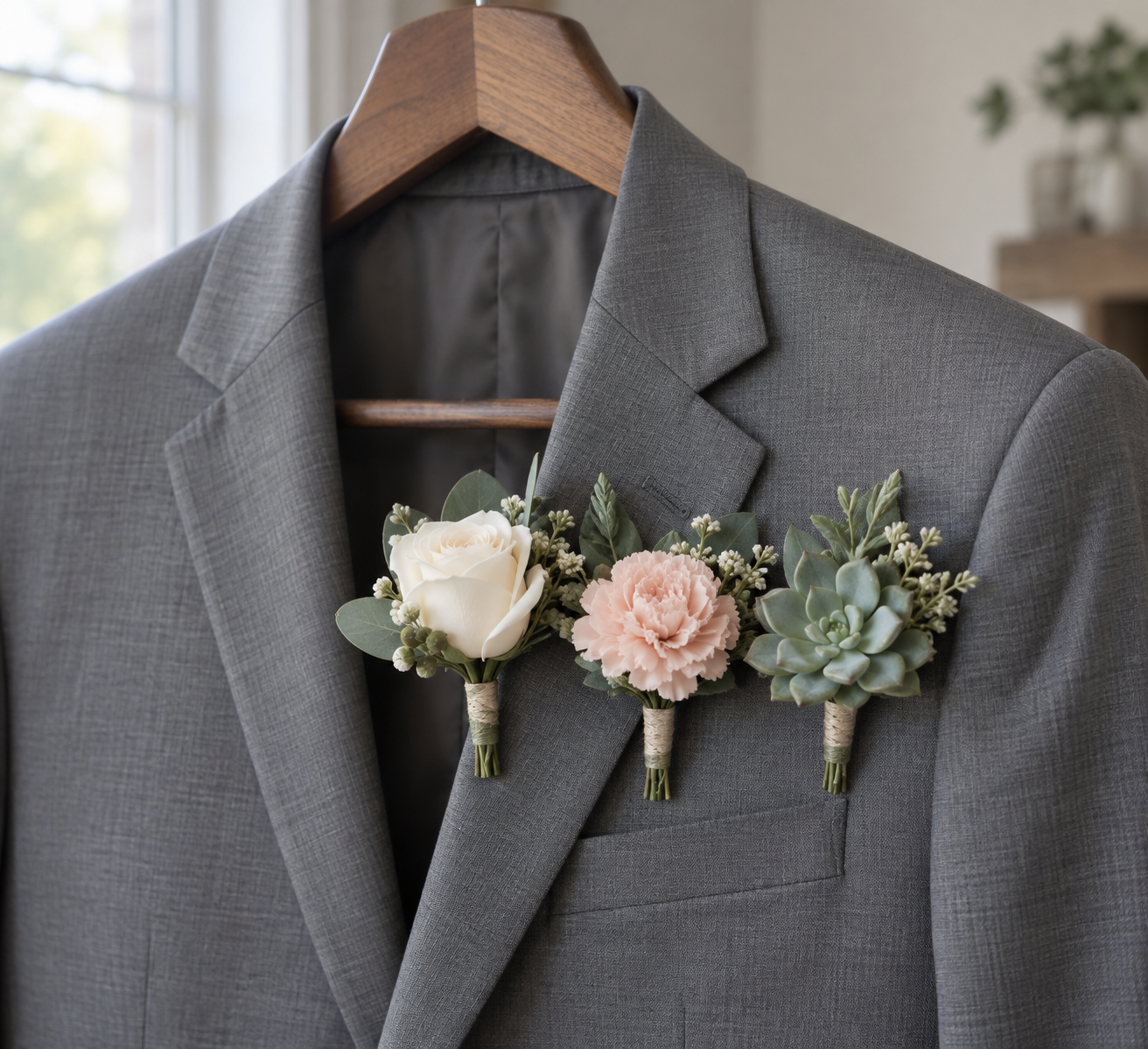
By Evercombe Team · Updated October 12, 2026 · 9-minute read
Quick answer: A wedding boutonniere is a single bloom or small cluster worn on the left lapel, over the heart — traditionally worn by the groom, groomsmen, both fathers, and other key men in the procession. Expect $10-35 each from a florist (fresh), $6-15 for quality faux that’s wearable after the wedding (competitor prices as of September 2026). Pin it stem-down through the back of the lapel, on the left, an hour before photos. The seven styles, the full who-wears list, and the fresh-vs-faux decision are below.
It’s the smallest line item on the wedding flower budget and the one closest to the camera. Every boutonniere ends up in the groom’s portraits, the ceremony wide shots, and the first-dance footage — which makes it worth ten minutes of actual planning instead of a checkbox. This guide covers the seven styles worth choosing between, the etiquette list (longer than most couples expect), how to pin one without bleeding on the shirt, and the pricing math nobody publishes.
First, the Spec: What Makes a Boutonniere Good
Four checkable attributes separate a proper boutonniere from a corsage that wandered onto a lapel:
- Size: one focal bloom, 2-3.5 inches across (a rosebud, a small carnation, a single succulent). Anything larger photographs as a corsage; anything smaller reads as a garnish from three pews back.
- A finished stem. The stem gets wrapped — floral tape, ribbon, or twine — and trimmed to 2-3 inches. A bare cut stem is the tell of a rushed DIY job in every close-up.
- Greenery and filler kept subordinate. One or two small accent pieces (eucalyptus, ruscus, baby’s breath) behind the focal bloom. The supporting cast should not have opinions.
- A real pin, not a magnet or clip, for formal wear. A pearl-headed pin through the lapel’s buttonhole side holds all night; magnets fail on thick wool, and clips visibly skew by the second hug. (Exceptions below, under casual styles.)
Match those four and the rest is style — which is where the actual decision lives.
The 7 Styles (With Honest Pros and Cons)
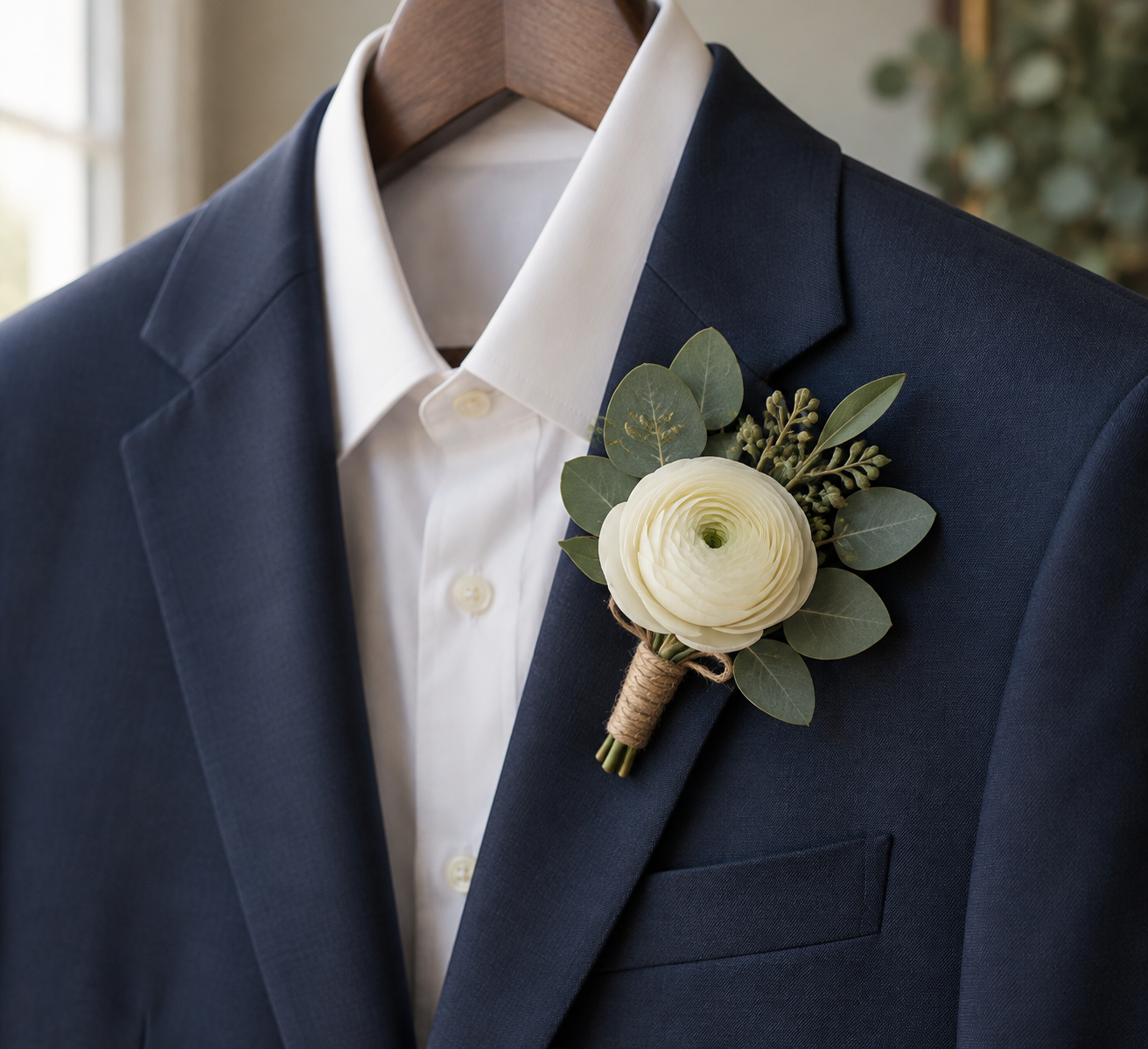
1. The Classic Single Rose
The default for a reason: one rosebud, wrapped stem, a whisper of greenery. Works with every palette and every level of formality. Pros: timeless; photographs cleanly; matches bridal bouquets built on roses (see our rose color meanings for palette logic). Cons: shows heat damage fast at outdoor summer weddings; the single most common boutonniere in existence, if originality matters to you. Spec note: ask for a rosebud-stage bloom, not fully open — it opens through the day instead of shedding by the reception.
2. The Carnation Classic
The budget workhorse and the historical one — carnations anchored prom boutonnieres for decades (the flower’s own story is in our red carnation meaning guide). Pros: structurally ruffled like a rose at a fraction of the cost; sturdy through a long day; light red carries “admiration” — a fitting register for groomsmen. Cons: carries a prom-era reputation some couples can’t unsee; lighter fragrance than roses (or none — pro or con depending on the wearer). Spec note: a single standard carnation hits the 2-3.5 inch spec exactly, no sizing guesswork.
3. The Textured Mix (Greenery-Forward)
Two or three small blooms (spray rose, hypericum berry, craspedia) over a base of herbs and greens — rosemary, eucalyptus, olive branch. Pros: the current editorial favorite; reads “designed” rather than “ordered”; herbs add a subtle scent close to the wearer, not the room. Cons: the most technique-sensitive style on the list — a bad mix reads as salad; harder to uniform across six groomsmen than single-bloom styles. Spec note: anchor it with one clear focal element even in a mix; two focal points fight in photos.
4. The Succulent
A small echeveria rosette, optionally accented with wire-wrapped kumquat or air plant. Pros: indestructible through heat, hugs, and hour four of dancing; becomes a take-home keepsake that literally keeps living when potted after the wedding. Cons: heavy relative to blooms — needs the pin plus a stitch of floral wire on lightweight suiting; the rustic/boho register clashes with black-tie formality. Spec note: choose 2-2.5 inch rosettes; larger ones pull the lapel out of line by the end of the night.
5. Dried and Preserved
Preserved fern, bunny tails, dried strawflower, lunaria — the everlasting palette. Pros: made weeks in advance, zero day-of logistics, ships without refrigeration; fits fall and winter palettes naturally (pair with our dahlia meaning autumn register). Cons: fragile to the touch even when colorfast — a firm hug can shatter a strawflower head; the look is deliberately vintage, not formal. Spec note: spray-on sealant exists for durability; it changes the texture slightly under flash photography.
6. The Faux / Real-Touch Route
Latex “real-touch” petals and silk greenery on a wrapped stem — the style our own wedding boutonnieres collection is built around. Pros: made months ahead; identical across the whole wearing party (no bloom-stage lottery); survives heat, freight, and the entire event; wearable again — groomsmen keepsakes, or re-worn at the one-year anniversary dinner; petal texture and stem wrap hold their exact shape in photos from first look to last dance. Cons: not for couples set on scent (faux stems carry none); premium real-touch materials cost more than entry-level fresh singles, though the per-wear math favors them after one reuse (competitor prices as of September 2026). Spec note: look for wired stems (posable to the lapel’s angle) and a finished pearl-head pin included; check the petal edge — soft, matte edges read as botanical at conversation distance, glossy plastic edges don’t.
7. The Statement Bloom
One dramatic head — orchid, ranunculus, protea, or a garden rose at full open. Pros: personality; photographs as a style decision; protea and orchid hold up to heat better than soft-petal roses. Cons: a 4-inch orchid on a groom wearing a slim-lapel tuxedo is a wardrobe dispute; statement styles amplify any mismatch across the wearing party; typically the most expensive fresh option per stem. Spec note: scale to the lapel — wide peak lapels carry statement blooms; shawl and notch collars want the 2.5-inch classics.
Who Actually Wears One (The Full List)
The tradition expanded. The modern answer:
| Wears one | Notes |
|---|---|
| Groom | Slightly differentiated — a unique accent bloom or richer wrap |
| Groomsmen | Uniform style; the visual “team” marker |
| Fathers and stepfathers | Yes — differentiating them from groomsmen honors without confusing |
| Grandfathers | Yes, by the same logic |
| Ushers and readers (male-presenting) | Optional; decide by symmetry in processional photos |
| Ring bearer | Miniature version or a single bloom alternative; skip the pin for little ones — a wrist corsage or nosegay |
| Officiant | Optional; common when the officiant processes in robes or clergy dress |
| Musicians and speakers | Optional; a nice touch that reads as “part of the ceremony” |
Count before ordering: the standard miscount is forgetting the stepfather, the officiant, or a late-added reader — order two spares and the problem disappears. And the mothers’ side of this tradition is the corsage; pair the two lists so nobody at the ceremony is visibly unassigned.
How to Pin One (Three Steps, One Rule)
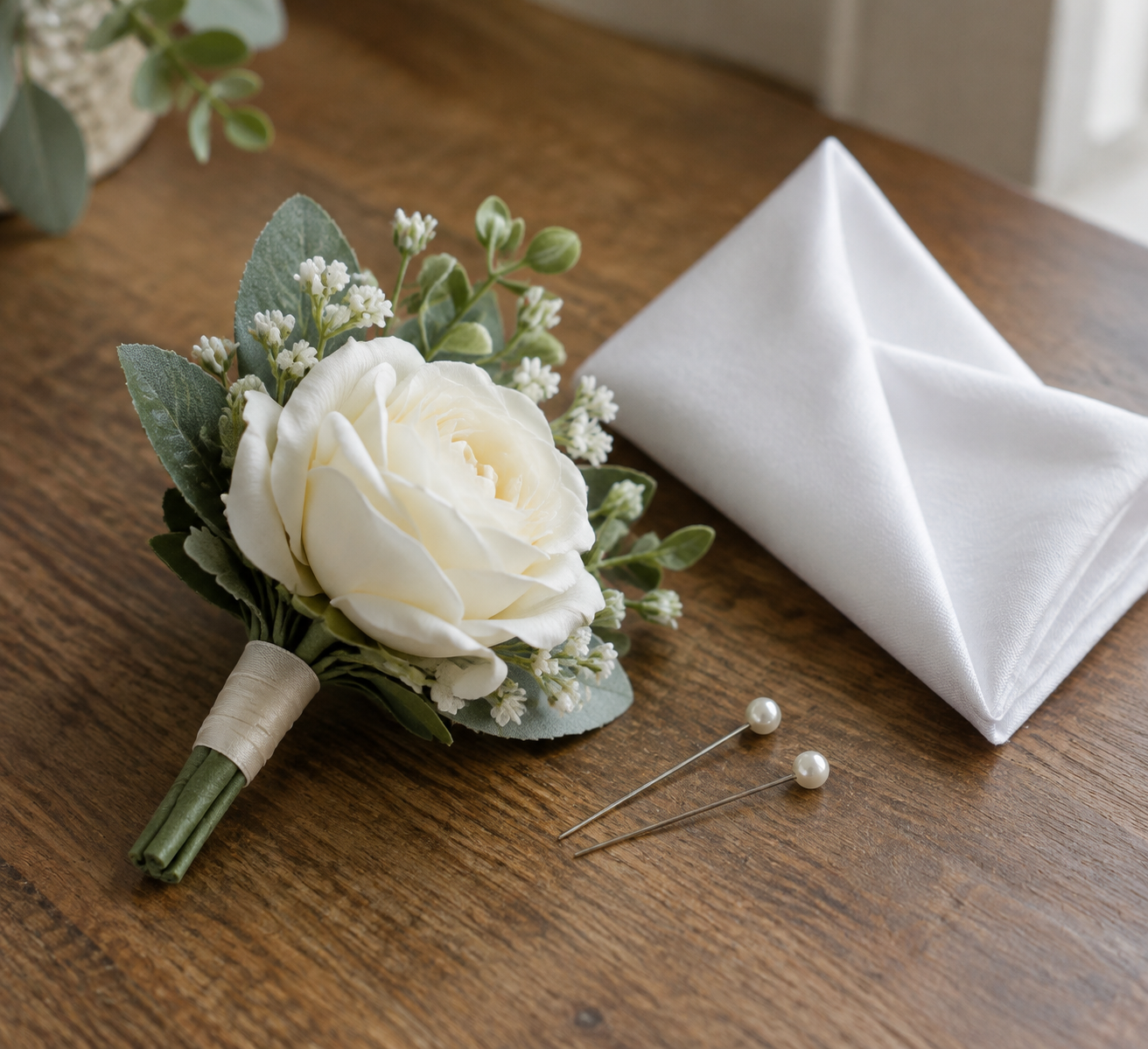
The rule: left lapel, over the heart, stem pointing down.
- Position the boutonniere on the left lapel with the bloom head just below the lapel’s widest point — roughly where a pocket square would peek, if anyone still carried one.
- Pin from behind. Push the pearl-head pin through the back of the lapel, catching the stem’s wrap, then back through the fabric so the pin hides in the lapel’s fold — the head of the pin invisible from the front. Most quality boutonnieres (ours included) ship with the pin pre-threaded through the wrap.
- Time it right. Pin the wearing party 45-60 minutes before first photos, after shirts and jackets are fully on — never before, or the jacket comes off and the geometry resets.
The single most common error is pinning through both the lapel and the shirt beneath, which welds the two together for the evening; catch the lapel layer only.
What Boutonnieres Cost (Realistic Ranges)
| Route | Per-stem range | What moves the price |
|---|---|---|
| Florist, fresh, classic styles | $10-35 (competitor prices as of September 2026) | Bloom choice (garden rose vs carnation), region, wedding-date premium |
| Florist, fresh, statement blooms | $20-50 (competitor prices as of September 2026) | Orchid and protea stems carry import and season costs |
| DIY fresh, self-assembled | $3-8 in materials (competitor prices as of September 2026) | Wholesale blooms plus tape, pins, ribbon — and your time |
| Quality faux (real-touch) | $6-15 (competitor prices as of September 2026) | Petal material grade; reusable across events, which amortizes it |
| Dried/preserved | $8-20 (competitor prices as of September 2026) | Preserved material costs more than fresh-cut but is made weeks ahead |
For the full flower-budget math — bouquets, centerpieces, and how the boutonniere line fits a total — our wedding flowers cost breakdown covers it line by line. Quick summary of where boutonnieres land: typically among the smallest line items, and the one where the faux route’s cost advantage compounds fastest, since a six-person wearing party in real-touch stems re-wears or keeps them all.
Fresh or Faux: The Honest Decision Table
| Your situation | The call | Why |
|---|---|---|
| Summer or outdoor ceremony | Faux or succulent | Soft-petal fresh blooms show heat wear by mid-ceremony |
| Destination wedding, flowers shipped ahead | Faux or dried | No refrigeration chain, no day-of wilting risk |
| Florist already doing full wedding flowers | Fresh, added to the order | One palette hand, one delivery, consistent bloom stage |
| Groomsmen in different cities pre-wedding | Faux | Everyone’s matches exactly; nothing depends on one local florist’s stock |
| Formal black-tie winter wedding | Fresh (or premium real-touch) | Cool venues are fresh’s best case; if uniformity across eight wearers matters more, real-touch holds it |
| Keepsake or re-wear matters | Faux or succulent | Both survive the night intact |
The mixed strategy — groom in fresh, groomsmen in faux — looks fine from the front row and inconsistent in the album; if budget forces a split, split by wearing group (all groomsmen faux, groom fresh reads as intentional) rather than checkerboarding individuals.
FAQ
Who wears a boutonniere at a wedding?
The groom, groomsmen, both fathers and stepfathers, grandfathers, and optionally ushers, readers, the officiant, and musicians. The ring bearer gets a miniature version or an alternative (no pins on small children). Full table above.
Which side does a boutonniere go on?
The left lapel, over the heart, stem pointing down — pinned from behind the lapel so the pin doesn’t show. Left-side placement is the settled convention across formal menswear.
How much do wedding boutonnieres cost?
Fresh from a florist, $10-35 each for classic styles and $20-50 for statement blooms; quality faux runs $6-15 and is reusable; DIY fresh materials run $3-8 per stem (competitor prices as of September 2026). See the full table above.
Are faux boutonnieres acceptable at formal weddings?
Yes — quality real-touch pieces hold uniform shape across the whole wearing party and photograph cleanly at conversation distance and beyond; the tradeoffs are no scent and a higher unit price than basic fresh singles, offset by reuse. Decide by venue and logistics with the table above.
What’s the difference between a boutonniere and a corsage?
Placement and build: a boutonniere is the small single-bloom piece pinned to a lapel; a corsage is the larger piece worn on a wrist or pinned at the shoulder, traditionally for the mothers and honored women. Both follow the wedding’s palette.
When should boutonnieres be pinned on?
45-60 minutes before photographs, after jackets are fully on — and never through both lapel and shirt, which staples the two together for the night.
Can boutonnieres be made ahead?
Faux and dried styles, fully — weeks ahead, no refrigeration. Fresh classics can be built the night before and refrigerated; succulents tolerate everything. The make-ahead hierarchy (faux/dried > succulent > fresh) is the practical argument for the reusable styles.
Keep Reading
- Wedding Flowers Cost — the full budget, line by line
- How to Make an Artificial Wedding Bouquet — the DIY version of the same logic, for bouquets
- Carnation Color Meanings — the boutonniere’s classic bloom, decoded
- Shop: wedding boutonnieres · red artificial flowers · white artificial flowers