
Blog
How to Preserve a Wedding Bouquet: 6 Methods Compared, With Costs, Failure Rates, and the Zero-Effort Alternative

By Evercombe Team · Updated October 12, 2026 · 8-minute read
Quick answer: The six ways to keep a wedding bouquet: air-dry it (free, 2-4 weeks, shrunken and vintage-looking), silica gel ($20-40, best color retention on sturdy blooms), press it (free-$15, flat art), resin-cast it ($50-150 DIY, $150-300 professional (competitor prices as of September 2026)), pay a professional preservation service ($150-500+), or skip the whole race — start with a faux bouquet, which is already preserved and needs nothing but a shelf. The method decides what you get: dried, dimensional, flat, or encased. None of them gives you back the bouquet as it looked at the ceremony.
The bouquet is thrown, dried in a garage, or kept — and kept is harder than it sounds. Fresh flowers start declining at the ceremony, which means preservation is a race that begins the morning after the wedding, usually while you’re on a plane. Here’s every method, what each genuinely delivers, what it costs, where each fails — and the honest case that most couples only hear from faux-flower sellers like us, stated with its limits.
The Golden Rule: 24 Hours Decide Everything
Every method below works best on flowers that haven’t started wilting. The practical timeline for a wedding weekend:
- Wedding night: refrigerate the bouquet (not freeze — freezing ruptures cells), stem wraps damp, nothing resting on the blooms.
- Next morning: begin drying or silica, or ship to a preservation service (the good ones send you a kit and instructions before the wedding for exactly this reason).
- The 72-hour cliff: blooms that sit out three days wilt past what any method recovers. Dried-from-wilted still works — but you’re preserving the wilt.
Method 1: Air-Drying (Free, the Default)
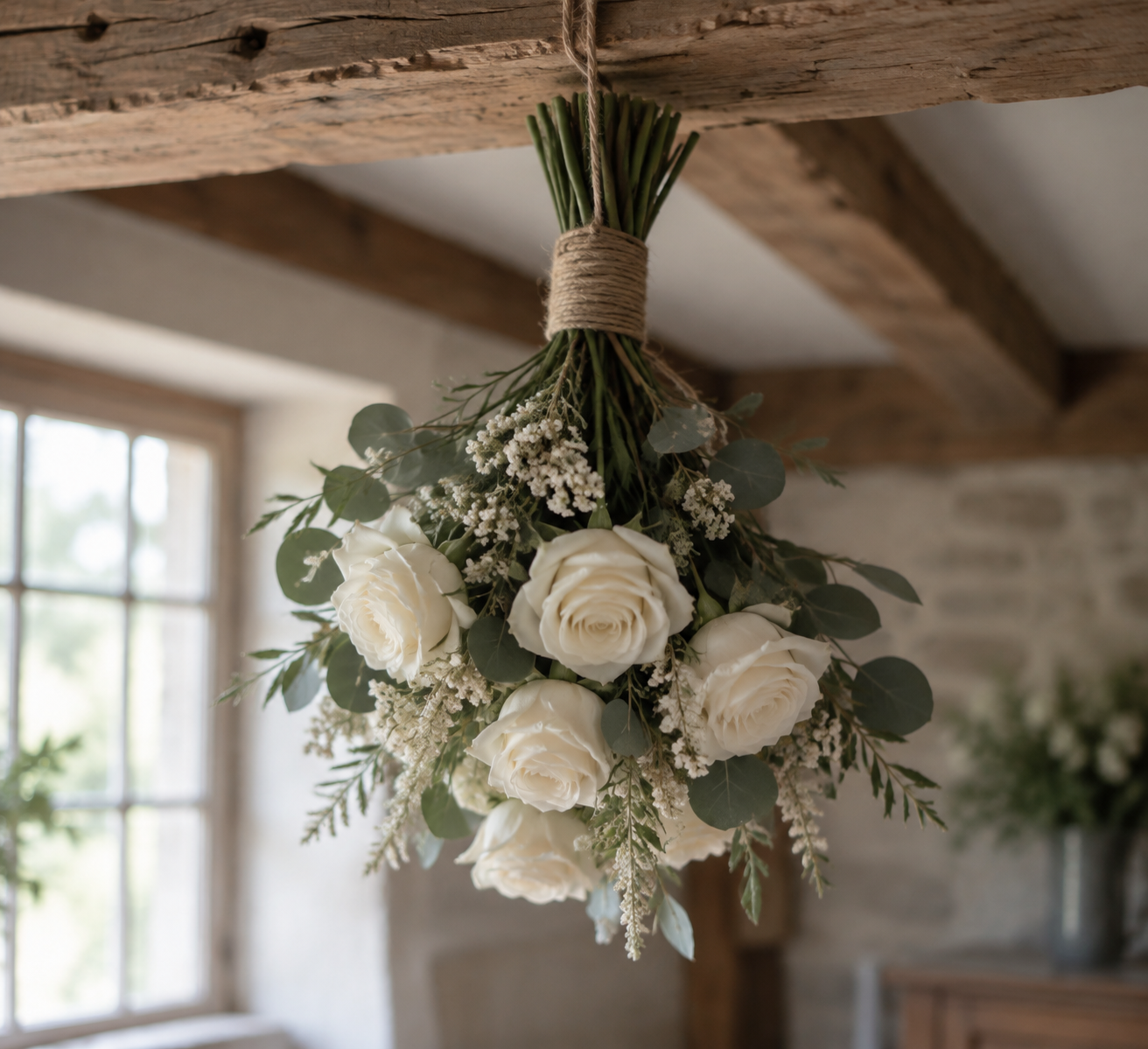
Hang the bouquet upside-down, blooms separate if you can, in a dark, dry, ventilated room. Two to four weeks.
What you get: the vintage look — dimensional, but visibly dried. Roses and hydrangeas air-dry well; peonies and ranunculus shed petals; anything white tends to tan.
Failure modes: mold in humid climates (the #1 killer of DIY air-drying — ventilation matters more than darkness); petal drop on delicate species; color drift toward brown for pinks and whites. Reds and purples keep the most of themselves.
Cost: $0. Success honesty: it always “works” — the question is whether you like dried flowers. Many couples don’t, which is how garage bouquets happen.
Method 2: Silica Gel Crystals ($20-40, Best Color)
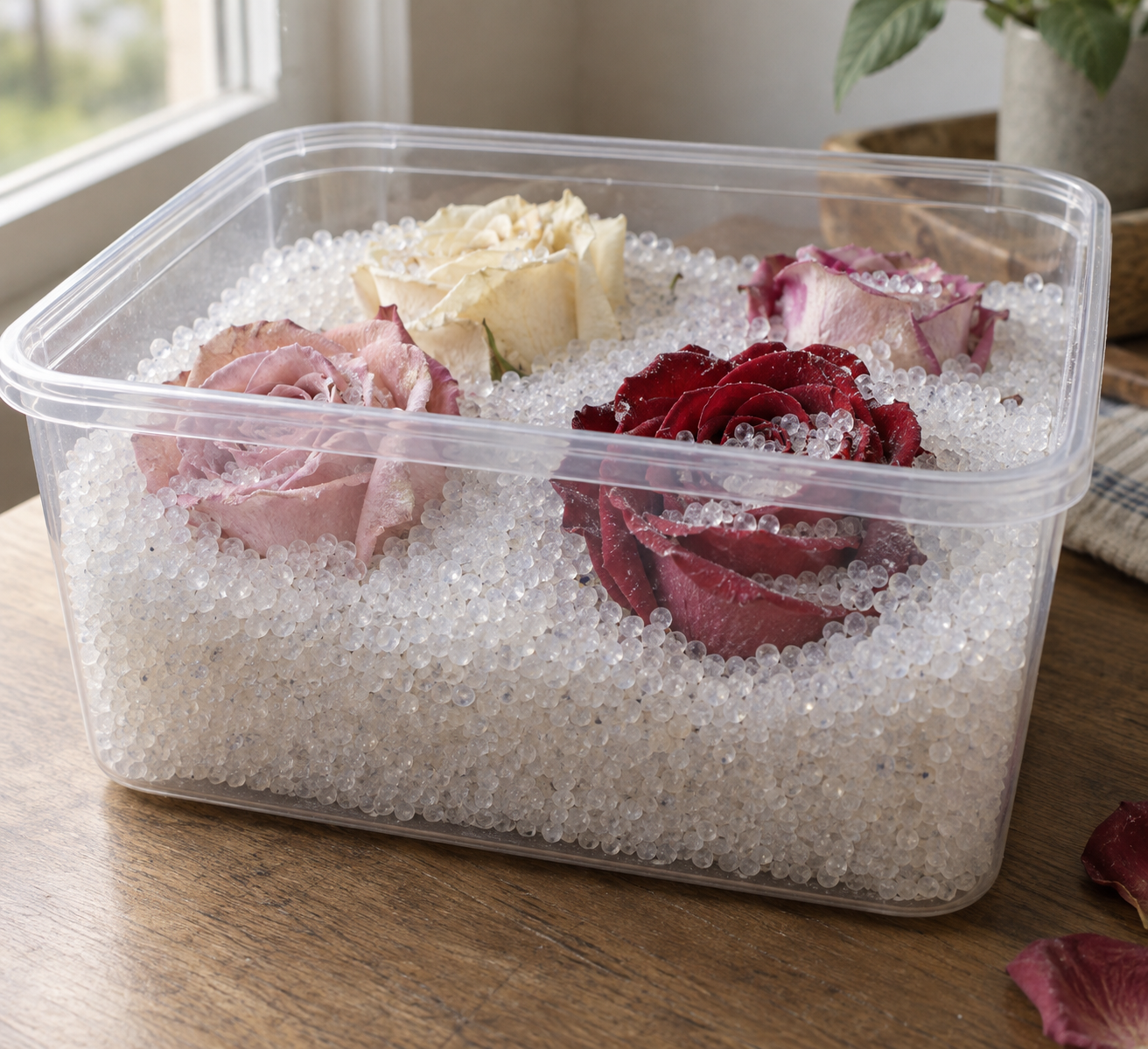
Bury the blooms head-up in silica gel crystals in an airtight container; 2-7 days for most flowers, then a sealant spray.
What you get: the closest thing to ceremony-day color and shape — silica pulls moisture fast enough that pigment barely moves. The industry standard for keeping a single rose looking like a rose.
Failure modes: blooms come out brittle (they are — sealant is not optional); oversized heads dry unevenly; multi-bloom arrangements must be dismantled, bloom by bloom — you preserve pieces of the bouquet, not the bouquet.
Cost: $20-40 in crystals for a bouquet’s worth of heads, reusable after oven re-drying. Success honesty: the best home method for color, and the most labor per bloom.
Method 3: Pressing (Free-$15, the Flat Route)
Heavy-book pressing (weeks) or a flower press (days-weeks), then framing or embedding in glass frames.
What you get: flat, two-dimensional botanicals — genuinely beautiful, and the method that pairs best with the invitation and vow pages in a frame.
Failure modes: thick blooms (peonies, orchids, succulents) mold rather than press; dimensional bouquets lose their whole point; timing overruns leave you with a flat, brown memorial instead of art.
Cost: free in books; $10-15 for a press; $30-100 to frame properly.
Method 4: Resin Casting ($50-150 DIY, $150-300 Professional)
Bloom(s) dried first (resin traps moisture into rot — the step DIY guides bury), then cast in epoxy in a mold: a paperweight, a ring dish, a block.
What you get: a solid, glass-like object containing flowers from the bouquet — the most “display object” of the outcomes, and the most popular keepsake format of the last several years.
Failure modes: the moisture trap (resin over insufficiently dried blooms clouds and browns — the #1 DIY resin failure); bubbles; yellowing over years in cheap resin (UV-stable resin exists, costs more, still isn’t a zero-yellowing guarantee); professional casting queues run months.
Cost: $50-150 in DIY resin gear and molds (plus failures); $150-300+ professional, size and complexity dependent (competitor prices as of September 2026).
Method 5: Professional Preservation Services ($150-500+)
Ship or deliver the bouquet; the studio dismantles, dries (usually silica), and rebuilds it — framed under glass, in a shadow box, a glass dome, or as resin work. Wedding-preservation studios commonly book out 2-6 months in season.
What you get: the dimensional bouquet, rebuilt and framed — the closest outcome to “the bouquet, on the wall.”
Failure modes: the shipping window (see the 72-hour cliff — studios mitigate with kits shipped before the wedding); some rebuilding is inherent (flowers shrink in drying; the studio re-poses them); price scales with bouquet size; results vary studio-to-studio — ask for recent before/afters of the same flower types as yours, not their portfolio’s best peonies.
Cost: $150-500+ framed (competitor prices as of September 2026).
Method 6: Start Faux (Zero Preservation Needed)
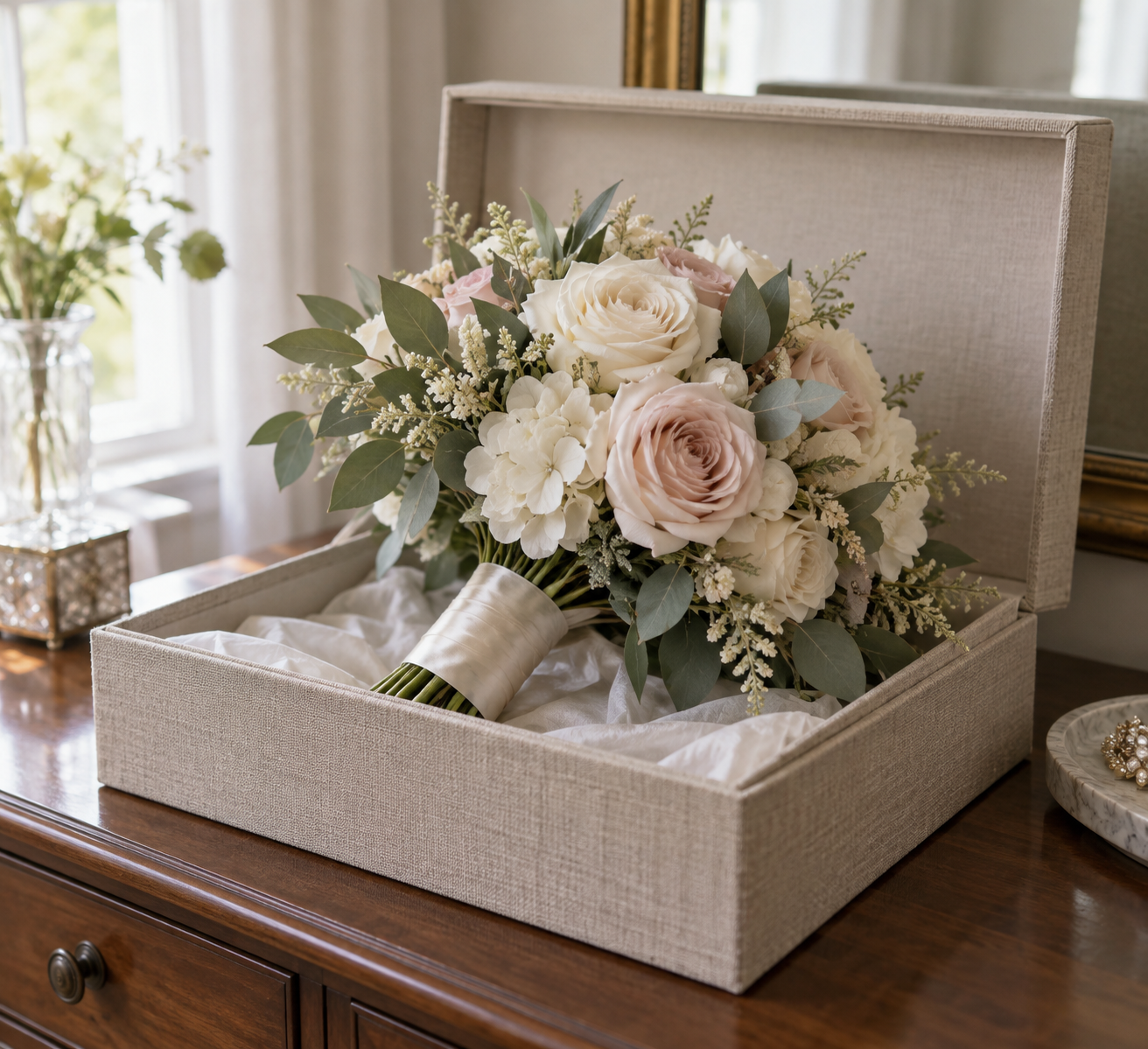
The route we sell, stated with its trade: a silk/real-touch bouquet is already permanent — no race, no drying, no framing bill — and it sits in a vase for years looking like the wedding-morning photo. Our faux wedding bouquets exist for exactly this use.
What you get: the actual bouquet from the day, on a shelf, indefinitely. Brides who chose real-touch report the close-up realism holds at bouquet distance — the honest limit is that it never had scent, and fingertip texture is material, not petal.
Failure modes: none of the preservation kind — the real costs are decided up front: no fresh scent, and the upfront realism depends on buying the right tier (the distance-by-material logic is in silk vs fresh flowers). One practical note: dust it a couple of times a year — the only maintenance a faux bouquet ever needs (cleaning methods).
The Decision Table
| If you want… | Method | Cost | Timeline | Failure watch |
|---|---|---|---|---|
| The bouquet, dimensional, on the wall | Professional silica + framing | $150-500+ | Booked months out | Shipping window; shrinkage rebuild |
| Best color, DIY, bloom by bloom | Silica gel | $20-40 | 1-2 weeks | Brittleness; must dismantle |
| Zero spend, vintage look | Air-dry | $0 | 2-4 weeks | Humidity mold; petal drop |
| Bouquet + invitation framed art | Pressing | $0-100 | Weeks | Thick blooms mold |
| A display object | Resin (pro) | $150-300+ | Months | Moisture trap; queue |
| The bouquet, exactly as-is, forever, no project | Faux from the start | Bouquet price | None | No scent — the trade |
If You’re Reading This After the Wedding
Triage for a bouquet that’s already a few days old: separate the blooms; anything still firm goes to silica or the press; anything wilted past saving gets air-dried (dried-is-dried — better than the bin); photograph everything before you start, because methods change shapes. And if it’s already been months — a resin or framing studio can still work with genuinely dried material; silica cannot rescue it now.
FAQ
How much does it cost to preserve a wedding bouquet?
Professional preservation runs $150-500+ depending on framing; DIY runs $0 (air-dry) to $150 (resin gear) (competitor prices as of September 2026). Compare against the faux route: a real-touch bouquet costs the same as a mid fresh one and arrives already permanent — the total-cost comparison is in wedding flowers cost.
What is the best way to preserve a wedding bouquet?
For the whole bouquet dimensional and framed: a professional silica-drying service. For single blooms in best color: DIY silica gel. For flat keepsake art: pressing. For keeping the exact bouquet with zero process: starting with faux. “Best” depends on whether you want the object, the art, or the bouquet itself.
How long do I have to preserve my bouquet after the wedding?
Start within 24-48 hours; by 72 hours, wilt has permanently changed what any method can recover. If you can’t start that fast, refrigerate (don’t freeze) the bouquet and get blooms into silica or onto a drying rack as soon as possible — and photograph it fresh regardless; the photo is the only perfect preservation.
Can I preserve a bouquet that’s already dried out?
Yes, differently: already-dried material works for resin casting, framing as-is, or display under a cloche. What you can’t do is silica-treat or press blooms that dried wild — they’ll shatter. Work with the dried state you have, or hand it to a studio that specializes in dried rebuilds.
Do faux wedding bouquets actually look kept-wedding-good years later?
Quality tiers do — real-touch and two-tone silk bouquets hold shape and color on a shelf for years with occasional dusting; the failure mode is sun (display it out of direct light, same as any textile) and the cheap tier (single-color petals age visibly). The buying logic and tiers: silk vs fresh flowers and how to make an artificial wedding bouquet.
Related Guides
- Silk vs Fresh Flowers — the full comparison, costs and verdicts
- How to Make an Artificial Wedding Bouquet — the DIY faux route
- Shop artificial wedding bouquets · DIY wedding flowers · wedding flower arrangements