
Blog
Best Artificial Flowers (2026): A Buyer’s Guide by Material, Scene, and Budget

By Evercombe Team · Updated October 12, 2026 · 9-minute read
Quick answer: The best artificial flowers depend on where they live. Real-touch latex and PE (polyethylene) blooms win on realism for entryways and weddings, silk-polyester blends are the workhorse for everyday arrangements, and UV-treated stems are the only sane choice for porches and patios. Expect roughly $3-8 per quality stem and $40-300 for a finished arrangement (competitor prices as of September 2026). Under about $2 a stem, the fabric frays and the seams show at arm’s length.
What Separates a $6 Stem From a $1 Stem
Four things, in this order: petal material, leaf quality, stem construction, and color depth.
Petal material does most of the work. Real-touch flowers use latex or PU-coated fabric that mimics the slight waxy give of a live petal — press one and it bounces back. PE blooms are injection-molded, so each petal holds an opaque, saturated color with a molded edge. Silk-polyester blend is the classic: matte, soft, and convincing from a meter away. EVA foam (the spongy kind used in cheap craft flowers) is light and inexpensive but hates water and dents when pressed.
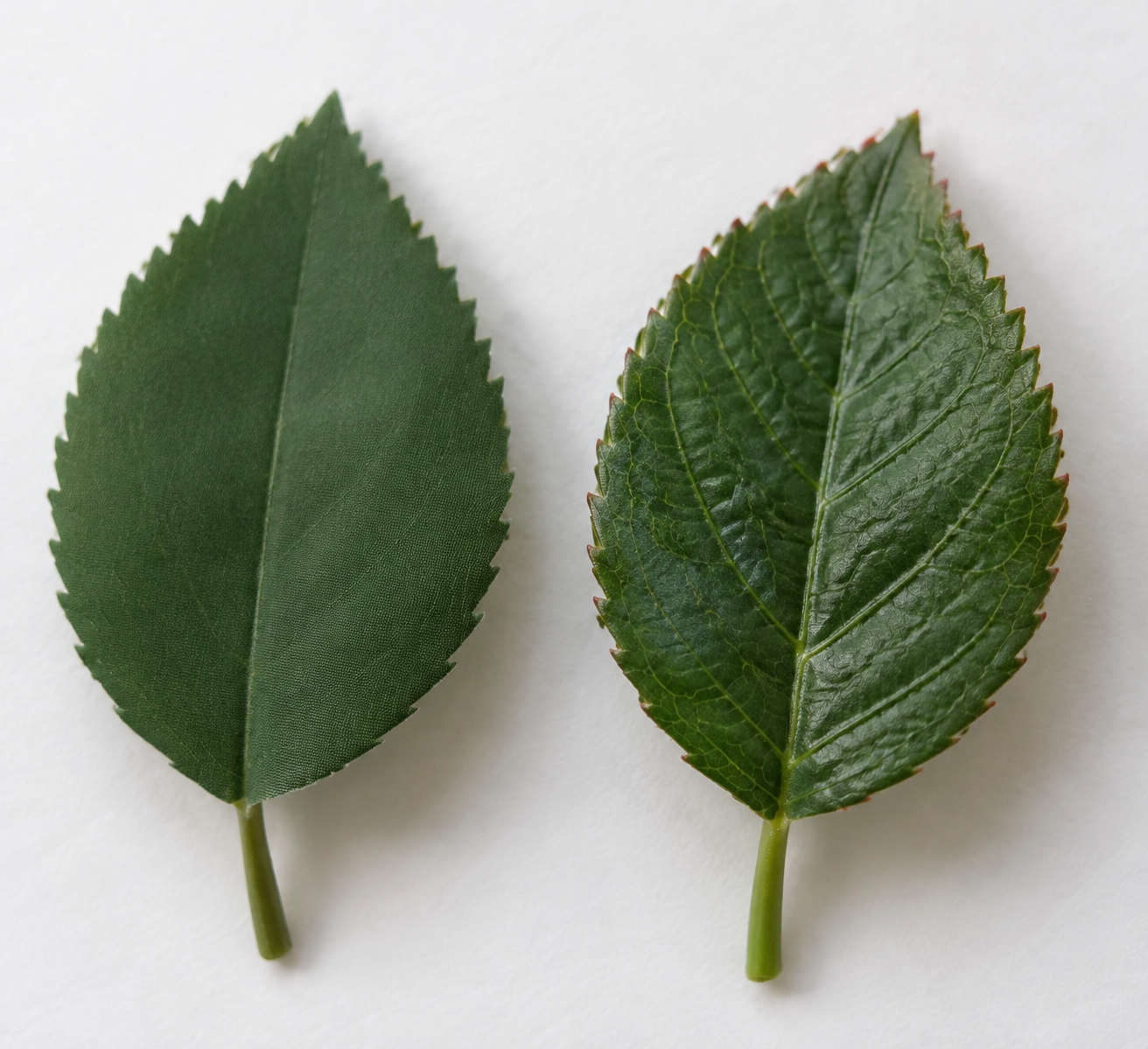
Leaf quality is the tell most buyers miss until the review gets written. Across thousands of buyer reviews on major faux-flower shops, the single most repeated complaint isn’t “the roses look fake” — it’s “the greenery looks plastic.” A batch can have gorgeous peonies on bargain-bin leaves. Good greenery uses two-tone, double-sided printed leaves on wired stalks; bad greenery is flat single-color plastic that reads as fake from across the room.
Stem construction: look for wired, bendable stems wrapped in floral tape, not hollow smooth plastic tubes. Wire lets you angle each bloom toward the light the way a real stem would. Cheap stems force every flower to point straight up — the arrangement equivalent of a bad haircut.
Color depth: premium blooms are dipped or hand-dusted with a second color so petals shade from edge to center (a real rose is never one flat red). Single-dye stems photograph fine and disappoint in person.
Material Cheat Sheet
| Material | Realism at arm’s length | Typical price/stem | Water-safe | Outdoor/UV | Best for |
|---|---|---|---|---|---|
| Real-touch latex/PU | Excellent — texture-level | $5-10 (competitor prices as of September 2026) | Wipe only | No | Wedding bouquets, entry tables |
| PE (molded) | Very good — opaque, crisp edges | $3-7 (competitor prices as of September 2026) | Yes | Only with UV coating | Outdoor arrangements, wreaths |
| Silk-polyester blend | Good — soft, matte | $2-6 (competitor prices as of September 2026) | Light rinse, air dry | Fades in seasons | Everyday home arrangements |
| EVA foam | Fair — dents, water-sensitive | $1-3 (competitor prices as of September 2026) | No | No | Craft projects, budget bulk |
The Best Artificial Flowers by Scene
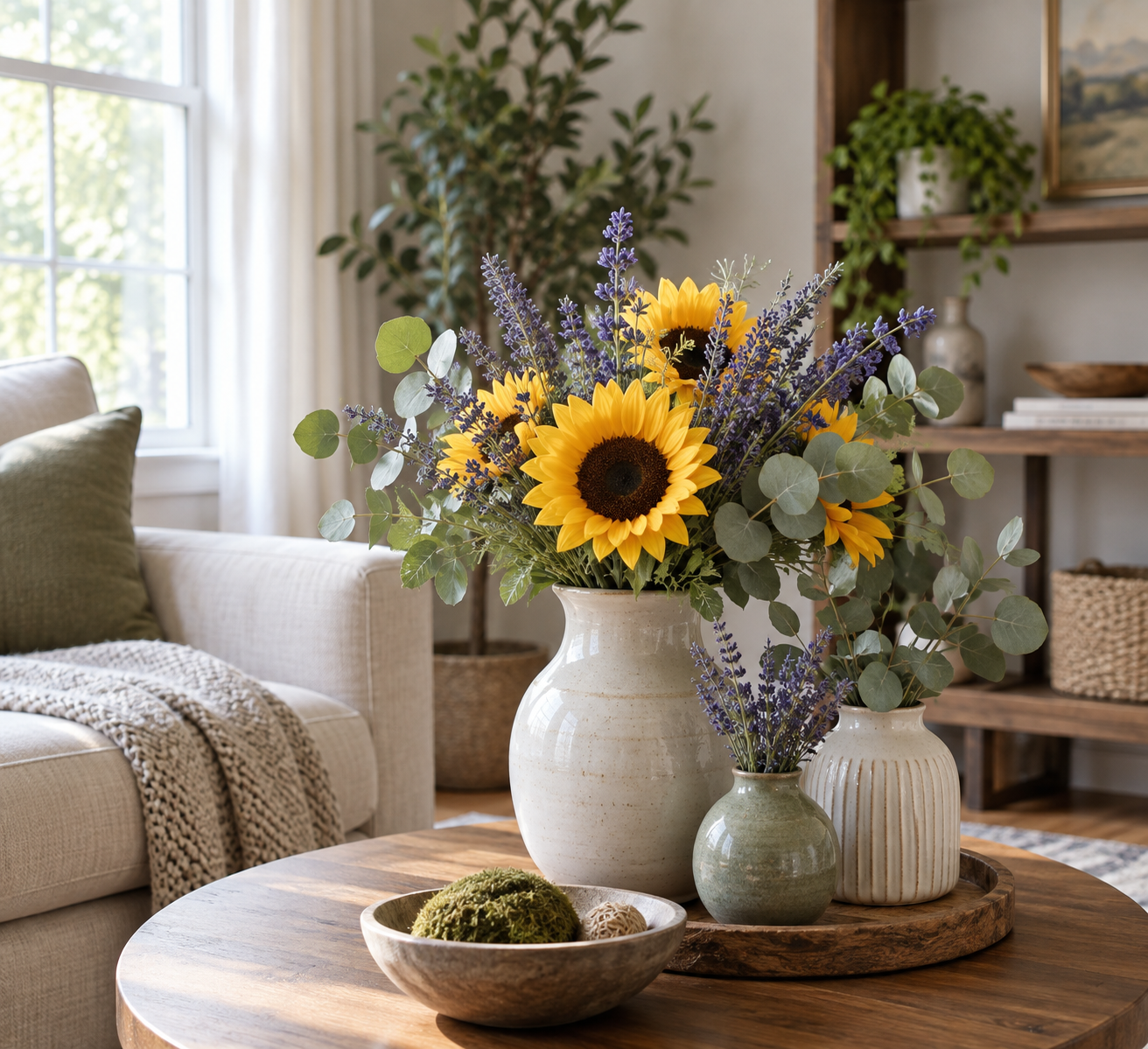
Best overall for home: silk-blend arrangements
For mantels, side tables, and shelves, a pre-arranged silk-polyester mix in a vase wins on value and versatility. The blend photographs well, survives dusting, and can be re-shaped season after season. Browse our full artificial flower arrangements collection for ready-styled options.
Watch out: at under one meter, silk petals can look slightly waxy under direct lamp light. Style them slightly above eye level and nobody checks.
Most realistic: real-touch blooms
When guests will touch the flowers — an entryway console, a wedding — real-touch latex is the category to buy. The petal texture holds up to actual fingertips, which is the moment most faux flowers fail. Our real-touch flowers selection is built for exactly that test.
Watch out: real-touch petals can scuff if scraped with a fingernail or ring, and the coating is not sun-stable. Keep them indoors and out of direct afternoon sun.
Best for weddings: bridal bouquets and boutonnieres
Faux wedding flowers made from real-touch and premium silk hold their shape through a 12-hour day, survive being clutched, photographed, and stuffed in a car, and can be kept afterward — no Preservation timeline, no pressing fee. Start with artificial wedding bouquets and matching wedding boutonnieres.
Watch out: order early and unbox the moment they arrive. Transit compression is normal and most blooms need a few minutes of fluffing — that’s true across the entire industry, not a defect.
Best for outdoors: UV-treated stems
Sun destroys untreated faux flowers — polyester yellows, PE fades chalky, sometimes within one summer. UV-inhibited stems are the fix; anything going on a porch, front door, or patio should be UV-rated or considered seasonal. See outdoor artificial flowers for the sun-safe lineup.
Watch out: “UV resistant” and “UV proof” are not the same. Even treated stems fade slowly; expect 1-2 seasons of full saturation in intense sun, then rotate or replace.
Best on a budget: bulk bush stems
Bush picks (several blooms on one branched stem) are the cheapest path to a full vase — one bush reads as five or six stems. They’re the standard for event decorators filling large volumes. Bulk artificial flowers pricing drops meaningfully past the dozen mark.
Watch out: bulk lots can vary batch to batch in color. Order the whole project in one order so every piece ships from the same dye lot.
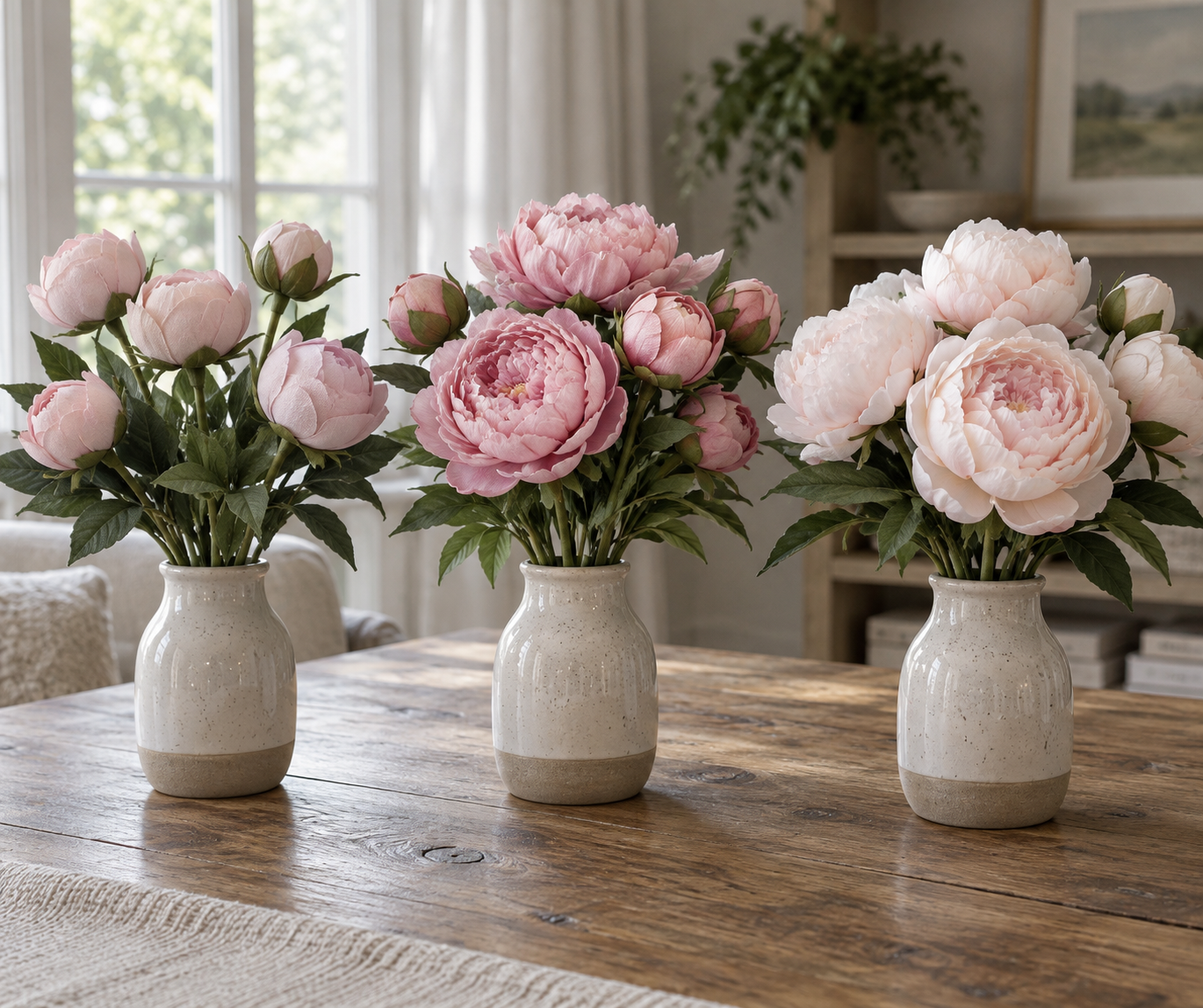
Best for dining tables: hydrangea and peony stems
Low, lush, and wide — hydrangeas and peonies fill a centerpiece with fewer stems, which means lower cost per table. Both flowers happen to be among the most convincing faux categories because their petal structure is naturally dense. Start with artificial flower centerpieces and peony stems.
Watch out: keep centerpiece height under about 13 inches so guests can see each other across the table.
What You Should Actually Pay
| Item | Reasonable range | Red flag |
|---|---|---|
| Single premium stem (real-touch/PE) | $3-8 (competitor prices as of September 2026) | Under $2 — thin fabric, visible glue |
| Bush pick (5-6 blooms) | $4-10 (competitor prices as of September 2026) | Under $3 — sparse, flat-backed |
| Finished arrangement with vase | $40-300 (competitor prices as of September 2026) | Under $25 — usually a photo showing more than the box holds |
| Bridal bouquet (real-touch) | $60-150 (competitor prices as of September 2026) | Under $40 — plastic-y greenery, wired-shut blooms |
| Wreath, 22-24 inch | $40-120 (competitor prices as of September 2026) | Under $30 — thin coverage, visible frame |
One habit worth stealing from florists: check whether product photos show a single unit or a styled combination. Buyer complaints about garlands and arrangements skew heavily toward “the photo showed two, the box had one” — count what you’re actually getting before comparing prices.
Which Should You Buy? A 30-Second Decision Table
| If you… | Buy… | Because… |
|---|---|---|
| Want flowers guests will touch | Real-touch latex | Texture survives fingertips |
| Are decorating a mantel or shelf | Silk-blend arrangement | Best realism-per-dollar at 1m+ |
| Need door/porch/patio pieces | UV-treated PE | Untreated fades within a season |
| Are getting married | Real-touch bouquets + silk backups | Keep forever, no wilt on the day |
| Fill large events on a budget | Bulk bush stems | Lowest cost per visible bloom |
| Set a dinner table tonight | Hydrangea/peony stems | Fewer stems, fuller look |
How to Judge a Stem in 60 Seconds (Without Buying Blind)
- Bend a petal edge gently — premium fabric flexes and returns; cheap fabric creases white.
- Flip a leaf over — two-tone printed underside means the batch is a grade up.
- Count petal layers — convincing roses and peonies have 3+ layers; flat singles read as craft-project material.
- Inspect where bloom meets stem — a tidy wrapped joint hides the glue; visible hot-glue spiderwebs mean assembly QC was skipped.
- Smell it — a faint fabric smell is normal; a sharp chemical smell means fresh cheap dye that can rub off.
Run those five checks and you can sort any shelf — ours included — into “worth it” and “skip” in under a minute.
FAQ
What are the best artificial flowers that look real?
Real-touch latex and high-grade PE flowers look most real, especially roses, peonies, ranunculus, and orchids — flowers whose petals are naturally thick or densely layered. We break the full ranking down, with close-up tell-tale signs, in best artificial flowers that look real.
Are expensive artificial flowers worth it?
Up to a point. The jump from $1 stems to $4-6 stems is dramatic (better fabric, wired stems, graded greenery); the jump from $6 to $12 is marginal outside the top real-touch tier. Spend most of your budget on the blooms that sit at eye level or get touched.
How many stems do I need for a vase?
For a 8-10 inch vase, 9-12 premium stems or 5-7 bush picks build a full arrangement. Add greenery at roughly 30-40% of the bloom count — under-filled greenery is the most common styling mistake we see.
Do artificial flowers fade in sunlight?
Untreated ones do, often within a single summer of direct sun — silk yellows and PE goes chalky. Only stems sold as UV-treated or UV-resistant belong outdoors, and even those should be expected to soften over 1-2 seasons.
How do I keep artificial flowers from getting dusty?
Dust weekly with a feather duster or cool hair-dryer blast, and deep-clean every few months. Our full method guide — including the vinegar spray recipe and which materials must never touch water — is how to clean artificial flowers.
Related Reading
- Best Artificial Flowers That Look Real — the realism ranking by flower type
- How to Clean Artificial Flowers — dust, deep-clean, and the materials that must stay dry
- Shop all artificial flower arrangements