
Blog
Best Outdoor Artificial Flowers for UV Resistance: What Actually Survives a Summer, by Sun Exposure

By Evercombe Team · Updated October 12, 2026 · 8-minute read
Quick answer: The outdoor artificial flowers that last are UV-treated PE (molded plastic) — hibiscus, geraniums, daisies, and boxwood shrubs are the category’s proven shapes. What fails outdoors, in order: real-touch latex coatings (the sun breaks the coating down), untreated silk-polyester (yellows and fades within a season), and dark reds/purples on any material (the dyes fade fastest). “UV-treated” on a listing means fade-resistant, not fade-proof — expect 1-3 seasons of good color in full sun, longer in part shade.
Outdoor faux flowers are the category’s biggest promise and most common disappointment, because a product that looks identical at purchase behaves completely differently by August. The material and the color — not the flower type — decide what survives. Here’s the field guide: what qualifies as genuinely outdoor-grade, the flower types worth buying, the fade behavior by color, and a placement guide by how much sun your spot actually gets.
What Qualifies as Outdoor-Grade (Judge Every Listing Against This)
- Material first: PE (polyethylene), injection-molded. PE is the only common faux-flower base that both holds petal shape in heat (no wilt-drape at 95°F) and chemically accepts UV inhibitor during production. That’s why nearly every genuinely outdoor-rated flower is PE. Silk-polyester fabric — the indoor standard — photo-degrades: colors fade and the weave yellows.
- The words “UV-treated” or “UV-stable” — and the difference. “UV-treated” means inhibitors added (usually in the material or a coating); “UV-stable” is the stronger pigmentation claim. Neither means forever. An honest listing says treated/stable and names a realistic expectation; an “all-weather, never fades” claim with no material named is the listing equivalent of a refund request form.
- Color choice is fade engineering. Red, burgundy, and purple lose their saturation fastest — those dye families absorb the most damaging UV wavelengths. White, cream, green, and yellow hold longest. If a west-facing wall gets brutal sun, plant white geraniums, not burgundy ones.
- One-piece construction over glued. Heat-cycled glue fails; petals drop. Look for stems where the bloom is molded or mechanically attached, not obviously glued — reviews searched for “petals fell” will tell you in one minute.
- Stems and leaves count too. The flower head can be UV-stable while the plastic stem goes chalky and the leaves shatter after two winters. Outdoor-grade means the whole assembly, which is why product lines built for outdoors (rather than indoor stems labeled outdoor) behave better.
The Flower Types That Survive Outdoors (Ranked)
Tier 1 — proven outdoor shapes:
- Hibiscus — the single most-established outdoor faux flower: tropical geometry hides UV-degraded texture, thick PE petals, built for sun by design. Hibiscus options.
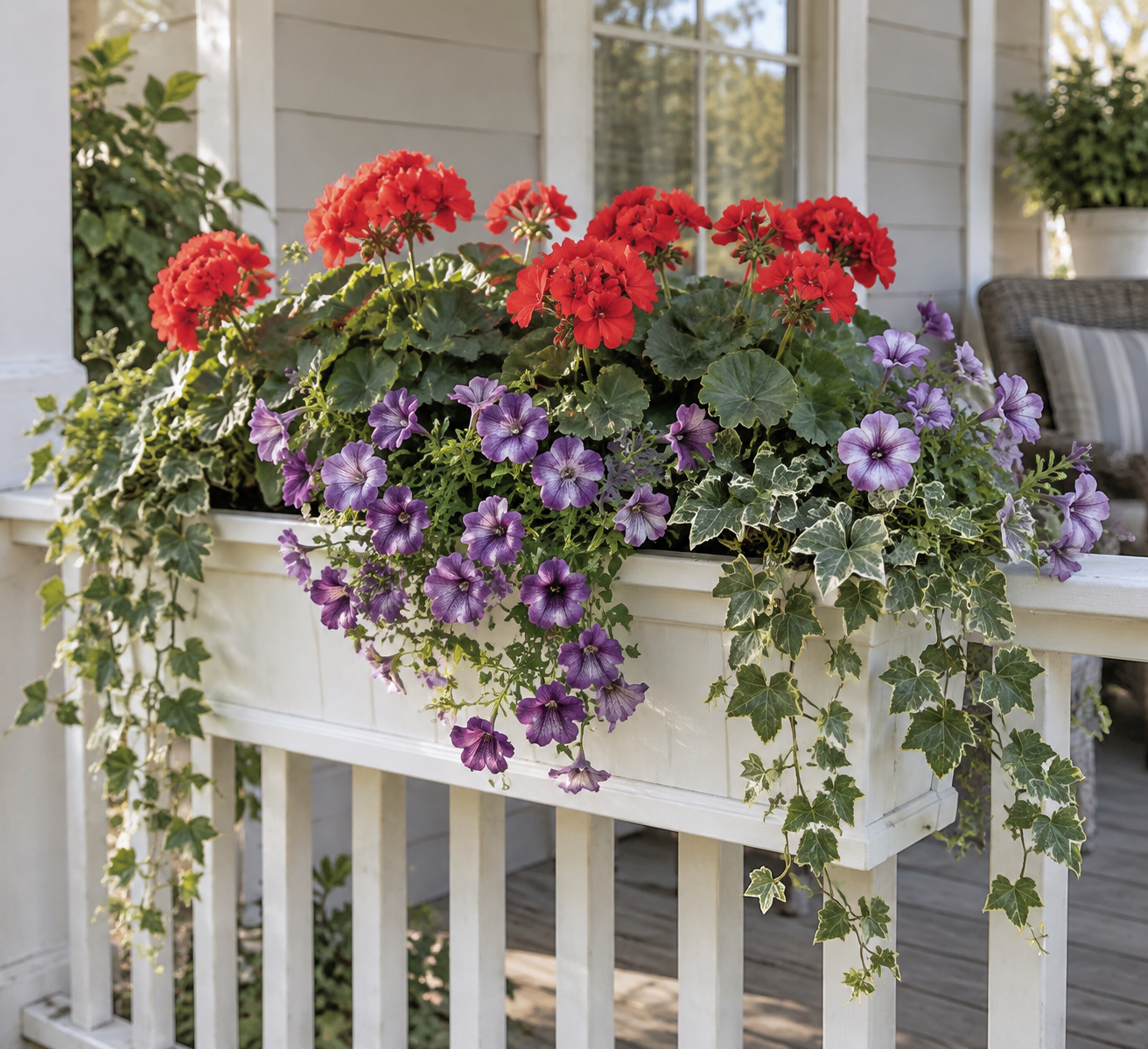
- Geraniums — the window-box and planter standard; dense clusters read as color mass from the street, which forgives everything.
- Daisies and mums — simple molded shapes, usually PE, cheap to replace, bright color families.
- Boxwood and shrubs — not flowers, but the outdoor faux category’s backbone; outdoor plants.
- Grasses and ferns — texture pieces that fade gracefully even when they fade; the safest visual bet in full sun.
Tier 2 — good with placement caveats:
- Petunia and impatiens-style baskets — good in part shade; the thin petals show fade sooner in full sun.
- Orchids and bougainvillea — work under covered porches; bougainvillea’s color mass hides fade, orchids’ don’t.
- Roses — the most-produced faux flower translates to outdoor only in specifically UV-rated lines; indoor silk roses are the most common wrong purchase in this category.
Tier 3 — keep indoors:
- Real-touch (latex/PU) anything — the coating that makes them pass a fingertip test is sun-degradable; outdoors they turn tacky, then chalky. The material map: silk vs latex vs foam flowers.
- Foam (EVA) — crumbles under UV; it was never an outdoor material.
- Anything dyed deep red or purple that you expect to keep two seasons in full sun — see the color section.
The Exposure Ladder (Match Material to Your Actual Sun)
| Exposure | What survives well | Lifespan expectation |
|---|---|---|
| Full sun, 6+ hrs (south/west facing) | UV-treated PE only; white/yellow/green colorways | 1-2 seasons strong color, 3+ structurally |
| Part sun, 3-6 hrs | UV-treated PE and quality silk-poly blends | 2-3 seasons |
| Dappled shade | Most quality faux including darker colors | 3+ seasons |
| Covered porch / overhang | Everything except real-touch and foam | Indefinite with cleaning |
The ladder explains most “my outdoor flowers faded in two months” reviews: full-sun exposure, untreated material, dark color — three strikes, any one of which alone shortens the run.
Where Outdoor Faux Flowers Actually Win
The honest case for outdoor faux, since outdoor is where fresh flowers are hardest to keep:
- Window boxes and hanging baskets — watering logistics end completely; a basket 12 feet up looks full from April to November.
- Mailbox and curb planters — no hose run needed; the single most popular outdoor faux install in suburban US.
- Vacation homes and rentals — zero maintenance between visits; nothing dies in your absence.
- Full-sun dead zones — the west wall where nothing survives August; faux boxwood and grasses fill it.
- Winter and early-spring curb appeal — a window box that doesn’t go dead from November to April.
Where fresh still wins outdoors: the herb garden by the grill, anything you want to smell, and very-close-view entry arrangements where petal texture matters daily.
Maintenance (Five Minutes a Season)
- Wash PE twice a year: hose off, wipe stems, done — PE is the only fully washable faux material (methods by material: how to clean artificial flowers).
- Check after storms: re-seat stems blown loose; UV-treated zip ties over wire on baskets.
- Rotate if you can: baskets and boxes fade fastest on the sun side; a quarter-turn each month evens it.
- Store or cover in the off-season in hard-winter climates — ice and wind do more structural damage than UV does.
Price Bands (What Outdoor-Grade Should Cost)
(competitor prices as of September 2026)
| Product type | Typical band | Notes |
|---|---|---|
| Single outdoor stem/bush | $6-15 | Bushes (geranium, hibiscus) price per bush, not per bloom |
| UV-treated PE bush, premium | $15-30 | Named UV treatment, one-piece construction |
| Hanging basket, pre-planted | $30-80 | Compare against fresh basket + a summer of watering time |
| Window box filler set | $25-70 | |
| Boxwood shrub/ball | $25-120 by size |
The pricing tell worth knowing: genuinely outdoor-rated product costs meaningfully more than indoor stems of the same flower — the UV inhibitor and one-piece tooling are real costs. An “outdoor” flower priced like an indoor stem usually is one, relabeled.
FAQ
What are the best artificial flowers for outdoor use?
UV-treated PE hibiscus, geraniums, daisies, grasses, and boxwood — molded shapes in fade-tolerant colors, bought from lines built for outdoors. The full exposure-matched approach is in the ladder table above; shop-ready versions: outdoor artificial flowers and UV-resistant collections.
How long do UV-treated artificial flowers last outside?
In full sun, expect 1-2 seasons of strong color and several more of structural life; in part shade, 2-3 seasons; covered porches, indefinite with occasional cleaning. UV treatment resists fading; it doesn’t repeal it.
Why do my outdoor fake flowers fade?
Three compounding causes: untreated material (silk-poly and un-rated plastic photo-degrade), dark colors (red/purple dye families fade fastest), and full-sun exposure. Any one shortens the run; all three together is the two-month fade you see in reviews.
Can real-touch flowers go outside?
Not in direct sun — the latex/PU coating that makes them feel real degrades under UV, turning tacky and then chalky. Covered, shaded porches only, and even then they’ll age faster than PE. The material logic: silk vs latex vs foam.
How do I clean outdoor artificial flowers?
PE: hose off and wipe — it’s fully washable. Silk blends kept under cover: brush dust off dry, no hosing (water-spots the dyes). Full method table: how to clean artificial flowers.
Are outdoor artificial flowers worth it versus planting real ones?
For reachable, watered beds you enjoy tending — no; real wins. For baskets you can’t reach, boxes you can’t water, second homes, full-sun dead zones, and four-season curb appeal — faux wins outright, and the math only improves each season the pieces last.
Related Guides
- Best Artificial Flowers — the indoor-by-scene companion to this guide
- How to Clean Artificial Flowers — five methods, by material
- Shop outdoor artificial flowers · UV-resistant flowers · hanging baskets · window box flowers · hibiscus