
Blog
April Birth Flower: Daisy and Sweet Pea Meanings, Colors, and Gift Ideas

By Evercombe Team · Updated October 12, 2026 · 8-minute read
Quick answer: April has two birth flowers: the daisy, meaning innocence, loyal love, and lips-sealed discretion — and the sweet pea, meaning blissful pleasure and “thank you for a lovely time.” The daisy is the friendliest flower in the catalogue; the sweet pea handles departures and gentle goodbyes. For April birthdays, a white-daisy-and-pink-sweet-pea mix is its signature — spring at speaking volume.
April’s birth flowers are the two friendliest entries in the whole calendar. The daisy has meant innocence since before flower dictionaries existed — its name is literally “day’s eye,” opening with the sun — and the sweet pea is the Victorian era’s thank-you note, blissful pleasure and a fond farewell in one vine. People born in April collect the write-up you’d predict: fresh-natured, direct, allergic to hidden meanings — and the flowers agree.
Daisy: The Primary April Birth Flower
Meaning: innocence, loyal love, and a secret kept.
Three meanings, stacked in order of age. The daisy’s innocence reading is as old as the flower’s name — day’s eye, the bloom that opens at sunrise and closes at sunset, a small daily loyalty performance. Its loyal-love meaning carried straight through the Victorian dictionaries. And “a secret kept” is the one modern guides forget: floriography filed the daisy under discretion — “I’ll never tell” — which makes it the rare flower that means both openness and its opposite.
Then there’s the game everyone knows: he loves me, he loves me not, petals plucked to a verdict. Its origins run back centuries through France and Germany, and it made the daisy the flower of love’s uncertain arithmetic — innocent about romance, but thoroughly involved in it.
Botanically, the daisy is a committee: what looks like one flower is a hundred florets arranged as a disc (the center) and rays (the “petals”), which is why daisies photograph with such satisfying geometry — and why faux daisies, mold-built from that same geometry, hold up so well at close range.
Daisy Color Variations
| Color | Refined meaning | Best for |
|---|---|---|
| White petals, yellow center (classic) | Innocence, loyal love | The April signature |
| Pink tips or full pink | Gentle affection | Friends, daughters, new relationships |
| Yellow (full) | Cheer, everyday joy | Get-well, no-reason gifts |
| Gerbera mixes | Celebration, brightness | Birthday centerpieces |
| Blue-violet (aster-family cousins) | Trust | Mentors, teachers |
Giving Daisies
Give daisies for April birthdays, new babies (the innocence reading applies literally), and get-well arrangements where cheer matters more than ceremony. They’re the least intimidating flower in the catalogue — no occasion required, no subtext attached — which is precisely their niche. Pair white daisies with pink sweet peas for the month’s signature; browse artificial daisies for stems that hold the geometry.
Sweet Pea: The Secondary April Birth Flower
Meaning: blissful pleasure — and “thank you for a lovely time,” the flower’s famous goodbye.
The sweet pea’s signature meaning is the politest sentence in floriography: thank you for a lovely time — the departing guest’s flower, the hostess gift with a built-in caption. Alongside it, the dictionaries listed blissful and delicate pleasure, which the flower’s scent backs up: sweet peas are among the most fragrant blooms a garden grows, a fact the perfume industry has worked since the Edwardian era, when sweet pea mania ran at near-tulip-mania volume.
The April connection is seasonal: sweet peas start their climb as spring settles in, the month’s first vine. Where the daisy is open-faced, the sweet pea is a small ruffled sail, built for softness — the two flowers together look like April feels.
Giving Sweet Peas
Give sweet peas as departure flowers (end of a visit, end of a lease, end of a wonderful dinner party), as thank-yous by any other name, and for April birthdays where tenderness is the register. Fair warning for the fresh route: sweet peas are a short-season, few-day vase flower, so the faux version is less a compromise than the standard way to keep the April message on a shelf.
Daisy or Sweet Pea: Which Do You Give?
| If the April person is… | Give… | Why |
|---|---|---|
| The official-flower traditionalist | White daisies, plenty | The primary, at its friendliest |
| Hosted you, fed you, sent you off well | Sweet peas | “Thank you for a lovely time” |
| A new parent | Daisies | Innocence, applied literally |
| Leaving — job, city, relationship | Sweet peas | The goodbye flower, gently |
| A child’s birthday | Daisies | The only flower that survives the demographics |
| Romantic, early days | Daisies with pink sweet peas | Loyal love plus delicate pleasure |
Building an April Birthday Gift Around the Flower

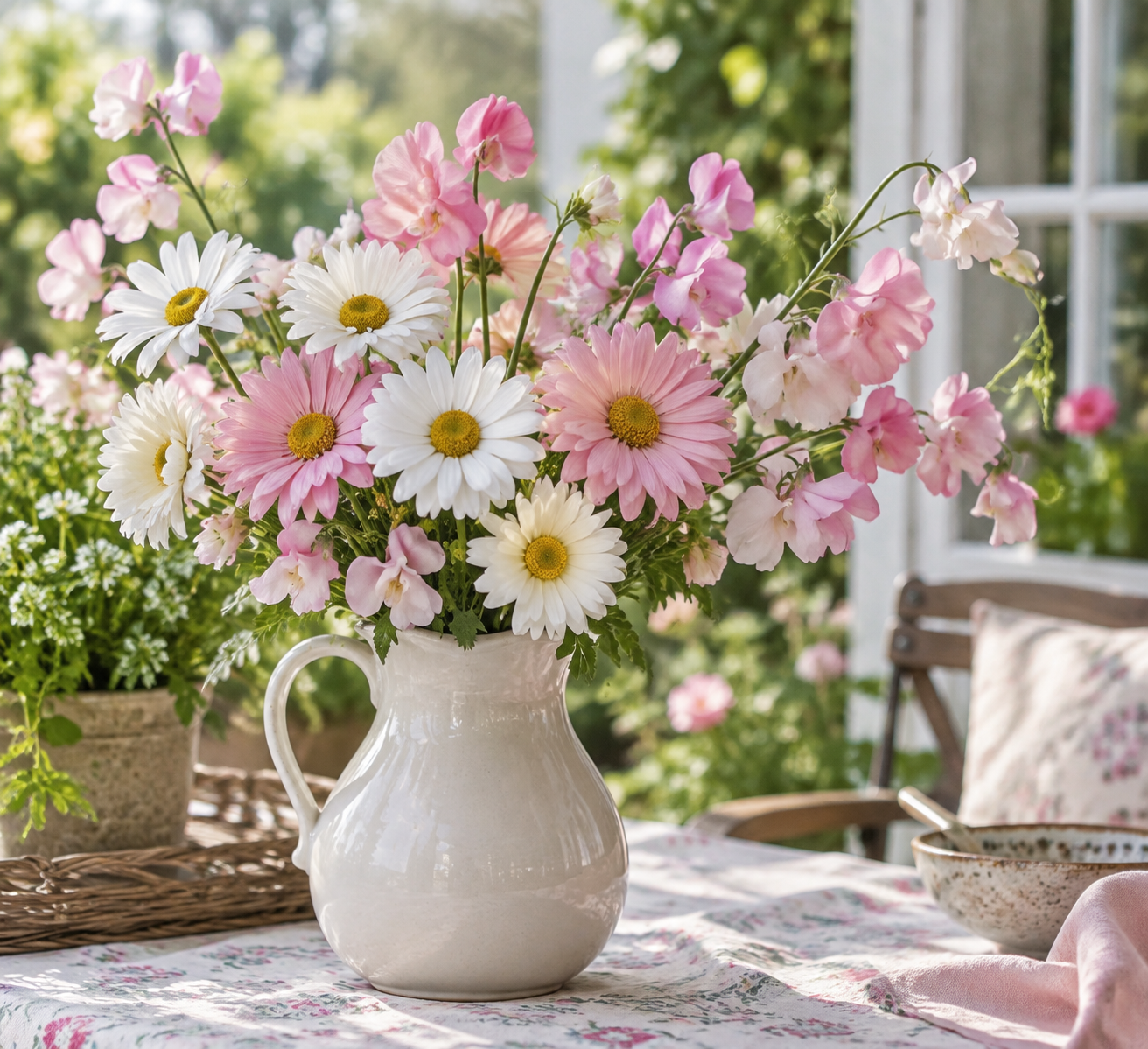
April’s palette: white, pink, and green, with yellow kept at the center — spring without the Easter pastel avalanche. An arrangement that reads intentional: white daisies as the field, pink sweet pea clusters climbing through, yellow-center accents doing the color work. It looks like a picnic that got promoted.
The calendar: Easter floats through late March or April and drowns the month in lilies and pastels — the April birthday arrangement benefits from staying daisy-forward to keep its distance. Earth Day (April 22) suits the daisy’s meadow associations; Administrative Professionals Day (late April) is the office-flower date on the calendar, where the daisy’s no-subtext reading is exactly the safety required — colleague gifting rules are strict, and the daisy clears them easily. April weddings, with their garden palettes, are where both birth flowers moonlight at scale.
Practical note: fresh sweet peas are a florist’s luxury with a few days of vase life; faux sweet peas and daisies hold the month’s look indefinitely — and daisies are among the most convincing faux forms there are, their flat geometric construction reading true at any distance. Start from artificial daisies and arrangements; the full year’s chart lives in birth month flowers.
FAQ
What is the birth flower for April?
Daisy (primary) and sweet pea (secondary). Daisies mean innocence, loyal love, and discretion; sweet peas mean blissful pleasure and “thank you for a lovely time.” Both appear on the standard lists.
What do daisies symbolize?
Innocence and loyal love — the name is “day’s eye,” for a bloom that opens at sunrise and closes at dusk. Victorian floriography also filed daisies under “I’ll never tell” — discretion, the meaning most guides skip.
What do sweet peas symbolize?
Blissful pleasure and departures — “thank you for a lovely time” is the classic dictionary line. They’re also among the most fragrant garden flowers, a scent the perfume industry has chased since the Edwardian era.
Why are daisies associated with “he loves me, he loves me not”?
The petal-plucking game runs back through France and Germany for centuries — the daisy became the flower of love’s uncertain arithmetic long before it meant plain innocence.
Are daisies good flowers for coworkers?
Among the safest: no romantic subtext, no funeral association, no cultural landmines — openness is the whole meaning. For colleague gifting rules in general, see the do-not-send table in our rose color meanings guide.
Can I get sweet peas out of season?
Not well — they’re a short-season, few-day vase flower. Faux sweet peas carry the look and the meaning year-round.
Keep Reading
- Birth Month Flowers — all 12 months, both flowers, one chart
- March Birth Flower — daffodil and jonquil, the month before
- Shop the April palette: daisies · arrangements